
Chapter Text
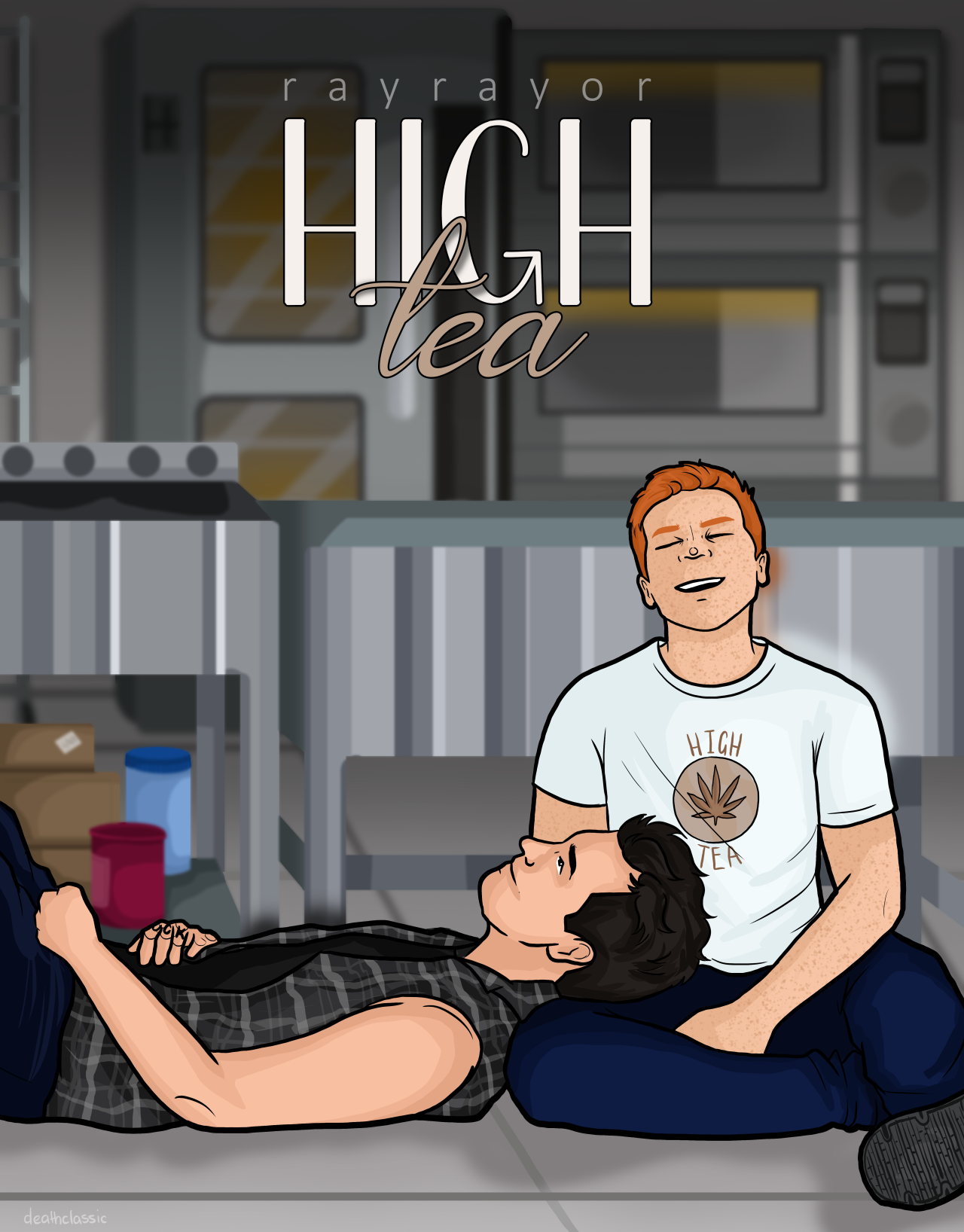
It was 6am. The wind outside whispered of winter, brushing against the windows with a chill that made the warmth inside feel decadent .The industrial kitchen glowed under the lights, cluttered but comforting—mugs stacked near the sink, a tea towel draped over the oven door and Siouxsie and the Banshees crooning from the speakers.Ari turned Ian onto the band, so much of his music came from learning by listening.
Ian stood in the kitchen, steam rising from his earl grey latte. He drank it fast, the bitterness grounding him. The worn green apron hung from a hook, and as he tied it around his waist, he felt the familiar tug of routine—a small ritual in a life that rarely offered stability until he found this place.
Tonight, Franny would be here , at his apartment over the shop. Debbie had a shift, and Liam was coming over too. The littlest Gallaghers. The ones who still had a shot at growing up without too many scars. Ian hoped, quietly, that they’d be okay. That he could be something steady for them, even if he didn’t always feel steady himself, he owed them that.When they were so young, he was not stable enough to watch himself, no less them.
His phone buzzed. He rolled his eyes, stuck his tongue out at it, and flipped it off. But then he sighed, the weight of promises tugging at him. He’d said he’d show up. And he meant it.
Two pills. A swig of latte. A glance upward. Because Ian hoped wherever Ari was , he could still feel Ian. Ian had no clue how accurate that hope was.
“You happy, Ari?” he asked the ceiling, the air, the memory.
A voice—familiar, teasing, maybe imagined—answered back. “Thrilled, Ian. You’re still a stubborn ass though.”
***
Ari watched Ian from the quiet beyond, a spectral sentinel tethered by love. The kid still bristled at his meds—those little pills that tugged at the threads of his moods—but Ari couldn’t fault him. How could he? Diagnosed at fifteen, abandoned by a family too fractured to care, haunted by the echo of his mother’s bipolar episodes. Ian hadn’t grown up; he'd survived. And Ari hadn’t loved him in the way people whispered about older men and younger messes. He loved him like a son, tenderly and without condition.
He saw it all—how Ian’s heart remained soft despite everything. How his failures hadn’t uprooted his desire to care for others: the army, paramedic school, both cracked and gone. High Tea had become his home—a refuge sweetened with weed and pastries, bruised laughter and stitched-up friendships. Ian was a decent businessman, a baker by necessity, but beneath that calm exterior, he still ached. For someone. For a man who wouldn’t recoil from his jagged parts, who could love him without needing him to be fixed first.
From the other side, Ari lingered. Not just to watch, but to nudge fate along. He knew that healing didn’t come in grand gestures—it came in tiny moments. Like guiding Ian to the fifty-dollar bottle of Madagascar vanilla he’d stashed during a manic haze and promptly lost. Hope smelled like warm sugar and found things.
And Ari? He was ready to help Ian find love—not just the kind that patched up broken places, but the kind that made them beautiful.
Iann smiled, just a little. The kind of smile that doesn’t reach the eyes but still means something. Cause he missed Ari.
***
Before the apron, before the latte, before Franny and Liam and the small rituals that kept the edges of his life stitched together, there was Ari.
Ari who showed up the week Ian got placed in the psych ward. Not with pity, but with baked goods and an overstuffed backpack full of random philosophy books. Ari who listened more than he spoke. Who treated Ian like someone capable of both catastrophe and brilliance. Ari was a volunteer at the hospital and Ian wanted to be left alone. But Ian's stubborn streak and chin had met his match with Ari’s ruthless optimism.
He was older, sharp-eyed but soft-spoken, the kind of person who made you feel smarter just by standing near him. He taught Ian how to breathe through panic, how to keep the edges of anxiety rounded, how to ask for help without feeling like a burden. It did not happen overnight. It was months of wearing Ian down, making him let someone in for the first time.
They became fast friends, Ari offering support like the father Frank or Clayton never were. Rumors swirled but were always crushed either by Ari’s cutting words or more than once Ian’s fists. Ari was the first older man not wanting to fuck and control him, and Ian was not letting gossip spread. Ari gave him a job, a purpose and a ragged team of coworkers who became the family he never knew he needed.
It was a good life, peaceful, until that day.
Two years ago, Ari’s car flipped on a slick Chicago bridge. Black ice. Fast lane. Gone in seconds.
Ian never got to say goodbye.
So now, when the winds howl in winter and the speakers croon old tracks, Ian ties the apron and takes his pills and looks up—not expecting answers, but needing the ritual. Needing to not feel so alone.
Because he is now tasked with keeping Ari’s legacy alive.
Ari’s legacy isn’t grandeur. It’s this: quiet moments, tea, a niece giggling on the carpet, a brother finally staying sober, and a stubborn Gallagher keeping promises even when he’d rather ignore his phone and the prescription bottles with his name on them. He thinks back to the first time Ari wore down Ian’s resolve, his plan to get by, then slip away, kill himself.
Flashback: Four years before the accident
The coffee shop smelled like cinnamon and wet shoes, with Lions Mane OG. Ian sat at a corner table with his hoodie pulled tight around his face, watching the rain smear the window into a gray blur. He was supposed to be at therapy. He wasn’t. Why, he was a lost cause.
That’s when Ari walked in—older, sharp jawline, crow’s feet. He didn’t glance around like someone looking for an escape. He walked up to Ian’s table with a wry smile. He was surprised, when he offered Ian the invite, he did not think the kid would come. Gusty little fucker, despite the air of hopelessness.
“I’m not on the volunteer clock, so I’m not a violation,” Ari said, setting down a cup and sliding it across. “Chamomile, honey, bit of mint. You look like someone who hasn’t exhaled since Tuesday.”
Ian blinked. “Look, you don't know me, or any shit about my life”
“Not yet,” Ari said. “But I teach mindfulness at the center. You keep skipping your class, which was a condition of your release . I figured I’d try a new tactic. Strategic ambush by offering tea and cookies.”
Ian eyed the tea like it might bite him. “I don't calm. It's not... a thing I know how to be.”
Ari pulled out a battered notebook, flipped to a page full of scratched notes and stick figures. “Stability isn’t calm,” he said. “Not really. It’s the art of not vanishing in your own chaos.”
Ian scoffed. “I vanish fine. People seem to like me better that way.”
Ari didn’t argue. He just slid the notebook closer, revealing a phrase written in looping script: “You don’t have to be gentle to be grounded.”
“The south side doesn't have to define you," Ari said, leaning back. “Needing help is not weakness.”
Ian stared at the words. Something in his chest tugged—sharp and unwelcome, like the beginning of understanding.
***
Ari made him feel less alone. Now he was alone , except for the ghost of the best man he had ever met. Not Kash, not Ned , not club pervs lining up to buy his body and destroy his self esteem . Ari, the dad he never had who taught him to balance a checkbook, make croissants , play chess and start loving himself.
The music shifted— Moonlight Sonata No. 17 , Robert Tau’s version. The keys dipped low, a little slower than expected, like the pianist had lived through loss and let it bleed through each note. Ari taught Ian about music, never putting your tastes in a box. Ian stood still for a moment in the heart of High Tea, surrounded by the soft hum of early morning warmth and the faint scent of earl grey, letting the piano wrap around him like a memory. Cause sometimes memory kept him whole.
He looked around the shop—sunlight catching on mismatched cups, the faded wallpaper Ari never replaced, the crooked shelf Ian had sworn to fix. This place was Ari’s dream, whimsical and brilliant and wildly impractical in all the best ways. A tea shop in the middle of South Side chaos. Somehow, it worked. And Ian had worked here, too—poorly, he always thought. Late shifts, broken glasses, attitude. But Ari never lost faith in him. That quiet, stubborn belief had held Ian together more than he'd ever admit.
Then came the accident. And after the funeral... silence. Numb nights. Lithium chased with liquor. Grief like static. Buzzing , taunting ,echoes of the dead. Ian stayed in that hazy limbo. Until Martha, Ari’s sister, broke down his door in a rage of love—poured cold water on his head, yelled something about promises, dragged him to the reading of the will like she was hauling him out of a burning building.
And there it was. A folder. Ari’s handwriting, confident and steady.
Ian Gallagher—50% owner, High Tea .
He’d stared at it for minutes. Days, maybe. Ownership didn’t feel like a reward. It felt like a challenge. A dare. “ Keep it alive. Stay alive .” That’s what Ari had really given him.
Now the shop buzzed quietly with possibilities. Franny would be here later. Liam too. The littlest Gallaghers—the ones Ari used to say deserved gentler lives and hot cocoa. Ian had gotten better. He was not the unstable brother kidnapping his brother. He had worked hard to earn Fi, Lip and Debbie's trust back. Now he was the brother and uncle who hosted sleep overs, dance parties, pizza. Tonight, he could kick back and just be a kid with the kids.
***
And that was enough. That and High Tea, a place and people Ian chose to cherish.
High Tea was sanctuary. Not by design, maybe, but by necessity. The mismatched chairs, the crooked shelf Ari never got around to fixing, the wall of teas that smelled like someone’s childhood—it was a place stitched together by imperfect hands, and maybe that’s why it held people so well.
Ian used to chase perfection. In boot camp, in ambulances, in lovers' eyes. Now he chased warmth. A latte with extra cinnamon just because it made a customer smile. A playlist Ari once made titled “Tea, But Make It Existential.” All of it he once scoffed as bullshit, now it was part of him .
He wasn’t good at many things. Not the kind that earns medals or applause. But he was good at remembering how you liked your tea. Good at noticing when you needed a seat that faced the wall. Good at creating spaces that didn’t ask you to explain why you were falling apart.
Ari had known. Of course he had. That’s why the will wasn’t a final goodbye—it was a baton pass.
Ian stirred the pot and watched the steam rise, swirling like breath and memory.
“Keep it alive,” Ari had written. “Not the shop. The soul.”
And he did. Every day. With every pour. Every unspoken kindness. Every failure turned into grace.
Ian did it because he grew up, stopped comparing himself to Monica, to Lip , to his ex boyfriends. He did it for regulars like Marcie.
3:47 PM, every single day, Marcie arrived precisely then—neither a moment early nor a second late. No one greeted her. No one asked her name. That was part of the unspoken pact at High Tea.
She chose the farthest corner: a small round table by the window. White peony tea, always. Ian learned to brew it just right—steeped for five minutes, not four, the water a few degrees cooler than boiling. She’d nod once when it was perfect. That was all.
He craved that nod like a trophy.
Outside, traffic groaned against the fading light, but inside, there was only quiet—the click of porcelain, the whisper of steam, the occasional flurry of staff rearranging tea tins. But around Marcie, stillness ruled. She’d sit, sometimes for two hours, never looking at her phone, never making a sound. Just gazing through the fogged glass as if trying to see a version of herself on the other side.
People noticed her, of course. Martha once left a lemon tart by her cup without saying a word. Julio drew a sun on the napkin and tucked it beside the teapot. Marcie didn’t respond, but she came the next day, and the next.
And then, one rainy Tuesday, she left a note. Folded neatly, tucked under the saucer. It read:
"I lost my husband a year ago. He used to say I reminded him of white peony—soft, but impossible to forget. This place helped me breathe again. Thank you for not asking. The silence healed more than questions ever could."
Ian read it in the back room, fingers trembling slightly. He didn’t tell anyone, just brewed the next pot of white peony.
High Tea wasn’t a cure—it became a place where healing didn’t have to explain itself.
Tea and weed, but more than that, for Ian it was now home.
At 26, it let him hold his head high, not see a bipolar stranger in the mirror.
Ian no longer flinched at the mirror. There were still days when the voices crept in—doubt dressed as stillness—but he’d learned how to wait through it, how to breathe until the sharp edges softened. High Tea remained his anchor, but not his crutch. The laughter there wasn’t always light, and the pastries weren’t always perfect, but the people showed up anyway, cracked and blooming. That mattered.
He mattered.
He’d started keeping a notebook again. Not the manic scrawling's of a sleepless night, but slow entries—reflections, dreams, fragments of healing. Ari would’ve loved that. Would’ve teased him about the musings on cinnamon ratios and heartbreak, would’ve slipped a joint into the notebook like a bookmark of approval.
Ian still wanted love. But he wasn’t starving for it anymore. He wanted someone who could sit with him in silence and not try to fix it. Someone whose presence felt like gentle sparks rather than out of control fireworks. He knew now that love didn't mean rescue—it meant recognition.
He had learned to say, “I’m not okay, but I’m trying.” He had learned to stay.
He wanted a man who could do the same.
And somewhere—maybe in a corner of the kitchen, where the vanilla finally reappeared, or in the way the sunlight warmed the mismatched mugs at High Tea—Ari’s spirit stirred. Watching Ian not just survive, but build something of his own.
But Ian couldn’t drift too long in memory; the day pressed on, full of things to do ,demands of running a business.. The mellow vet charity was due in an hour, coming to pick up boxes stacked with spiced scones, buttery muffins, and those dense chocolate bars he'd learned to make just for them. The pastries were headed to homebound vets navigating their own psychic minefields—those quiet wars that never made it into headlines.
Ian never took their money, no matter how insistently the charity offered. “We’ve got funding,” they’d say, nudging envelopes toward him. Ian would shake his head with a firm smile, scrawling a zeroed invoice.. He’d wanted to be one of them once. ROTC golden boy, big plans.. Then came the diagnosis. Came the unraveling. Came the war inside his own mind.
So no, he wasn’t taking a cent from people still in the trenches. These pastries were a peace offering—his way of saying, I see you. Of saying, thank you for your service and sacrifice.
He tied the last bakery box with twine, pressed a sticker that read Healing Is Messy. So Is Baking. Then he paused. Took a breath. Looked at the tray of herbed rolls Ari used to tease him about. Somewhere in that sweetness was purpose. Not redemption, but resilience. The kind that kept showing up, one flour-dusted act of love at a time.
Julio’s name was still etched on the whiteboard where the crew left notes—“Get more chai,” “Don’t touch the jam until it sets,” and now: JULIO MADE IT: GRAD SCHOOL!
Ian had hugged the kid so hard he nearly knocked him into the flour bin. Julio had been so unsure of himself, scared his past would block him from a future. But the acceptance letter was proof—some dreams could be tried again.
And like Ian some dreams died but new ones filled their shoes.
But that left an open shift in the kitchen. He was about to place an ad when his bestie, Mandy, asked for a favor.
***
Ian kept glancing at the clock, though he wasn’t sure why. He didn’t hover like this for anyone’s first shift—hell, most hires didn’t get more than a nod and a flour-smeared to-do list. But Mickey was different. Mandy’s brother, straight from probation. The kind of hire other shop owners might politely ignore, then quietly avoid.
But Ian had made the call himself. Mickey had grit, and Mandy had looked scared in that way Ian recognized—the kind of fear that came from seeing someone you love inch toward a familiar cliff. He knew every unmedicated episode in his past, Fiona and Lip had the same look.
“He’s solid,” she’d said. “But if he doesn’t get work, he’ll go back. And next time? He won’t be lucky.”
That stuck with Ian. Too close to his own story. Too close to the nights he’d spun out and the mornings he’d clawed back. So, he’d said yes. Not out of pity, but out of belief. Mandy was his bestie, and he trusted her.
Now the kitchen was too quiet. Ian adjusted the racks of pasties, checked the oven, scrubbed his hands clean even though there wasn’t a speck of batter on them. The boxes for the vet charity were stacked near the counter.
His apron was wrinkled and the whiteboard near the coffee maker still said: Mickey starts today—be kind. But not fake.
Ari would’ve laughed at that. Would’ve rolled a joint, lit it with flair, and made some joke about crusty ex-cons and kitchen karma. Ian missed him most on days like this—when he felt like a kid playing boss.
But at 26 he was no longer a kid and somehow, he was now the boss.
***
Mickey stood beneath the faded awning outside the service entrance; his hands shoved deep in his jacket pockets. Honest work—hell, that phrase felt foreign. Terry’s boys didn’t get jobs, they got by. His dad used to call theft “earning the hard way,” and Mickey had believed it, swallowed it whole until he choked on it behind bars. Ten years gone. Ten years traded for a legacy he never wanted.
Post-release hadn’t felt much freer. Probation had turned him into fuck you toy—his PO strutted around in discount power, barked like she was a warden. She got her kickbacks. He got to wear bad shorts and answer to someone who never saw him as more than a statistic. Now, off probation and canned by the only job that’d take him, he was down to a room the size of a closet. Decent water pressure. No roaches. It wasn’t home—but home meant Terry, and Terry meant bruises you didn’t explain.
And then Mandy. Little sister who’d once clung to him like hope, now the one handing it back. She’d gotten him the job here. High Tea. Said the owner was a friend, the place low-key. Mickey had nodded, but it burned. He used to protect her. Used to be the wall between her and Terry and that twisted bitch Kenyetta. And when he got locked up, that wall crumbled. Mandy got hurt. The shame clung to him like grease.
He knew it was love. Knew Mandy wasn’t trying to humiliate him. But charity—especially from her—dug into old wounds. Made him feel soft, vulnerable. Like Terry always sneered he was deep down.
Still, he didn’t turn around. Didn’t bail. He reached for the rusted handle and took a breath. Whatever waited inside, he’d deal. Not for redemption. Not for pity. But maybe—just maybe—for something better than survival. Maybe a real apartment, a steak once in a while, clothes not from Good Will.
***
Ari watches the boy at the door, his fists clenched not in anger, but in fear of what softness might feel like. The kettle whistles inside. Ian moves about unaware setting the table with mismatched cups. The ritual begins, even without certainty. Welcoming and training staff was the key
And then, the steam curls toward Ari, and he remembers.
A flicker—Lena’s kitchen, her silence, the first tea offered without demand. That moment still lives in Ari’s bones, the warmth of it. The way breath had finally returned to his body. He stayed as a foster kid of hers, 10 years and she became his rock. That gift of life he wanted to pass onto others. Ian, his bruised heart called to him. He took the chance with Ian and Ian stayed, flourished.
He wonders if this boy, too, will sit and taste safety.
Ari doesn’t speak. He doesn’t push. Spirits aren’t meant to bend time, only bear witness to it. But the kitchen light catches the boy’s face as he finally steps inside, and Ari thinks:
Let it begin.
***
The bell over the door chimed. Ian didn't look up at first—he’d learned not to startle people who hesitated at the threshold. But he felt it: the way Mickey’s presence was big, trying to be menacing, like a storm. Ian took it all in.
Raven hair dripping. Eyes scanning too fast. Shoulders squared like he thought someone might challenge him.
“My dumbass brother,” Mandy had warned him. “Looks like he sleeps with a knife under his pillow and dreams in profanity.”
Now, in person, Ian saw it. Mickey wore deflection like a jacket—unzipped just enough to hint at softness but still armored.
“You the tea guy?” Mickey asked, voice sharp enough to cut through steam.
Ian kept his tone level. “Depends. You the guy who can poach eggs without violence?”
A snort. Half a grin. Not quite a truce, but close. Mickey stepped further in, rain dripping onto the welcome mat Ari had chosen years ago—a threadbare thing that read You’re home. Or at least safe enough for now.
“Don’t usually stick around places,” he said, not quite looking at Ian.
“I didn’t either,” Ian replied. “Until this one stuck to me.”
Mickey didn’t answer. Just stared at the cup Ian slid across the counter—Gunpowder green, strong and steady. He didn’t thank him, but he didn’t walk away either