
Chapter Text
The late daylight was filtered through Seoul’s haze, giving everything a golden-yellow sheen. At the college’s entrance, a gaggle of students exhaled smoke and self-importance; one had blue hair, another wore a jumpsuit that appeared to be made from actual newspaper. Gi-hun passed them with the practiced invisibility of the seasoned interloper. None of the students so much as glanced at him.
He paused in the vestibule to check the classroom number, and where he was supposed to go. He was early, but not too early, which was both good and disastrous. If he’d had more time, he would’ve staged a rehearsal in the stairwell, run through his lines: ‘Hello, I’m here for the modeling, please let me know where I should change.’ Instead, he was forced to rely on intuition and inertia, both of which had a terrible track record in recent months.
He found the classroom by the dull thud of techno-pop leaking through its door. Someone inside, probably a student, was making a point at high volume, their voice ricocheting off plaster. Gi-hun stood outside for a while and tried not to listen. Instead, he pictured his daughter’s face from last weekend—her hair in symmetrical pigtails, squinting at the bowl of noodles in front of her, as if trying to hide her disappointment that it wasn’t anything better. He pictured, too, the amount in his bank account, a number so small it had to be padded with a note from the bank reminding him to “seek additional sources of income,” his day job at the garage being not quite enough to cover everything.
Well. Here he was. Seeking additional sources of income. In the past, he’d done worse.
The summer prior, he’d spent three weeks in a chicken costume. Not a cartoon chicken, either, but a hyper-realistic one: articulated wings, latex beak, feet with three splayed talons. The suit was rented by a promotion company in Mapo. The inside was lined with something close to sandpaper, and after a week, Gi-hun had a rash around his neck that lasted almost a month. On his first day, a group of middle school boys had called him “pervert chicken” and tried to knock him over; on his last, a toddler approached and, with the wisdom only toddlers have, reached straight up the leg hole to see what he might find.
Another winter, he’d worked as a taste-tester for experimental health drinks. The pay was excellent, but his urine was lime-green for three days and the taste of spirulina still haunted him. There was also the stint as a moving billboard, where he was paid hourly to walk a circuit around Gangnam Station with a fiberglass sandwich board strapped to his back, alternating between diet pills and anti-hangover drinks depending on the sponsor. The work gave him excellent calves and a constant sunburn.
When Jung-bae had first brought up the modeling gig, Gi-hun assumed it was a prank. “It’s art school. Night classes,” Jung-bae insisted over soju, lowering his voice as if they were about to discuss national secrets. “They don’t care what you look like. You just sit there. It’s the easiest hundred-thousand won you’ll ever make.”
Gi-hun had grunted. “They want an old man?”
“Middle-aged. Or, more like… man with experience.” Jung-bae had taken a long, meaningful sip. “They really prefer people with visible regrets.”
Gi-hun barked a laugh, half genuine, half defensive. “Visible regrets? What, like the bags under my eyes?”
“Those help,” Jung-bae said, grinning. “Adds realism. You’ve got that lived-in look. Artists eat that up.”
“Great,” Gi-hun muttered. “So I’m not a model, I’m a cautionary tale.”
“Exactly,” Jung-bae said, raising his glass. “The tragedy of modern man—rendered in charcoal. You’ll be immortal.”
Gi-hun snorted. “Yeah, until someone recycles the paper.”
They both laughed, but later, when the conversation drifted to other things and the drinks went dry, the phrase stayed with him. Man with visible regrets.
And when the modeling coordinator called to confirm his time slot and went over the payment details with the clinical detachment of a government functionary, he agreed before he could talk himself out of it.
He’d tried to prepare by looking up “nude modeling for art” on the internet, but the search engine returned either classical paintings of muscular Greeks or message board posts full of horror stories.
Now, standing outside the door, Gi-hun did what he always did when faced with the threshold of a new humiliation: he made a deal with himself. Just get through the first ten minutes, then you can quit. You can tell them you’re sick. Or that you remembered a family emergency. No one will care, and if they do, you’ll never see them again.
He flexed his fingers and, finding no new courage there, knocked.
The techno-pop stopped, abruptly replaced by a hush, followed by footsteps. The door opened, and a young woman peered at him with the air of someone seeing a package delivered to the wrong address.
“I’m here for the…” He trailed off, unsure if the word “modeling” was supposed to be whispered. He tried again: “The figure session.”
She nodded, then held the door wide. “You’re early. You can wait inside if you like.”
Inside, the room was almost empty, aside from two students hunched over portfolios at the far end. The walls were covered in an exhibition of still-lifes: wilting flowers, half-peeled oranges, one painting of a pigeon so lifelike it seemed to be actively judging him. A platform, waist-high and covered in faded velvet, occupied the center of the floor, surrounded by a horseshoe of wooden easels.
He sat in the corner, by the radiators, and tried to look both present and invisible. He debated texting Jung-bae to moan at him, but thought better of it. His friend had done him a favour, and no one liked a man who complained about gifts.
The radiator clicked and hissed, then fell silent. He could feel the eyes of the pigeon painting at his back. He wished that he’d brought something to read, or at least something to do with his hands. Instead, he scrolled through his bank account again and added up the utility bills in his head, a familiar ritual. With tonight’s payment added to his account, he could cover the next week’s bills and—if his maths was right—still have enough for another bowl of noodles with his daughter next Sunday.
The door swung open and a man entered, his silhouette framed by the raw glare of hallway light. He moved with a careful economy, neither rushed nor slow, just present — and immediately, all of Gi-hun’s internal panic increased. He shut the door behind him and the echo died instantly, as if the whole room had been holding its breath
For a brief, irrational moment, Gi-hun expected scrutiny. A cold, clinical once-over. Judgement, or worse: disappointment.
Instead, the man smiled. There was nothing forced in it. Warmth, genuine and quiet, as if this meeting weren’t strange at all.
“You must be Gi-hun.” No raised eyebrow, no hesitation. Just an easy certainty. “I’m Park Gyeong-seok, the instructor.”
Gi-hun rose, feeling the automatic compulsion to bow, but stopped himself halfway.
“Yes,” he replied. “Thank you for having me.”
“No, thank you for being here.” Professor Park gestured to the velvet platform. “We will start in about fifteen minutes. There’s a room just over there for you to change.” He pointed to a door with a frosted glass pane just behind the platform.
“Is there anything I should know?” Gi-hun asked. His hands were in his pockets, twisting the fabric until it threatened to tear.
Park tilted his head, the smile never wavering. “You’ve done this before?”
Gi-hun hesitated. “Not exactly. But I’m not shy.”
The professor’s smile grew, then softened. “That’s the most important thing. Just relax. You’re among artists here. They’re all very respectful.”
The reassurance felt genuine, and Gi-hun let himself believe it for a moment. He remembered the chicken suit, the taste of spirulina, the sandwich board’s bruise along his ribcage. He supposed there were worse ways to be looked at.
He glanced at the platform. It was an ordinary thing—just a cushion and some velvet—but it seemed to glow under the bank of overhead lights.
He closed his eyes and inhaled, catching a whiff of pencil shavings and old coffee. When he opened them again, Professor Park had already moved on, greeting the students and arranging materials with the efficiency of a veteran.
Gi-hun exhaled. He had survived worse. For a hundred-thousand won, he could do anything for two hours.
He squared his shoulders and walked to the changing room.
***
The changing room was little more than a tiled cube, but at least it was private. A battered coat rack, a stack of thin blue robes, and a full-length mirror angled to catch the maximum possible fluorescence. Gi-hun peeled off his shirt, folding it into a neat rectangle on the bench, then hesitated before undoing his jeans, and pushing them and his boxers down over his hips in a single movement.
He stood before the mirror, squinting as if to borrow an art student's perspective. His reflection stared back, all angles and edges where he expected softness. When he turned sideways, his stomach remained flat against the fluorescent light. Not like Jung-soo at the garage, whose belly strained against his uniform, or Deok-su with the deep lines framing his eyes. At forty-eight, he supposed he'd gotten lucky with whatever remained of his youth.
He sat on the bench and stared at the wall, letting the static in his head run until it exhausted itself. After a few minutes, he became aware of the silence—classrooms in his memory always throbbed with noise, but here, there was only the distant shuffling of paper and the intermittent, gentle tap of something being adjusted outside.
He took two measured breaths and stepped out, the robe cinched tight at his waist.
Professor Park met him at the door, holding a clipboard. “Perfect timing. We’ll begin with a simple pose—seated, arms relaxed. No pressure to hold anything too dramatic.”
Gi-hun managed a small smile. “I’m not exactly Michelangelo’s David.”
Park chuckled, as if the joke were new. “Classical models were regular people, too. Artists just add the rest.”
They walked together to the platform, Park explaining as they went. “Each pose will be thirty minutes. We’ll break in between, stretch, have some water. If anything feels uncomfortable, please say so.”
Gi-hun nodded, his mouth suddenly dry.
The professor led him to the platform, adjusted a chair, and set a small cushion where Gi-hun was to sit. He noticed the little things: the way Park angled the chair toward the widest semicircle of easels, the subtle adjustment of lighting to be bright but not blinding.
The students had gathered in a loose formation around the platform, all older than he’d expected—one or two may have been in their twenties, but most looked to be working professionals doing art in the evenings, or retirees chasing lost ambition. No one ogled him or even seemed to give him a second glance.
Park clapped his hands once, softly. “Okay, everyone. Let’s settle in.”
Gi-hun perched on the edge of the chair, ankles crossed and hands resting on his knees. He fought the urge to cross his arms, which would’ve felt more natural but probably looked defensive. Park handed him a bottle of water and lowered his voice. “When you’re ready, just drop the robe. There’s no rush.”
Gi-hun watched as the students adjusted their sketch pads and sharpened pencils. Some chatted quietly, others were lost in their own rituals. It all felt far less clinical than he’d imagined. He waited for a lull, then shrugged the robe off his shoulders and set it neatly behind him. The suddenness of exposure sent a prickly flush up his arms, but no one reacted.
Park observed the group, then looked back at Gi-hun. “Perfect. Just like that. Hold as still as you can, but don’t worry about little movements.”
Gi-hun nodded, then froze, unsure if nodding counted as a “little movement.”
Park addressed the class: “We’re working with natural proportions tonight. Think about the relationship between the body and the space around it. Use the negative shapes.”
It was as if Park’s words transformed the room. The students’ eyes flicked rapidly between Gi-hun and their papers, but it wasn’t a hungry gaze—more like the careful, respectful curiosity of botanists with a rare specimen. One older woman wore reading glasses perched at the end of her nose and made quick, birdlike gestures on her pad. A bearded man in a black turtleneck used charcoal so vigorously the dust hung in the air. The blue-haired woman from outside worked with a digital tablet, her stylus tapping like raindrops.
Gi-hun found himself relaxing into the role. The air was cool but not cold, and the lights gave his skin a soft, even color. After a few minutes, the initial anxiety faded, replaced by a sensation of being useful, a necessary part of some process larger than himself.
He tried not to think about what would happen if he sneezed.
Park circled the perimeter, offering quiet advice, sometimes taking a moment to gently correct a student’s grip or suggest a new perspective. Every so often, he would glance at Gi-hun with a look of calm encouragement, as if to say, ‘you’re doing fine.’
In the moments when he could let his mind wander, Gi-hun observed the professor himself. Park moved with the fluidity of someone who’d spent his life navigating crowded rooms, never bumping into an easel or a student. His tone was never condescending, but always authoritative, and the students seemed to relax under his guidance, never flinching at critique or bristling at correction. Once, when a student looked up with visible frustration, Park knelt beside her and said, “It’s not about getting it right. It’s about seeing more clearly.” The student smiled, and so did Gi-hun.
When the timer buzzed at the end of the first pose, Park addressed him directly. “You can stretch, take a break if you like. There’s coffee in the corner, but please don’t go too far. We’ll take a full break after the next pose.
Gi-hun slipped the robe back on, and padded over to the coffee station. The man in the turtleneck was already there, stirring sugar into a paper cup.
“First time?” the man asked.
Gi-hun nodded.
“Not bad. You’ve got good posture. Some people wilt after five minutes.”
Gi-hun grinned. “Good to know I’ve got at least one marketable skill.”
The man laughed, then returned to his easel.
Gi-hun sipped the coffee, and glanced around the room. The students didn’t seem to be gossiping or whispering about him. They were too absorbed in their work, too intent on capturing something in the slouch of a shoulder or the shape of a knee. He caught himself wondering how he looked through their eyes.
Park called the class back to order. “Next pose, please. Something standing, but relaxed.”
He followed the professor’s gentle guidance, stood in place, and let the robe drop to his hips. This time, the act was easier, and he even felt a strange pride. Park adjusted the lights and said, “Very good,” as if complimenting a well-trained student, and strangely, he began to feel useful. Not invisible, not a man doing penance for a string of mistakes, but a part of something intentional.
When the session resumed, he held his pose, eyes fixed on the far wall, and let the students draw him into being.
Time compressed. There was only the sound of graphite scratching paper, the occasional clatter of a pencil rolling off a desk, and the low hum of air-conditioning. He could feel his heart beating in his fingertips, but from the outside, he was still as furniture.
He was aware, in some far-off way, that he looked absurd. That his knees were too knobby, his shoulders too sloped, his stomach too flat for art —neither muscular enough nor fat enough to be interesting. He wondered if the artists preferred drama—scar, tattoo, some sign of story.
To distract himself, he counted the number of students who wore glasses (eight), the number of windows in the room (three, all painted shut), and the number of minutes until the break (fourteen, according to the clock on the far wall).
After a while, the fear of being stared at dulled into a kind of numbness, replaced by the monotony of holding still. The muscles in his thighs trembled slightly, but he clenched and released them in sequence, hoping no one would notice. His mind wandered. He remembered sitting for his wedding photographs, the way the photographer had barked orders while his mother, wife, and mother-in-law had exasperatedly posed him precisely how they wanted. He’d felt just as exposed then, though dressed in a rented suit.
He risked a glance at Park, who stood at the edge of the circle, arms crossed, eyes moving from Gi-hun to the students and back. Every so often, Park would approach a student, murmur a comment, and then recede, careful not to disrupt the process. The professor’s gaze never lingered on Gi-hun. It was as if Park had already mapped the entire outline of his body, internalized it, and moved on to more pressing matters.
As the minutes bled together, Gi-hun found a rhythm: stare at a spot on the wall, inhale through the nose, exhale through the mouth. After the third repetition, the tension in his neck melted a fraction. He pretended he was alone, an object at the center of a forgotten room.
When the timer finally beeped, it startled him. Park called for a break, and the students relaxed as one—stretching arms, rolling shoulders, standing up to compare sketches. Gi-hun, uncertain of the protocol, reached for his robe and wrapped it around himself. He stood there, suddenly more self-conscious in the blue garment than he’d been naked. He looked for instruction, but Park merely smiled and gave a subtle thumbs-up.
When the students filed out for break, the studio emptied with surprising speed. Some left sketchbooks behind, open to fresh drawings; others packed up pencils as if guarding state secrets. The room was suddenly quiet.
Gi-hun stayed put, still in his robe, unsure if he was supposed to follow the others or remain on call like a doctor in the on-call room. He considered the etiquette—was it against the rules to look at their work? Would it seem vain? He sipped his coffee and tried to stare at nothing, but his gaze crept inevitably toward the easels.
He stood and padded over to the first row, careful not to disturb the arrangement. The closest sketch was rough, all long lines and geometric blocks, but already the posture was recognizable: the slope of his shoulders, the way he had almost tried to be invisible during the first pose. The next sheet showed a more detailed rendering, the muscle of his thigh exaggerated, almost heroic. He half-laughed at the notion—if only his ex-wife could see this version of him.
He made his way down the line, studying each drawing in turn. Some were generous, bestowing noble contours and elegant shadows. Others were honest to the point of cruelty, exaggerating all of his least favourite features. He admired the differences, the way each artist found a new truth in the same arrangement of flesh and bone.
Then he saw the one that stopped him.
It was halfway down the line, rendered in charcoal so dark it seemed to rise off the page. The pose was perfect—he remembered the way he’d shifted his weight, the fleeting embarrassment in his eyes—but the face was different. Not a direct likeness, but something deeper, as if the artist had excavated a layer beneath the skin. The expression was wary, the eyes more wounded than he’d realized. There was an intensity there that unsettled him.
He leaned closer, drawn to the subtle crosshatching at the jaw, the heavy darkness at the brow. Whoever made this had studied him differently, searching for secrets instead of surfaces.
He was still staring when a voice behind him said, “Don’t touch it.”
He flinched, nearly knocking the easel over. The artist was already there, and Gi-hun wasn’t sure where to look. The man was devastatingly handsome, dark eyes framed by high cheekbones and a jawline that could cut glass. He wore a black button-up with the sleeves rolled, exposing strong forearms smudged with charcoal.
“Sorry,” Gi-hun said, stepping back. “I was just—”
“It’s not finished.” The artist folded his arms, eyes never leaving Gi-hun’s face.
Gi-hun nodded, hands up in surrender. “Of course. I just— It’s good. It’s really…”
He tried to find the right word, but everything sounded shallow.
The artist stared for a moment longer, then shrugged. “Most models try not to look.”
“I couldn’t help it,” Gi-hun said, and instantly regretted it.
The silence between them stretched, awkward and too quiet. Gi-hun rubbed at the sleeve of his robe, trying to find something to say.
“I didn’t mean to touch anything,” he offered. “It’s just—seeing how people draw you, it’s strange. Like looking at yourself from the outside.”
The artist gave a short, sharp laugh — not cruel, but close. “You think that’s what we’re doing? Showing you what you look like?”
Gi-hun blinked. “Isn’t that the point?”
“No,” the artist said. His voice had flattened. “We’re not mirrors. We’re not here to make anyone feel better about themselves.”
Gi-hun hesitated, thrown by the sudden edge. “I didn’t mean— I wasn’t asking for that.”
“Sure,” the artist said, looking back at his drawing, smudging the charcoal with his thumb. “Most people say that.”
Gi-hun’s pulse picked up. “Look, I just said it was good. I wasn’t—”
The artist turned to him again, eyes sharp, expression unreadable. “You don’t have to explain.” A pause. Then, quieter: “Maybe you just like being stared at.”
The words landed heavier than he expected, not teasing but dismissive, almost contemptuous.
Gi-hun felt his face heat. “What’s that supposed to mean?”
The artist didn’t answer right away. He leaned over the easel, adjusting the paper’s edge, like he’d already dismissed the conversation. “Nothing,” he said finally. “You can go get your coffee before the next pose.”
Gi-hun stood there for a moment, robe belt digging into his stomach, the urge to defend himself caught somewhere between his throat and his pride. But the artist had already turned away, adding lines to the drawing with aggressive precision. Gi-hun watched for a moment, then retreated toward the exit.
He found the side door and stepped outside, the autumn air stinging his skin through the thin robe. He lit a cigarette and inhaled, letting the nicotine smooth out the edges of his embarrassment.
The artist’s voice echoed in his head: Maybe you just like being stared at.
He exhaled smoke, watching it twist away in the night.
He let the cigarette burn down, filter stinging his fingers, before he crushed it out against the wall. then lingered outside until the chill became uncomfortable. He was reluctant to go back in, but break time was over, and he didn’t want to keep the class waiting. The robe felt flimsier than ever against his skin. With a resigned breath, he reentered the building.
The classroom had filled again. Students reclaimed their seats and supplies, but the usual social chatter was subdued; most focused on their work, or on the timer counting down the minutes until the next pose. Gi-hun’s gaze immediately found the artist from before. He was at his easel, already drawing, his eyes flicking up only when Gi-hun stepped onto the platform.
They locked eyes for a fraction of a second. The stare was direct, almost territorial. The artist’s mouth twitched in a way that could have been annoyance, or a smirk.
Gi-hun settled onto the stool, this time sitting sideways, one arm draped over the backrest as Park had suggested. The new pose was easier on his legs, but left his chest and stomach exposed at a vulnerable angle. He tried to focus on a particular spot in the wall, but every few seconds his gaze was dragged back to the artist.
The man drew with savage efficiency, barely glancing at his page. When he looked up, his eyes seemed to strip away the outer layer of Gi-hun’s skin, searching for some hidden structure underneath. Gi-hun felt himself blushing, the heat crawling up from his collarbone into his cheeks.
He told himself it was nothing, just the professional scrutiny of an art student with standards. But the sensation didn’t fade. Each time their eyes met, the artist’s attention felt heavier, more purposeful. It was as if the man had decided to memorize every inch of Gi-hun’s body and then commit it, line by line, to the paper.
Gi-hun shifted in his seat, which drew a sharp click of the tongue from Park. He stilled himself, palms sweating despite the chill in the room.
He felt like he was more aware of his nudity than ever. He tried to remember every humiliating job he’d ever done, just to dull the edge, but none of them compared to the sensation of being dissected by this man’s gaze.
He found himself wondering what the artist saw. Was he judging or admiring? There was no way to know, and the ambiguity made it worse.
After thirty minutes, Park called time. Gi-hun nearly sagged with relief, the tension releasing all at once. He reached for the robe and wrapped it tight, glancing once more at the artist. The man was still drawing, and the intensity in his face made Gi-hun’s skin prickle.
He stepped off the platform, hoping to disappear, but the artist intercepted him at the coffee station.
“You moved,” the man said, voice low. “Twice.”
Gi-hun shrugged, caught off guard. “I’m not a professional.”
The artist’s eyes lingered on his face. “That’s obvious.” There was a pause, then: “You have good lines. You shouldn’t hide them.”
Gi-hun fumbled for a response. “I… thanks? You’re good at drawing. The picture was—”
“I know.” The artist turned away before Gi-hun could finish, refilling his mug from the scalding coffee pot.
The conversation left him rattled, a mix of irritation and something else. Flattered? Offended? He couldn’t name it.
Gi-hun climbed onto the platform for the third and final pose, guided by Professor Park’s steady, unobtrusive hands. Park murmured, “Face forward this time, please. Shoulders squared, eyes up.” It was as if he knew what was needed: confrontation, not escape.
Gi-hun centered himself on the stool. He gazed out over the room, unblinking, and let his attention fix on the artist who’d unsettled him so completely.
The artist was already looking at him, eyes narrow and unguarded, mouth pressed into a hard line. He drew without hesitation, every movement of the charcoal a strike, a claim. Their stares clashed in the open air, neither backing down.
In this pose, Gi-hun was completely visible—no turned shoulder to hide behind, no opportunity to fake a slouch or slump. Every inch of skin felt awake, every imperfection on display. The artist devoured each detail, sometimes looking at the drawing, sometimes straight into Gi-hun’s face, as if to verify something. It was unnerving, then electric.
Other students worked as before, occasionally glancing up, rarely making eye contact. But the artist’s gaze was relentless, as if he could will Gi-hun to stay exactly as he was.
The longer he held still, the more Gi-hun became aware of the rest of his body: the rise and fall of his chest, the trembling in his thighs, the slow pulse in his wrists. He was sweating, but not from the heat. The adrenaline made every sensation sharper, the air around him vibrating.
He stopped pretending to look through or past the artist. He just looked at him, returning the stare, trying to decode it. Was it anger? Hunger? Competition? The energy bounced between them, stronger with each exchange.
At one point, the artist paused in his drawing, wiped his brow, and gave a small, sardonic smile. Gi-hun felt his face flush in response. He wasn’t sure if he wanted to laugh or run away, but he couldn’t move regardless.
When Park called time for the final time, Gi-hun wrapped the robe around himself, but didn’t hide. He stepped down, grabbed a cup of water, and tried to steady his breathing. The artist finished his sketch, then came over, not bothering with pleasantries.
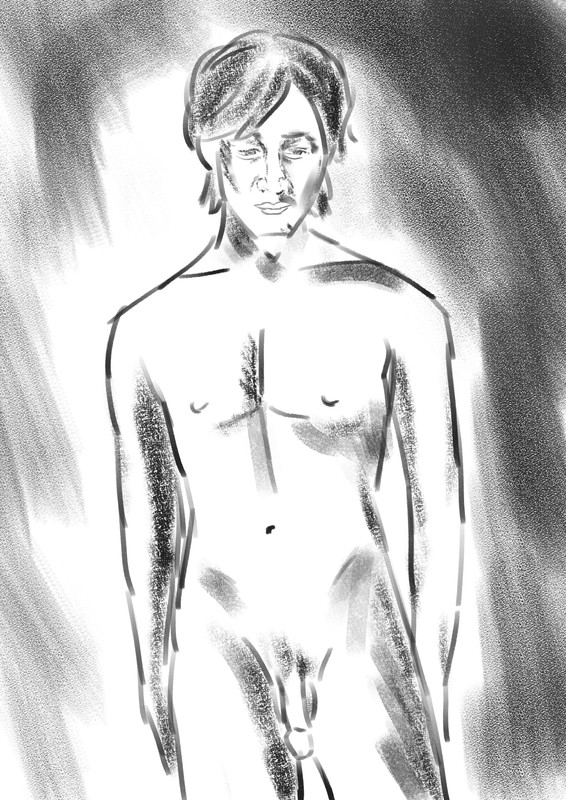
He held up the drawing. It was Gi-hun—uncompromising, every awkward line and hard-earned wrinkle visible, the face open and defiant. The artist looked at him, eyes bright and alive.
“I wanted to get you right,” he said, voice low and steady.
Gi-hun’s heart thudded. “Did you?”
The artist’s mouth twisted, not quite a smile. “I’ll let you decide.”
He handed over the drawing, then left, the scent of charcoal and a faint trace of expensive cologne trailing after him.
After the students had all trailed out, Professor Park thanked Gi-hun with a sincere bow, complimented his discipline, and asked if he’d return next week. Gi-hun agreed before thinking, still staring at the portrait in his hands.
He dressed slowly in the changing room, touching his chest where the artist had drawn the shadows a little deeper, the jawline a little sharper. He didn’t recognize the man on the page entirely, but he wasn’t sure he wanted to.
Outside, the air was cold and clear. Gi-hun walked the block to the bus stop with the sketch rolled in his bag. He wondered what would happen next time. Whether the artist would be there, whether the staring contest would end in a draw or something else.
He realized he wanted that answer more than the pay.