
Work Text:
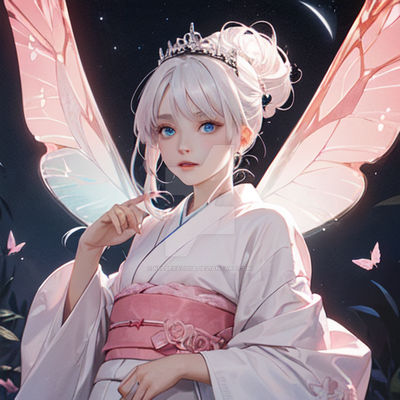
The marble gates of Keaparabeau shimmered softly under the golden haze of the Spirit World's afternoon. Within the palace, the gardens bloomed with colors beyond mortal imagination—trees with leaves of pale green, cornflower blue, and glimmering silver swayed gently as breezes carried the sweet scent of silver apples. Birds, larger than eagles, glided overhead, their saffron chests, crimson crests, and violet tails catching the light of the infinite sky.
Alanna lounged on her alabaster throne, a swan-feather blanket casually draped over it. Her white hair glistened like freshly fallen snow, and her pink, human-sized butterfly wings quivered with each delicate movement. Beside her stood her mother, Raava, tall and poised, her aquamarine gown rippling like river currents, her braided hair adorned with sparkling stones, as she regarded the spirits before them with serene authority.
Before them stood the Magistrate of Souls, Lady Meng Po, alongside her father, Taimusupritto, the Spirit of Time. They lingered near the fountain's edge, the jasmine fragrance of her presence blending with the earthy, temporal scent surrounding them. Lady Meng Po's son, Adroanzi, small and boyish, darted playfully between their legs like a beam of sunlight, his wide eyes filled with both curiosity and worry.
Alanna kept her eyes on the shimmering portal beyond the eastern gates, where glimpses of the mortal world flickered like candlelight. "Avatar Aang's mother's actions have been... significant," she said, her tone steady but firm. "Akanke's influence has crossed the veil, repeatedly reaching out to her children. Many of you view this as a disturbance."
A ripple of murmurs passed among the assembled spirits.
Taimusupritto's sightless eyes emitted a faint glow. "Disruption is one way to describe it," he murmured. "The flow of time has been disturbed. The Avatar is meant to draw wisdom from past lives, to carry their teachings onward—not to be shielded by those long detached from mortal life."
Lady Meng Po tilted her head, her dark eyes unwavering. "But what is coddling, Father? She shields her children as I shield my own. Akanke intervenes only to protect her family from harm. She guides them as any mother would, without seeking to rule the world or claim their hearts beyond their own will."
Adroanzi's voice, soft but resolute, chimed in. "I am the Spirit and Guardian of Children. I've been among them more recently and see this through their eyes. A child is not a vessel for burdens, not meant to bear the weight of empires or destinies. Even the Avatar is still human—still a child. Who are we, distant and eternal, to condemn a mother for safeguarding what belongs to her?"
Lady Raava's voice, steady but warm, spoke gently. "Balance must be considered. The spirits and the mortal world are deeply connected. The unnatural bond of someone so distant risks unraveling the delicate harmony of both realms. Akanke's love is genuine, but she has crossed into territories meant only for the living."
Alanna leaned in, her wings folding softly against her back. "I see her actions for what they are. She does not aim to disrupt the natural order or claim divinity. She acts from her deepest truth: protecting her children and keeping them safe. Aang, Ari, Zephyr—they are fragile, human, and still growing. Have we, with all our age and power, forgotten the weight of childhood?"
The spirits exchanged uncertain glances, some nodding in agreement. Lady Meng Po spoke again. "We have been distant from humanity for so long that we've forgotten. We've forgotten how fleeting innocence is, how crucial it is to protect it. Akanke remembers—she remembers the warmth of being present, the quiet strength of a mother's care. How can we condemn that?"
Taimusupritto traced invisible patterns in the air, rippling the fountain's water. "Even so, the Avatar carries the weight of the world in his soul. Each decision, each protection, each intervention sends ripples outward. If she shields him too much, will he ever learn to carry his own burden?"
Alanna's gaze softened but held steady. "He will learn. He is human. He will stumble, falter, and rise again. Akanke's guidance doesn't take away his responsibility. It gives him the chance to be a child—to feel, grow, and breathe before the war consumes him. That isn't interference; it's life."
A hush fell over Keaparabeau. Even the birds seemed to pause mid-flight, watching the unfolding discussion.
Raava inclined her head. "Let us remember that even divinity must balance judgment with understanding. A child's heart must first be allowed to be human. The Avatar is not a god; he is a boy. He deserves the same chance as any other child."
Adroanzi smiled faintly, and Lady Meng Po nodded in agreement. Taimusupritto exhaled, the flow of time shifting subtly as the tension eased.
Alanna stood, her wings fully extended. "Then we watch, as all spirits must. We guide where we can, but do not erase what makes him human. Akanke's actions do not disrupt balance—they remind us of what we forgot. Humanity's children, even the Avatar, must be allowed to live, to be loved, and to be protected."
And so, in the shimmering gardens of Keaparabeau, the spirits reached a quiet accord. The debate, as always, lingered between life and duty, but for now, they found peace in the understanding.