
Work Text:
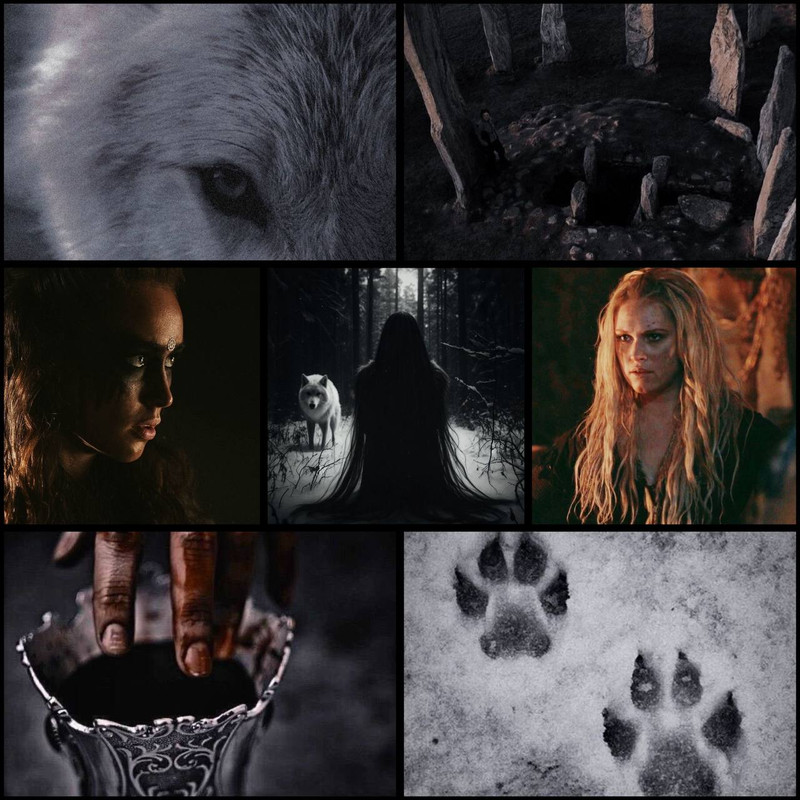
The forest breathed with the long, warm flame of the bonfire and the cold whisper from the canopy. The night glittered with crumbling threads of frost; somewhere far away, in the lowland, a stream murmured—the sound of water echoing through the earth like a heart that won't quiet before sleep. Clarke stood in the stone circle and felt the moss respond beneath her soles: quiet, tart, alive. The salt, poured along the perimeter, glinted in granules, as if tiny stars had been spilled from a palm onto the earth. Heather swayed in the wind, its dry bells faintly chiming. Rowan berries, strung on a thread, hung between two stones.
Nine candles burned with a steady flame—as steady as they are allowed to burn on such nights. Clarke had lit them from the large fire at the northern stone, then bent down, took a slender log from the flames, and, stepping into the center, placed it on a prepared pile of kindling. The small fire flared up, accepting the flame from its elder brother: a double fire—like a bridge, like a breath between. Clarke's palms smelled of smoke and sage; on her wrists, dark rowan knots glinted—she had tied them slowly, whispering names as she counted.
"Tonight is the night the forest breathes differently," she said into the silence, and the sky seemed to lower itself, catching her voice.
The leaves stirred, not from the wind. It was a different movement—even, enveloping. Clarke, without hurry, knelt. The salt crunched. At the shimmering boundary of the circle, where the firelight ended and the darkness had not yet begun, the air stood dense, like the heart of deep water. She ran her fingers over the ground, touching the moss beneath the layer of salt, and heard them—the voices of the ancestors: a whisper, the familiar weight of a hand on her shoulders. Her breathing evened out.
The fire crackled in time with her pulse. The night listened.
She felt the other's presence with her skin. Nearby, beyond the line of the unseen, where the circle ended and the forest began, something opened. Branches crunched. The smell of iron—cold, profound—touched her tongue.
A wolf stepped out of the darkness.
He walked slowly, each paw sinking into the soft, wet moss. His fur was silver, hazy, as if dusted with ash. On his flanks was caked blood, dark, viscous; it gleamed like sap on bark. On his forehead was a black mark, shimmering in the moonlight: a sign not born of nature, but forged by the hands of hunters. Clarke knew this symbol, had seen it in old drafts of Order brands, in sketches hidden in books on her shelf; had seen it in her dreams, like a flash.
The wolf looked directly at Clarke, and in his gaze was what she feared: human pain, stark, unbearable. Clarke tilted her head back slightly to catch her breath; something clicked softly in her chest.
His steps were halted by a barrier. Invisible, it gave a soft push, not letting him inside the circle, and the wolf… did not press. He lowered his head slightly, as if asking. Clarke knew what she had no right to do, and there are rules that make the forest a forest, and the night a night.
"A poor design, to ask this of me," she whispered. "And yet."
She passed her palm through the air, along the very boundary, and undid the loop. The barrier vibrated like a string—thinly, anxiously—but under her fingers, it softly unraveled. The smell of wet fur and fresh blood rushed inward; the wolf stepped across the boundary, without breaking it, and entered the circle with careful steps. The salt did not flare up. The fires did not waver. Only the air grew thick, as if warm mist was rising over icy water.
And then the wolf broke.
The spasm came like a blow. His legs gave way; he fell, heavily, collapsing on his side. His shoulder jerked so sharply that he struck his wounded flank against a stone; his teeth snapped, striking a tiny, dry spark. The wolf wheezed, a sound that people make when their breath is gone.
"Hush," said Clarke, holding back her own hands, which were already reaching out. She knelt beside him, unafraid of the beast—the circle had accepted the blood. "Listen. Breathe."
She placed her palms on his neck, where the pulse beat a double rhythm beneath the fur, and felt the brand—a cold like metal. The mark seemed to swell, gathering strength. Clarke exhaled evenly. A strand of hair stuck to her cheek from the steam of the fire; she fell into the rhythm, forcing her own heart to keep the count. The wolf jerked, but he had almost no strength left, and Clarke's hands held firm.
"On the edge—with the world," she uttered, barely audible. "By blood—into life."
The words fell like a stone into water: almost unnoticed, but the circles spread. The spasm shifted into a fine, ragged shiver. The breath in the wolf's chest responded—at first as if he were gulping air all at once, then it evened out, growing into the rhythm of her palms. The brand on his forehead seemed to go dark for a second.
"You can't sleep here now," Clarke said, more to herself, turning to the fires. They reacted to every word, the light of their flames changing.
The wolf watched. Through the pain, through the heaviness of his drooping eyelids. He watched, and did not growl.
Clarke carefully pulled a cloth of dense fabric from under his head; it was infused with sage, chamomile, and a drop of her own blood. She had prepared it by day, knowing that Samhain Eve is the night when one must ask correctly. With her palm, she found the spot where ear met cheek, and placed the cloth there, to let the cold release. She wiped his side with water from a waterskin, only where the blood was fresh; the old wounds she left—old things are better left untouched on this night.
Somewhere outside the circle, on the border of light and dark, something glinted with a dull, sharp light. Clarke raised her gaze.
On a thin, crooked branch, at the very limit of the illuminated circle, hung a forked rune, carved from bone: the symbol of "cleansing," used to mark beast trails before a sweep. Below, in the grass, beyond the salt line, protruded an arrowhead—short, thick, with a yellowish-green resin on its tip. Even from here, the bitterness reached her—a mixture of henbane and dried hemlock; in the right proportion, it doesn't kill, but stuns, to drive the wolf to a place where it's easier to call him a monster.
Clarke rose slightly on her knees, not crossing the line.
"So, you were close," she said quietly. The voices of the ancestors rustled in response, like grass in the wind.
The branches outside swayed, as if someone had passed by in the darkness, and grew still again. Clarke did not follow the shadow; the circle held her. She merely ran her fingers through the air, touching the invisible edge, checking if the barrier was intact.
The wolf shuddered, the mark on his forehead glowing faintly. Clarke sharply pulled her hand back, so as not to provoke. Silence reigned inside the circle once more.
"Don't," she said to those who hid. Quietly, without a shout, but so they would hear. "Not this night."
The darkness twitched, almost offended, and settled again. The forest accepted this and laid it out over the branches, the needles, the moss.
She returned to the wolf. The blood had almost stopped; where the fur was torn, it had congealed into a thin crust. Clarke mixed salt with herbs and a drop of water on her palm, and with the wet paste traced the edge of the wound, not touching the tear itself. The wolf flinched, but did not lash out. Clarke breathed with him, calming. The lights in the circle dimmed for a second, then yielded, listening.
"I won't hurt you," she said, more to the fire, it seemed, than to him. "I just won't close my eyes when you look at me like that."
She knew: letting a beast into the circle was forbidden. You do not bring one who bears a mark into the circle—not because it will defile it, but because the circle is a mirror; it will multiply what is not yours. But Clarke saw: in his eyes—not a burden. There was a choice. Weak, thin, tearing, but his own. It was enough.
"Do you hear?" she leaned closer. "They are murmuring. The ancestors. Those who breathed before us. They hold the circle while we learn to be within it."
The wolf blinked slowly. Clarke smoothed the fur on his head, the firelight silvering her fingers. She almost smiled: the gesture was too human for the night, but the night of Samhain Eve allows for weaknesses that later become strengths.
Beyond the circle, far away, in the lowland, something clinked. A quiet impact against bark, like a bell without a tongue. Clarke pressed her lips together. A familiar severity stirred in her chest: she had long ceased to fear the Order, but the habit of listening for their steps in the forest remained in her body. The forked rune was a warning: they would check here when the lights went out. The mark on the wolf's forehead was not just a sign; it was a bridle that answered a call. If they called, he would break. If he broke—the deed would be done.
"I'm not touching you," she said quietly to the mark, as if it were alive. "And you will not touch him."
She tore her gaze away, returned to the small fire, and added a chip from a rowan branch. The flame took it eagerly, and for a second, a thread stretched from it, thin as a string. Clarke touched this thread with her fingers, unburned, and pulled it into the circle, toward the wolf. The flame did not follow, but a sound did. Quiet, humming. The mark on his forehead responded—the vibration not of rage, but of sleep.
"On the edge—with the world," Clarke repeated, and the darkness nodded. "By blood—into life."
The wolf slept. His breathing grew sparse. Clarke took a small pouch with an embroidered spiral from her pocket. Inside—pomegranate crumbs, a root of marshmallow, two rowan berries. She was not making a talisman, it was too early, and the night had not yet said "yes." She merely placed the pouch beside him, near his neck, a hand's span away.
"I do not take. I offer," said Clarke, and the fires nodded in time.
She let her gaze travel around the circle—the stones, edges sunk into the earth, stood firm. The salt lay in an even line. The nine candles burned down neatly. The branches above were dry, but not yet brittle.
Near the eastern stone, at knee-level where her hand had touched his fur, a stripe of blood remained. Clarke crouched, touched it with the edge of her sleeve, wiping it, and felt the warmth with something close to tenderness. She disliked the word "pity"—it was one of those that pretends to be a virtue. The night was not about pity. The night was about price.
"The price is not a punishment," she said, barely audible. "It is a confirmation that it was important."
The voices of the ancestors rustled like leaves. Clarke raised her head and closed her eyes, listening, and suddenly a vision came to her with perfect clarity: the road at dawn, along which people in leather cloaks would walk, with staffs and quiet voices; runes on the trees, hung earlier; a gaze in which confidence is built on fear. She let this vision pass through her. Not to cling. Not to grow angry ahead of time.
She straightened up, added a couple of logs to the large fire—one of spruce, one of birch, so the smoke would be different: dense and sweetish. The smoke rose, met the cold, and fell apart into layers. This is how you sometimes understand: the world still holds.
The wolf sighed quietly in his sleep. The fur on his chest quivered slightly; his tongue slipped out for an instant, touched his teeth, hid. Clarke reached out a hand, simply to have her palm nearby, and left it in the air, not touching. It was like a promise no one had asked for, but heard all the same.
The forest breathed. The fires answered. The darkness watched with its age-old blindness. Somewhere far away, an owl called out and fell silent again. The night bent its fingers, counting.
Clarke sat closer to the small fire, drew her knees up, and wrapped her arms around them. Her cheek was scorched by the heat, and still she did not turn away. On Samhain Eve, it is right to look into the fire for a long time, until it turns from flame into a tongue, and then into speech one can understand. The fire told her what she already knew:
"This is only the beginning."
Morning arrived with a heavy step, like a belated traveler who knocks on the door anyway and asks for shelter. Light filtered through deep curtains of linen strips—in this house, the windows were no larger than eyes, and the curtains were the world's eyelashes. Smoke from the night's fires still drifted into the cracks above the hearth, lingering in the fireplace; on the table lay bundles of herbs and a knife with a wooden handle, while bunches of sage, mint, and St. John's wort dried on a hook.
The girl woke to a foreign sound—to someone breathing nearby, not like a beast, but with that hurried unevenness that humans have. A faint rustle of fabric, a sigh. She opened her eyes, and they held more night than morning: pupils dilated, gaze clouded. Her arm, which in the night had been a paw, was bandaged—strings of nettle intertwined with strips of linen, a warm moisture seeping through them. The skin around the bandage was pale.
Clarke rose, approached, and didn't wait for her to fully wake, simply took her by the shoulders and shifted her onto a more comfortable roll of bedding in the corner. A faint tremor passed through the girl—a beast's habit of keeping its guard up, the reflex to bolt when boundaries are unclear.
"You're in the hut," Clarke said quietly. Her voice was even, unhurried. "It's safe here."
The girl blinked, her lips moving. The first word that escaped her mouth was an indistinct rasp, then she spoke more clearly:
"You... saved me." Doubt flickered in her eyes, and perhaps fear. "I'm dangerous to you."
Clarke gave a slight, wry smile.
"You're not the first to carry more than one nature within you," she said. "Here, it is not a sin, but a gift."
She paused a moment, then added more softly:
"Do you have a name? But if you don't wish to—don't name it."
The girl lifted her head, her hair falling over her eyes, the shadow of her lashes sliding down her cheek.
"Lexa," she said finally. Her own name sounded unfamiliar, as if it had been kept locked away for a long time.
Clarke nodded, not breaking her gaze.
"Clarke," she replied. "A witch of the northern forests."
She removed the nettle bandage carefully, mindful not to tear the newly healed skin. Lexa flinched but didn't pull her arm back, sensing another force nearby: not a cruel one, but steady, like the earth underfoot.
Beneath the bandage lay a dark wound—the mark of a ring that had bitten into the flesh, leaving a pattern: a fine, barely visible mesh. There was little blood; a crust had already formed. Clarke ran her fingers along the edge, not touching the old tissue. She sighed. The mark on Lexa's forehead glinted weakly.
"This is no ordinary wound," she said. "It's a sigil. They brand. Iron, poured into flesh. They do it so the beast obeys not itself, but a Call." Clarke took a heavy breath. "The Order of the Pure Dawn."
Lexa watched her intently, but her gaze was wary.
"We saw their faces," Lexa said quietly. "My pack... They said they were cleansing."
"They believe in order," said Clarke, and her voice held no judgment, only weariness. "Only, their order is built on fear. Samhain gives them purchase. But rituals are fragile. On this night, curses are easier to crack than at any other time. Their knots fray if pushed in the right place. They can break you, yes, but one can also give you a reason not to break entirely."
Lexa bit her lip. Her eyes held the memory of what it meant to hear a foreign Call. When the brand awoke, it pulled not the body, but the will, with a fine thread, as if the forest itself were calling one to the hunt, only the voice within it was not one's own. To be the beast was natural. To obey another was not.
"How do they do it?" asked Lexa. "They place the brand and wait for the right night, yes? The Call—it's like a whistle, quiet, insistent. It sounds, and the beast goes."
Clarke bent down, took a wooden spoon, and stirred a bowl of warm milk with honey and herbs—a simple remedy that warmed and cleansed. She offered the bowl but didn't take her eyes off Lexa.
"The mark works always," said Clarke, as Lexa took a cautious sip. "By day, it just pulls from within, disrupts your rhythm. By night, it forces the beast to wake against your will. But at Samhain, the boundaries are thinner, and they can use the mark as a channel."
She looked at the fire in the hearth.
"The Order marks not only bodies but the land itself—stones, the oak by the spring, nodes of power. When on Samhain night they burn these places, the marks answer. The Call travels in a circle, and those who bear the brand walk toward the sound."
Clarke raised her eyes to Lexa.
"They call it cleansing. But in essence—it is a hunt where the prey walks willingly to the pyre."
Silence hung around them for a moment.
"You are not an abomination, Lexa." Clarke touched Lexa's arm where the bandage had been. "You are flesh and blood. They simply fear what they cannot tame."
Lexa placed her palm against the bowl; her fingers trembled, but not from cold. A glimmer of trust showed in her gaze. Clarke observed it as she would a ritual fire.
"They slaughtered almost everyone," Lexa said quietly. Her voice was hollow, as if it belonged to someone else. "My pack. My family."
She looked into the bowl but didn't see it.
"We didn't attack first. We just hunted in our territory, and those who wandered too deep into the forest, we just scared off or led away. We didn't harm people." She closed her eyes and shook her head slightly, in denial. "But it made no difference to them. They came at night. Some they killed outright, others..." She fell silent, exhaled. "Others they branded."
Clarke didn't interrupt. Only added quietly:
"They create monsters so they can later claim the right to kill them."
Lexa looked up.
"And you?" she asked. "Why aren't you afraid?"
Clarke didn't answer immediately.
"Because I have lived next to the dark for too long not to see the life within it."
"What can you do?" asked Lexa.
Clarke placed her palm on the table, hooked a finger through a small pouch of herbs, and lifted it to the light. Nothing loud, but everything that was needed.
"A ritual won't remove the brand entirely," she said, "but it can fracture it. I can give you a space where the beast will not hear the foreign Call. I will set a frame around you, not to hide you, but to give you a choice. On this night, boundaries grow thin, Lexa, but will—on the contrary—grows thicker than stone."
Lexa forced a smile. Her free hand clenched into a fist. Inside her was strength, and weariness.
"I saw your flame," she said, her voice dry but warm. "It didn't burn. It called."
"If you are here, it means the ancestors called you here."
Clarke sat down beside her, not too close, but enough for their knees to touch slightly. She placed the herb pouch between them, and for a second, their fingers touched it simultaneously. Lexa suddenly caught Clarke's scent: smoke, sage, that faint sweetness that lingers from honey. Her shoulders lowered slightly.
"I don't want to become a weapon in the hands of others," whispered Lexa. "I don't want my essence to become a shield for their fear."
"Then we won't let them," Clarke answered firmly. "We will make your will your own. We will stand in the circle again. You will be beside me—not a subordinate, but an ally. If they come, we will meet them."
Lexa looked at Clarke's hand, which had stilled on the pouch for a moment. In that touch was not an order, not a promise of power, but an invitation: to tend the fire together. She nodded.
"When?" Lexa asked.
"When dusk falls," Clarke replied. "For now, we only prepare. When the sun begins to sleep, then our ritual will begin."
And they sat like that, preserving the silence, while the house filled with the faint, rattling sounds of the waking day. In the hut, the smells of herbs mingled with the scent of living, healing skin. Lexa fell asleep. And Clarke watched, counting every breath as a master counts over a charm: attentively, losing not a single thread.
She made an amulet: a spiral of thin bone, at its center a crumb of pomegranate, along the rim a hoop of rowan. The amulet hummed softly, like a tuning fork that sets the body right, reminding: here is your home, here is your center.
Clarke placed it by Lexa's pillow: let her, touching it in her sleep, feel not another's power, but her own balance.
***
Dusk fell swiftly, as if someone had upended an inkwell onto the world and decided that was enough for today.
The circle at the edges was already ablaze: a large foundation of flame supported two lines—an outer one, warm and broad, and an inner one, swift and sharp. Clarke stood by the northern stone, and Lexa, dressed in a simple tunic, held her shoulders straight, like a soldier who hasn't yet learned to relax in the presence of another power. Sage and rowan were woven into her hair for their scent, so the spirit of the forest would know: here are allies.
"Are you ready?" Clarke asked, and the question held no doubt, only an invitation.
Lexa looked at the circle, at the candles, at the strips of salt glowing in the half-light, and nodded. She approached and stood opposite Clarke.
Clarke took out the amulet and held it up to the light. She passed it through the air, and the air responded like a string.
"The double fire is not for destruction," Clarke said when they stood in the center. "It is a bridge: the small flame holds what the great one cannot encompass. You will hold the center, and I—the edge. If need be, I will draw the power into myself."
Lexa listened. Her palms were tense; she unclenched and clenched her fingers, keeping the rhythm. It was the body's lesson—how to teach a hand not to tremble with rage, how to teach teeth not to bare in defense too soon.
Clarke placed her palm on the amulet and whispered an incantation:
"By blood—to life, by name—to light, by loop—not to captivity, but to the circle's answer."
The words came in even rows. The rhythm was simple, so the body could memorize it and take it as its foundation.
When Clarke spoke the last words, Lexa sighed quietly and took a step forward. The air around them grew denser; even the fog stilled in respect. The small flame flared up, embracing her legs, while the large one behind her rose like a wall. This was magic that cleansed.
"If I lose control—run," Lexa said so quietly that almost no one would hear, save for a heart, if it could listen.
Clarke raised her head; her eyes were warm, but her gaze was sharp as a honed stone. She took Lexa by the wrist.
"If you lose control—I will hold you tighter than the circle," she replied. "Not to break you, but so you can choose who to be. If needed—I will calm the wolf within you, to keep it from tearing the world apart."
Lexa smiled. It was a promise, but also a challenge: not to trust only in strength, but to trust the hand that holds.
The circle became their body. The fires hummed, their tongues weaving patterns, and Clarke took the cords into her hands—thin, taut, but warm. She tied them gently around Lexa's wrists, barely touching. They were not shackles, but guides; when the flight began in her body, her eyes would find the line, her palm the point. The rowan smelled sour, like first blood, and simultaneously sweetish—like sap.
"We perform the rituals so the body remembers: there is a time for the hunt, and a time for returning. You will learn to hear the difference," Clarke said.
Lexa closed her eyes for a minute, breathing in; the light reflected on her face, dividing the world in half and allowing her to see both shadow and form simultaneously. She sensed something stir in the forest, as if someone in the distance shifted their footing, and heard a thin sound in her ears—it was the Call, like a silken thread pulling at her. She knew that if she yielded, she would lose not only control but the right to choose.
Clarke raised her hand; the amulet chimed like a tiny bell, and this sound drowned out the Call that whispered: "Come." It remained somewhere in the forest, never reaching her heart.
Their hands were close, and in that moment, the world seemed to grow smaller.
Blades crunched in the distance—a sound that signaled the beginning of action. The hunters began to surround the circle, in small groups, whispering amongst themselves. The distant call of a horn, bells on their belts—it was all calculated for effect, to breed fear. But inside the circle, other things pulsed: trust, warmth, strength.
Lexa stepped back and looked at Clarke. Their eyes met; no words passed between them, but there was too much left unspoken. Lexa leaned in and touched her lips to Clarke's fingers—briefly, like an oath given without words. It was more than a sign—it was a contact that said: you are near, and I will remember this.
"You don't pull away," whispered Lexa. "Many would have."
"It's a choice," Clarke replied, her answer almost a whisper too. "A reminder that we are still human."
When the first shadows of the hunters froze at the very edge of the forest, when footsteps were heard, Clarke uttered an ancient chant—not to frighten, but to remind them: the circle is an oath. The wolf inside Lexa, feeling the path to the Call blocked, began to resist, and in that moment Lexa smiled and clenched her teeth: she knew the price.
Clarke stepped forward, took her by the shoulders, and pulled her close with the sense that she could warm and hold her. The small flame licked at their feet, and the great fire behind them formed a wall through which no gaze could pass uninvited. The circle's power held, but far more important were the hands holding onto forearms.
"If you lose control—I will stay by your side," said Clarke. "Not to restrain, but to remind you who you are."
And Lexa nodded. On her lips was resolve; in her soul—a promise. Their fingers intertwined, and this touch was like a star in the night sky—quiet, but bright enough to see the road back.
The fires roared, the air tightened, and the night they had both awaited and feared arrived. They stood shoulder to shoulder, and this, more than the stones and herbs, was their defense.
The silence was broken by no beast, no wind—only by breath, thick and viscous like honey spilled on the ground. The world seemed to be waiting.
Clarke felt a faint hum pass beneath her feet—the Call, low and traveling through the roots, like the heart of the forest waking deep within. Lexa raised her head, her ears catching the sound before words formed. Somewhere far away, beyond the circle's limit, a branch snapped. Then a second. Then dozens at once, as if someone was advancing in a chain.
Hunters.
They did not hurry. They moved methodically, as in a ritual. Among the trees, lights ignited: green, pale, like swamp candles held in glass lanterns. In their light, the bark on the trees looked ashen, and the faces—like dead masks. On their foreheads—runes, the same that burned on Lexa's mark.
"They're coming," Clarke said quietly.
She lowered her palms to the earth. The fires within the circle sighed, their flame-tongues stretching toward her, recognizing.
"Don't be afraid," she said, and her voice was level. "Fire is breath. We will simply make it breathe differently."
She raised her hands, and between the fires stretched thin, amber threads, like veins. They wove in the air, forming a dome. It rose and fell like lungs, admitting only what was necessary. The forest around grew still, listening to this new rhythm.
But the Call had already awoken. It came from within. First quietly, like a silken string inside the skull. Then louder.
The Call. That one. The mark on Lexa's forehead flared like a drop of molten iron. She hissed, clutched her head. Clarke turned sharply and saw the skin on Lexa's arms beginning to pattern.
"Lexa!"
"It's calling..." the other whispered, her voice trembling. "It's calling me."
A whistle cut through the air, as if someone had blown a horn. The hunters' staffs glowed.
Clarke stepped closer.
"Look at me," she said quietly. "Not there. Only here."
Lexa raised her eyes. Their gazes met briefly, sharply, like an electric shock.
Clarke touched her palm to Lexa's chest, where her heart beat.
"Here," she whispered. "Here, you are. Not them."
The whistle died. The mark trembled, ready to erupt, but Lexa stood, teeth clenched, gaze direct. She took one step forward, then another. The air in the circle shuddered. Clarke kept her palm at Lexa's chest, her pulse matching the rhythm of the fires.
"On the edge—with the world," said Clarke.
Lexa exhaled, and stepped into the fire. Her body arched. A wave traveled up her spine, her shoulders shook, her skin gleamed silver, fur pushing from within. The light of the fires wrapped around her like a cloak. When she opened her eyes, fire danced in her pupils. Before Clarke stood a she-wolf—silver, as if woven from ash and light. The mark on her forehead burned, but no longer like a brand—like a scar one need not be ashamed of.
"You see?" whispered Clarke. "You are not their weapon."
The she-wolf raised her head and growled. The growl was clean, low, not rage—a response. The forest answered with an echo.
From the darkness stepped the hunters. In masks of deer skulls, with iron staffs in their hands. They moved in a chain. The first to step out was a tall man in a grey cloak. The Commander.
"Witch," he said. "Give us the beast. She is ours."
"Yours?" Clarke lifted her chin. "You mark with fear and call it authority."
He raised his staff. The rune on its end blazed.
"Your magic is smoke from a fire. Ours is the flame that cleanses."
"Smoke is the fire's trace," Clarke answered. "We stand where it begins."
She struck the amulet against her palm. A bell rang, thin and high, like the breath of light. The dome flared, the air grew thick. The flame rose above them, turning into a living tapestry stretched between worlds.
The hunters threw smoke bombs. The world turned grey. The flame bent low, as if losing its footing.
But Clarke closed her eyes.
"Breathe," she whispered.
The flame stretched out again, gathering the smoke into threads, weaving it into the fabric of light. The forest breathed with them.
The Commander lowered his staff, and the earth beneath their feet shuddered. A metallic ring, a counter-signal, passed through them in a wave. The mark on Lexa's forehead flared, making her howl.
Clarke understood—he was striking at the brand.
"Don't you dare," she said.
The amulet in her hand sang. A pure sound traveled through the air. It was like a bell—thin, cutting, alive. The she-wolf tensed, then moved. Not attacking—meeting.
The first hunter fell, as if the ground had opened beneath him. The second she disarmed with a single leap. She did not kill. In every movement was a choice.
The Commander swung his staff, but the metal wavered. The she-wolf lunged, caught it in her teeth, knocking it from his hands. Sparks scattered across the ground.
Clarke stood in the center of the circle, eyes amber, hair glowing from the fire.
"Let it burn, if it is alive," she said.
And the flame truly became light. From it emerged a female figure, in a cloak of shadow.
The Foremother.
The one whose name Clarke invoked in her prayers. The woman nodded, touched the dome with her hand, and the forest stopped. Even the hunters. Even the night.
"Time to hold," Clarke uttered.
The shadow nodded and dissolved into the light.
The dome flashed and turned gold, the light spreading out in a ring. The hunters shielded their eyes. The she-wolf stepped into this light calmly, confidently. Her movements became fluid. She was reclaiming the space for herself.
One of the hunters tore off his mask: a boy, no older than sixteen. Lexa stopped a step away from him. Her own fear was reflected in his eyes. She stepped back.
Clarke saw it and knew: the wolf had made a choice.
The Commander fell to one knee, his staff cracked, crumbling to dust.
"Witch," he rasped. "What have you done…"
"Reminded you that life does not belong to you," she answered.
The flame began to slowly die down. The forest exhaled.
The hunters, one by one, retreated into the darkness. The Commander threw out a final remark:
"You are not eternal."
"Nor," Clarke replied, "are you."
The dome crumbled into light, vanishing. The she-wolf stood in the center of the circle, silver, trembling, but calm. The mark on her forehead had cracked and faded.
Clarke approached, held out a hand.
"It's over," she said. "It's over."
The she-wolf lowered her head, allowed herself to be touched between the ears.
"Alive," whispered Clarke.
In response—a heavy exhale. Warm, like morning mist. And in it—gratitude.
A light morning mist lay over the earth, the rowan tree by the house was covered in frost, its berries glistening like drops of frozen blood.
Clarke stepped over the threshold, wrapped in a woolen cloak. A mug of herbal infusion steamed in her hands. The air smelled of smoke and cold.
From around the corner, Lexa appeared, already in her human form. Her hair was tangled, the cracked mark on her forehead visible like an old scar.
"Awake," said Clarke.
"I didn't sleep," Lexa replied. "The forest whispered all night."
They stood in silence. Somewhere in the distance, a bird cried out; the sun broke through the clouds, turning the mist to gold.
"The mark is silent," Lexa said quietly. "But I still hear…"
"Yourself," Clarke finished.
Lexa smiled.
"Myself."
A howl came from the mist. Not threatening—calling. At the edge of the woods, two wolves appeared. Grey, watchful. They stood at the forest's border, not crossing it.
"Yours?" asked Clarke.
Lexa nodded. She took a step, but stopped.
"It's time for us to go."
Clarke took the amulet from her own neck—the very same one, of bone, with a rowan hoop—and hung it around Lexa's.
"Take it. It won't hold you, won't force you. It will just remind you that there is a place where you are awaited."
Lexa touched the amulet. The metal was warm.
"Our place is no longer here, Clarke," she said, looking toward the forest. "But I… will remember the way."
Clarke smiled, barely perceptibly.
"An anchor is not a restraint. An anchor is a point to which one can return."
The wind stirred the rowan tree, and the frost fell like sparks.
Lexa looked at her for a long time, as if trying to memorize every feature.
"I will return," she said simply.
Then she stepped into the mist. The wolves moved after her, dissolving into the white light. Just before disappearing among the trees, she turned back.
Their gazes met: the witch and the she-wolf—two sides of the same boundary.
Clarke stood until their silhouettes vanished. She turned her gaze to the sky, transparent and cold as glass. She raised a hand, not in farewell, but in blessing.
The sun touched the rowan branches, and the frost sparkled with a thousand sparks.
"The path is open," she said into the silence.
The forest answered with a rustle.
And there, where darkness had stood just moments before, a light flickered—thin, barely noticeable—a thread between life and legend.