
Chapter Text
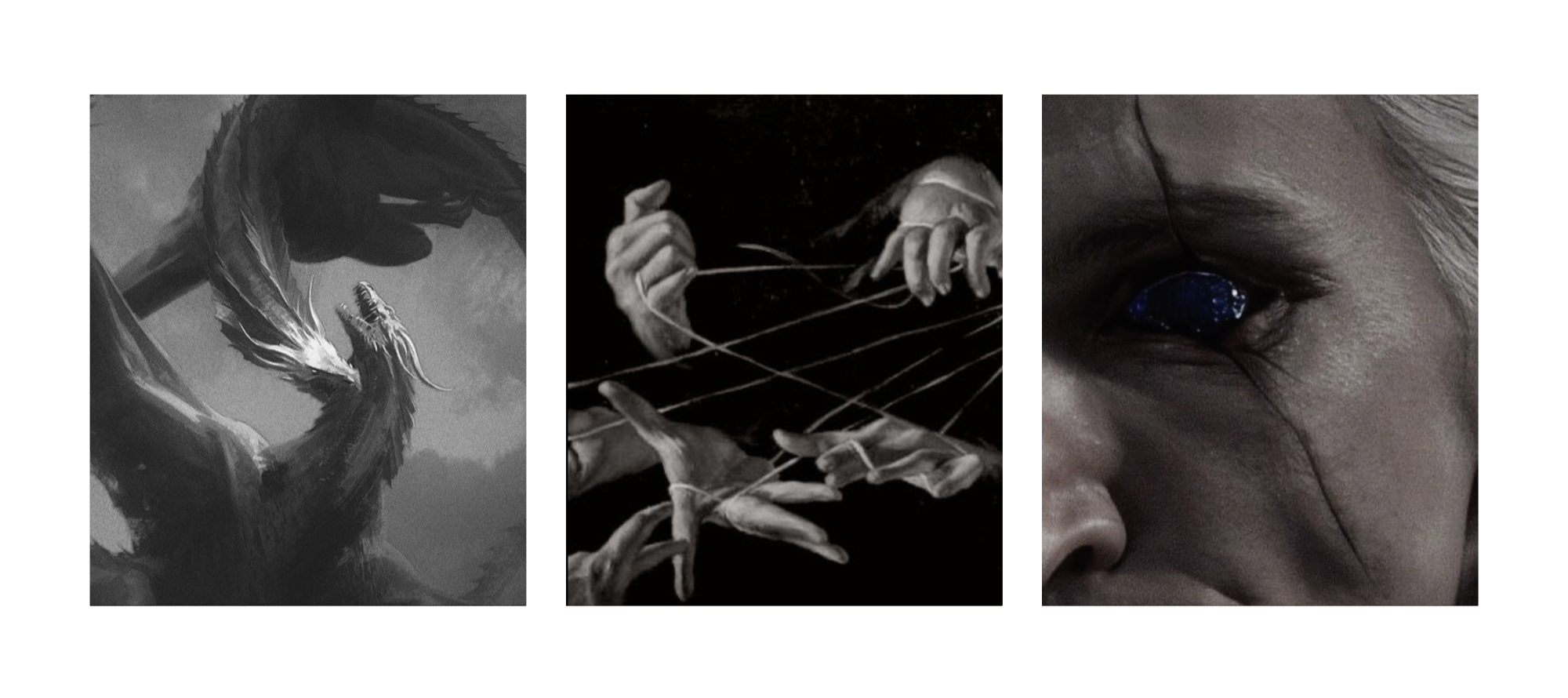
Oh, Icarus
You are a foolish one.
Excessive ambition never makes it to see the light of day.
You had too much hope in yourself.
our pride took you away.
He wondered if he could ever witness a storm again and not taste blood between the sheets of rain.
Even hours after, the metallic tang still lingered in his mouth, bitter and unpleasant. It clung to his teeth, slicked the back of his throat when he swallowed, and seemed to clog his nose with every breath.
The taste had come not from his own wounds—those were old stories etched into skin, silvered over with time. It had nothing to do with the copper penny flavour of his own split lips or bitten tongue. No, it was the sky itself, as if the tempest above Storm’s End had turned corporeal, bleeding its vengeance into the air. It had settled in his lungs and would not be purged.
Iron. Salt. Copper. And something fouler still. Vhagar had dredged it up from the deep black of the world.
It belonged to neither sky nor sea, but to that terrible place between them, where dragons clawed through cloud and kin and something ancient stirred. A place he had known in stories, in prophecy, in the marrow of his bones—but never tasted until now.
He had left the storm behind, but its shadow flew with him.
The clouds thinned, and the night bled into pale-grey morning. Beneath him, the Crownlands unspooled in slow, barren ribbons: bleak hills, half-dead trees bowed in the wind, riverbanks swollen and muddied. Far ahead, somewhere beyond the smudge of mist that crowned the horizon, the city awaited.
He had left the clouds in his back with the cover of night, trading it for the crystalline bite of morning air and the echo of thunder that seemed to reverberate still in his bones. The dread remained. The cold, too—burrowed deep, marrow-deep, where no fire could reach. In the dark, he had let himself believe, if only for a few minutes, that it might not be real. That it had been a nightmare made of thunder and hatred. That he had not seen Arrax’s small body trapped between his dragon’s jaws. That Lucerys had not vanished with him, a scream swallowed by the storm.
But daylight came, as it always did. Cold and clear and merciless. It stripped the dream from him, finger by finger, until nothing was left but truth.
On the horizon, King’s Landing awaited. Still distant, still drowsing. He wondered if they had begun to stir behind the walls of the Red Keep. His mother, her head bent in morning prayer. His brother, heavy with wine and sleep. Cole, sharp as ever, guarding her door. None of them knew what was coming. Not yet. Not until Vhagar’s wings shadowed the city.
Not until the poison he carried arrived on his breath.
If Vhagar sensed his unease, she gave no sign. The great she-dragon moved through the air with the same terrible grace she had possessed for over a century, her bronze scales catching the early light like burnished armour. The wind bowed to her. The sky parted. She was conquest incarnate. He had once found awe in her presence, reverence in her enormity. He had stood beside her flank on the shore of Driftmark and claimed her with blood and fire and boyish desperation. He had been ten and aching for something that would make him more than what they whispered he was.
Now, flying above the trembling sea, he could barely look at her without unease twisting in his gut. She flew steady beneath him, vast and ancient, her wings beating slow and tireless through the thinning clouds.
He had always known her strength. Admired it. Claimed it as his. But never before had he feared it.
She was no longer truly his.
Or worse—perhaps she never had been.
He had felt it, in the moment before Arrax fell. Not fear, not horror, but something bright and savage. A thrill he had not known since that first night at Driftmark, when she had answered his call and made him something greater. For a heartbeat—just one—he had felt whole. He had felt right. The world had realigned. He had chased Lucerys into the storm to remind the boy of a debt, yes—but more than that, to assert what should be. That boys who wielded knives would come to know the cost of their folly.
But Vhagar did not know debt. She cared only for what was owed to her: blood, terror, obedience. And in that moment, Aemond had owed her all three.
His jaw clenched. The wind bit at his cheeks and eye, but he barely felt its sting.
He had not meant to kill Lucerys. Of that, he was certain. He’d meant to chase him, terrify him, perhaps even scar him, if the boy had been too slow or too bold. A lost eye for a torn wing, a broken nose, a shattered pride. Something to balance the scale that had never been right.
He had screamed the words into the storm, but his dragon had already chosen for him. Vhagar did not understand balance. She had known only fury and blood, and in the end, her joy had been his as much as hers.
He did not remember giving the order. He did not need to.
But he remembered the moment before.
That second when the sky cracked and he felt her spine align with his own. When her hunger met the hollow in his chest and filled it, just for a breath, with something that felt like victory. The clean, radiant kind. The kind boys dream of in bed with daggers beneath their pillows. The kind men ride to battle for to find and never do.
She was conquest and collapse.
And in that moment, they had been more attuned than ever. He had felt her fury echo his own, had reached for it without thinking, and she had met him halfway with fire and fang. They were one. Rider and beast. War and wrath.
He had felt it. That flash of savage, soaring exultation when her jaws snapped shut. The shudder of impact. The way the night itself had seemed to still around them. In that moment, he had felt powerful in a way he had not felt since the night he claimed her—before the eye, before the taunts, before the mask he had taught himself to wear.
And then the boy was gone.
And there was only the fall.
It was not the storm that haunted him. It was what came after.
He did not regret the bastard. Not truly. The hatred had never faded. He still remembered the sting of flesh torn from his face, the hot burst of pain, the voices shouting in the dark, and the feel of the sapphire being pushed into place where his eye once was.
But this—this—he had not meant for.
He regretted the loss of control.
The slipping of the reins.
The reminder that even the blood of Old Valyria could not truly command a creature that had once burned through the Conqueror's enemies like parchment. That she had outlived three riders and would outlive him, too, perhaps. That when the moment came, it had been her will that moved, not his.
And that will had answered something deep in him.
What does that make me?
He felt small now. Smaller than he had even six years ago, when he had been but a child who dreamed of greatness. The boy with the ancient dragon had grown into a prince with a sword at his hip and silver in his hair, but what was it worth if he could not master the mount beneath him? What use was blood and fire if neither obeyed him?
He flew her still, but he did not command her. Not in the way he once had. Their old bond—that fierce, impossible claim—felt stained now. Claimed in return.
Even the wind was thin. It did not cleanse him.
He breathed it in and choked on it.
As the skies brightened ahead, the land below folded like old parchment, familiar and false. Pale winter sunlight streaked the water, setting the towers of King’s Landing aglow in the distance. It did not matter how high he flew, he could feel it stirring already. The Red Keep turning in its sleep.
He should have turned back. Not towards the city, but to some dark and nameless hollow where Vhagar could curl and he could forget how brightly her scales had shone in the flash of lightning. How proud he had felt, how right, even as the boy fell.
He had not meant for it.
That was the truth.
Soon he would pass over the city walls. Soon the guards would see him. Soon he would descend into the courtyard with smoke on his boots and ruin on his tongue.
They would ask what happened. They would see the fire in his eye and think it was victory.
He had gone to Storm’s End to win a marriage pact. He had returned with war on his heels.
And what frightened him most—what sat like a splinter in his heart—was that in the space between command and catastrophe, he had tasted joy.
Aemond Targaryen did not weep.
He did not cry out.
But he closed his eye against the morning light and knew the truth of what he had become.
This is what he had wrought.
Not justice. Not vengeance.
Only a wraith on wings.
Bringing death ahead of the dawn.
And when at last the wide brick sprawl of the capital began to rise, when the first shapes of towers pricked the edge of the world, he felt it settle in him like a second heart.
The name that will follow him long past his death. It would be the first curse cried in answer.
Kinslayer.
The gods would condemn it.
The poets savour it.
His mother would weep—he knew she would. His grandfather might rage.
But how much he wanted it, when the sky tore open.
And how good it felt.
Just before the fall.
I.
The Red Keep was alive with noise when Aemond returned.
It was midmorning, and sunlight poured through the high windows like molten glass, gilding the marble floors and the courtiers that drifted over them. It turned the stone to honey and warmed the tapestries that depicted ancient tales from the Seven-Pointed Star. Pages hurried past with scrolls in their hands. Septas whispered blessings. Laughter rippled from the distant hall, where a cluster of young knights were recounting the exploits from the night before. The air stank faintly of wine and perfume, incense and ambition.
Aemond walked through its halls like a revenant, his boots striking marble with too-loud precision. Around him, the vultures laughed behind gloved hands, servants hurried past with arms full of fresh linens, and somewhere distant a lute played a song he did not recognise. Below, the city sprawled in its usual chaos—merchants shouting their wares, gulls wheeling above the harbour, the distant clang of a blacksmith's hammer keeping time with the heartbeat of the realm.
It should have felt familiar. It should have felt like home.
Instead, he moved through it as if through water, every sound thickened and strange, every voice warped into something alien. The Keep that had once seemed a fortress of order and purpose, where iron will ruled and the Seven watched over the righteous now looked soft to his eyes—too rich, too indulgent, draped in silks and song to hide the rot beneath. This was his brother’s castle, drowned in wine and whoredom, gilded filth wearing the face of royalty.
None of them knew what had happened yet. The ravens had not come. To most, he was simply the prince returned from Storm's End, a diplomat come home from securing an alliance. They bowed as he passed, their eyes sliding past him with the practiced disinterest of people accustomed to the presence of those of the blood. But he could feel it already, that subtle shift in the air, the way whispers followed in his wake like smoke.
And those who looked at him—truly looked—saw something that made them step aside.
He wondered if they could smell it on him. The stink of death and rain and dragonfire. The scent of the storm that had swallowed a boy whole and spat nothing back but silence.
A servant carrying a tray of honeyed cakes nearly collided with him, stumbling back with a breathless apology. Aemond barely registered it. He walked on, his hand resting on the pommel of his sword out of habit, though the gesture brought no comfort. The weight of it felt wrong now, too light or too heavy, he could not tell which.
He had thought victory would warm him like fire. Instead, it tasted of copper and ash.
The galleries opened above him as he crossed the main hall, their arched windows spilling light across the floor in geometric patterns. He glanced up, half-aware, and stopped.
Helaena stood in one of the upper corridors, framed by a shaft of sunlight that turned her pale hair almost white. She seemed to glow in it, ethereal and untouchable, her hands clasped before her in that particular way she had: fingers interlaced, thumbs pressed together as if in prayer. Around her, the vultures had gathered like moths to flame, their silks rustling, their voices a chorus of false warmth and calculated courtesy.
They pressed close, too close, their questions overlapping. All seeking her favour — the good queen, the gentle one, the mirror of her mother’s grace. Lady Ambrose spoke of her needlework. Lord Stokeworth asked after the health of the young princes. They fed on her patience, her kindness, her quiet. The court did not know mercy. Only appetite.
Helaena nodded to each in turn, her voice too soft to carry, her smile fragile as spun glass. She looked tired. She always looked tired now, but the weight of the crown had made it worse. Her gentleness, which should have been treasured, was instead crushed beneath the pressure of her title, ground down by the endless demands of people who mistook her silence for weakness to exploit.
Aemond stood in the shadow of a pillar, watching. The sight cut him in a way he had not anticipated.
She was the purest of them. The only one who had never sought power, never schemed, never hurt anyone for the sake of ambition or pride. She was good in a way that the rest of them could never be. And they were bleeding her dry for it.
He thought to go to her. To push through the crowd, to take her hand, to say nothing and everything at once. To climb the stairs and stand at her side, to shield her from the press of vultures in velvet. To say something, though what, he did not know. Perhaps his presence alone would be enough to make them back away, to give her room to breathe.
But then she shifted slightly, and the light caught her face at a different angle, and he saw the weariness there, the way her eyes did not quite focus on the people speaking to her. She was somewhere else entirely, lost in whatever strange currents moved through her mind.
But what right did he have to stand beside her now? His hands were unclean. His name would soon be unclean.
She was a queen now. Queens did not concern themselves with the troubles of kinslayers.
She was sunlight, and he was the shadow that followed it.
The thought settled over him like a shroud. He could not approach her. Not like this. Not with the blood still fresh on his hands, even if no one else could see it. He was tainted now, accursed, and she was still—somehow, impossibly—untouched by the filth that coated the rest of them.
If she looked at him, if her eyes met his, she would see what he had become. And he could not bear that. Could not bear to watch whatever light remained in her dim at the sight of him.
So he turned away before she could glance down and find him watching. Turned away and continued towards the stairs that led to the upper floors, to the king's solar, to the reckoning that awaited him there.
The corridors grew quieter as he climbed. The laughter and music faded behind him, replaced by the soft echo of his boots on stone and the low hum of torches burning in their sconces. Fewer servants moved through these halls. Fewer courtiers lingered. This was the domain of power, not performance, and those who did not belong knew better than to wander here uninvited.
His hand brushed the hilt of his sword again. What good was a blade now? He had already struck the blow that mattered, and no amount of steel could undo it.
He rehearsed what he would say, trying different words in his mind like a mummer testing lines.
It was an accident. No. They would call it cowardice. Weakness. A failure to control his dragon, his temper, himself.
He provoked me. True, but too small a truth. It would sound like an excuse, like the whining of a child caught in mischief.
It was owed. That, at least, they might understand. An eye for an eye. A blood debt paid. If he framed it as deliberate, as justice rather than rage, they could make use of it. His grandsire especially. Otto Hightower had always been skilled at turning disasters into opportunities.
But even as the thought formed, something in him recoiled. To claim it as intentional would be to own it fully, to let the mask he wore become the face beneath. And yet, what choice did he have? No one would believe the truth. No one wanted to believe it. To them, "accident" would mean "failure," and he could not afford to be seen as weak. Not now. Not ever.
He stopped before the great double door of the king's solar. Inside, voices murmured: his mother's soft and strained, Otto's clipped and controlled, Aegon's louder and edged with wine-soaked amusement. They were waiting for him. Had been waiting since word arrived, no doubt. Waiting to pass judgment on what he had done, to decide whether he was asset or liability, hero or villain.
Aemond straightened. Drew his shoulders back, smoothed the front of his cloak where rain had stiffened the fabric. Breathed once, deep and slow, the way Ser Criston had taught him before sparring matches. Then he folded the truth inward, buried it somewhere deep and unreachable, and locked it away.
If they would have a kinslayer, let them have one worthy of the name.
He pushed open the door.
The solar was bright with morning sun, almost painfully so after the dimness of the corridors. Light poured through the tall windows that overlooked the city, illuminating the room in stark, unforgiving clarity. It provided no shadows, no refuge for those seeking shelter from scrutiny, no mercy in the brilliance. The chamber might have been a courtroom: the Hand presiding like a stern magistrate, the dowager queen poised as jury, the king slouched in the seat of power but somehow never the one on trial. In that cold illumination every movement felt like evidence, every silence offered only damnation.
The long table was cluttered with scrolls, some unrolled and weighed down with inkpots, others still sealed with wax. A breakfast had been laid out but largely ignored: bread torn but not eaten, fruit going brown at the edges, wine cups half-full and abandoned.
His grandsire stood by the window, his back to the door, hands clasped behind him. He was perfectly still, but tension radiated from the square set of his shoulders. Aegon lounged near the hearth despite the warmth of the day, one leg thrown over the arm of his chair, a cup of wine dangling from his fingers. His eyes were bright with delight, a faint smirk playing at the corners of his mouth.
Alicent sat at the table, her posture rigid, her hands gripping a pendant of the Seven-Pointed Star so tightly her knuckles had gone white. She did not look up when he entered. That, more than anything, told him how bad it would be.
The door closed behind him with a soft click.
For a long moment, no one spoke.
Otto Hightower’s gaze remained fixed upon the city sprawling below, hands still clasped behind his back. Aegon shifted lazily, the soft creak of leather cutting through the silence as he swirled his wine. Only Alicent moved—a small, brittle movement, the thumb of her right hand tracing the edge of her pendant, as though the act could summon order from ruin.
When Otto finally turned, it was not with the measured calm of a man gathering his words, but with the cold efficiency of one delivering sentence.
“Do you grasp the magnitude of what you’ve done, boy?”
His voice cut through the room sharply, shattering the last claim to sympathy he might have had.
“You’ve turned a storm into a war.”
He did not wait for an answer. The Hand of the King had no need for dialogue; he spoke to be obeyed, not to be heard.
“Rhaenyra’s son is dead." Otto began to pace, his hands clasping and unclasping behind his back. " Her child. A boy of fourteen. Slain by his own uncle in the skies above Storm's End. You have given her cause not just for war, but for vengeance. Turned an issue of succession into a blood feud.”
Aemond said nothing. Met his grandfather's gaze and held it, though it cost him.
“Do you think she will consider peace now?”
Still, Aemond remained silent. What could he say that would make any difference? Otto was not looking for an explanation. He was tallying consequences, calculating damage, assessing what this meant for the crown's position. There was no room in his grandfather's ledger for regret or horror or the sick twist of guilt that lived in Aemond's chest.
Alicent finally looked up, and the sight of her face nearly broke his composure. She was pale, drawn, her eyes red-rimmed as if she had been weeping, or fighting not to. When she spoke, her voice trembled with something between fear and heartbreak.
"Mother have mercy on us all." The words came out as a prayer, desperate and small. "The boy was your own kin, Aemond."
She searched his face as if looking for the boy she thought she knew, the dutiful son who had been her solace, her steady one. And found nothing familiar there. He saw the moment she gave up looking, the way her eyes slid away from his as if the sight of him pained her.
That wounded him more than Otto's anger. More than anything else could have.
"You have given Rhaenyra—and worse, Daemon—their cause. You’ve set the match to dry kindling. Served them every justification they need. Do you think Lord Fleabottom will hesitate to answer blood with blood? He has been waiting for a reason. You have given him one wrapped in silver and flame."
The name hung in the air. Aemond's jaw tensed, and before he could stop himself, the words came out low: "Let him come. I do not fear him."
Otto stopped pacing. When he spoke again, his voice was almost soft, a pitiful thing from the mouth of such a man. "You should. You may have his bloodlust, boy, but you have not his cunning. He will not meet you in the sky where you expect him. He will tear this house apart from within, find every weakness, every crack, and pry us open until there is nothing left."
Through it all, Alicent had not moved. Had not looked up. Had not spoken beyond those few whispered words. But Aemond could feel her silence pressing down on him, heavier than all of Otto's words could weigh.
He had been meant to be her constant. Dutiful where Aegon rebelled, strong where Helaena was fragile, near while Daeron was far. The son shaped by her faith, fashioned in the light of the Seven, a reflection of every virtue she had prayed into him. Now that image lay in ruin, and the wreckage showed not in the tremor of her hands but in her eyes when she had finally looked up at him, only to turn away almost immediately at the sight.
There was none of his grandsire’s restrained anger there. Only something colder. A distance that had not existed before, a chasm that had opened between them in the span of a single day.
He opened his mouth. No words came.
He could have told her then. Could have explained that it had spiralled beyond his control, that the storm had turned everything into chaos and terror. But her gaze slid away before he could find the words, and he understood that it would not matter. The boy was still dead. The war had still begun.
If he told them it had been a miscalculation, a moment of lost control, they would call it weakness. Otto would use it as evidence of his incompetence. Aegon would mock him. And his mother would know that her perfect son had never existed at all.
At least if they believed he had done it deliberately, there was purpose in it. Strength. A blade drawn with intention rather than fumbled in panic.
Standing in the merciless light of the solar, Aemond made his choice.
It was easier than the truth.
"The realm will burn," Otto said, his voice cutting through the moment. "Every house that might have supported Aegon's claim will now question our judgment, our control. You have stained us with the worst crime known to gods and men. There is no washing that clean."
"Stained?" Aegon spoke up suddenly, his voice ringing out through the tension with wine-bright amusement. "Or sanctified?" He shifted in his chair, grinning at Otto's expression of disbelief. "Seems to me that he's given our dear half-sister reason to fear us, grandsire. That's worth more than all your sermons. Fear does what diplomacy cannot."
Otto rounded on him. "You think fear will hold the realm together? He's set fire to it! This is not some tavern brawl, boy—this is the succession, the very foundation of—"
"This is my reign." Aegon's smile faded, replaced by something harder. "I am the king. Not you. Not mother. Me. And I say Aemond's proven himself the true blood of the dragon, and the realm will see we don't flinch from what must be done. That's a beginning, grandsire. Perhaps not the one you would have chosen, but a beginning nonetheless."
The room erupted. Otto's measured fury, Aegon's provocations, Alicent's quiet pleas that no one heeded. The voices overlapped, tangled, became a single roar of judgment and justification. Through it all, Aemond stood silent, his jaw locked, his hands clenched at his sides, letting the accusations wash over him.
Inside, his stomach twisted. Inside, he saw the bastard’s face in those final moments: terrified, young, so impossibly small. Heard the scream that had been swallowed by wind and rain. Felt the sick lurch of victory curdling into horror.
But outwardly, he looked every inch the war prince they needed him to be.
The Hand would find a way to use it. Aegon would toast to it. And his mother would mourn him, but at least she would understand in her own way. At least there would be a reason, however terrible, for what he had done.
"If you were not my blood," Otto said to him at last, his voice dropping to something cold and final, "I would have you in chains. I would name you what you are—dangerous and a fool—and be done with you."
He turned away, hands curling into fists at his sides. For a moment, Aemond thought his grandfather might actually strike something. The table, the wall, Aegon himself. But Otto Hightower had not risen this high by giving in to rage. Instead, he exhaled slowly and spoke with terrible calm.
"This changes everything. We will need to move before Rhaenyra does. Double the guards. Call in every bannerman. Fortify every stronghold. Prepare for her response." He turned to look at Aemond, and his eyes were winter itself. "Because it will come. And when it does, we will all pay the price for what you've done. Gods help us all."
Only when her father paused for breath did Alicent finally look up again. The motion was slow, as though she feared that even that small movement might break her entirely. Her eyes found her son, and for the first time since he entered, Aemond wished she had not looked at him at all.
She did not cry. Did not shout. Her disappointment was quieter, deeper, and it hollowed him out more completely than Otto’s fury ever could. There was no fire in her gaze, only ice, a terrible stillness that mirrored the emptiness he felt within himself.
"Gods have no place in this anymore."
Her voice was barely above a whisper, but it carried steel.
"Enough mourning," Aegon announced, his voice too loud, too bright. "The war's begun, and we're the better for it. If my brother can kill one pup, we'll kill the litter." He raised his cup in a toast to no one. "A fine start to my reign. We should drink to it. We'll have a feast to celebrate the first blood drawn in our name."
The disgust that rose in Aemond's throat was almost overwhelming. But he swallowed it down, buried it with everything else, and said nothing.
Otto’s head turned sharply. “You are a fool if you think this is victory. The realm will not see it so. The smallfolk will whisper of this curse, the Faith will condemn it, and our banners will pay in blood for your brother’s rashness.”
“Let them whisper,” his brother said, swatting at the words with his free hand as others would at a bothersome fly. “They’ll learn soon enough that fear is loyalty by another name.”
Otto opened his mouth to argue further, but Aegon cut him off with a gesture that was pure newfound arrogance.
"It's decided. I am not some mewling child to be lectured at. We feast." He took a long drink of wine, then added with deliberate lightness, "Let it be known that we do not apologise for our strength."
The dismissal was clear. Otto's jaw worked, but he said nothing more. He had wasted years trying to teach Aegon to be king, and now the boy—no, the man—had had his first taste of power. There was bitter irony in it.
Aemond inclined his head slightly, a gesture of dismissal that could have just as well been interpreted as acquiescence, then turned toward the door. Behind him, the room fell into an uneasy quiet, electrified, the kind that followed storms.
"Aemond."
His mother's voice, soft and broken. He stopped, his hand on the door latch, but did not turn around. Could not turn around.
"I will pray for you," she said quietly. "Night and day I will pray that the gods have mercy on your soul."
He stood there for a heartbeat longer. Part of him wanted to turn, to look at her one last time, to see if there was anything left in her eyes besides that terrible coldness. But he knew what he would find. Or worse, what he wouldn't find.
So he opened the door and stepped through without a word.
The corridor beyond was blessedly empty. He walked quickly, his breath coming faster now that he was alone, his hands trembling faintly at his sides. The voices from the solar faded behind him, Aegon's laughter, Otto's renewed protests, the sound that might have been his mother weeping.
He pulled his hood low and began the long walk back through the Keep's corridors, back to his chambers where he could finally be alone with what he had done.
The mask he had chosen settled over his face, and beneath it, the boy who had once wanted to be good, the boy his mother had prayed into existence, began his slow death.
Kinslayer. Prince. Weapon.
That was all he would be now.
That was all he had left.
They dressed him in black.
As they always have done. As if woven thread could ever contain what he had become—not the scarred son, not truly, but a weapon wrought from grief and set alight by reprisal. Black suited him, they said: the colour of mourning, of wrath, of monsters.
He didn’t argue. Let them title him the Kinslayer. It was far easier to wear their hatred than their pity.
The leather lay cold against his skin, fine but unfeeling. The gold fastenings caught the candlelight like flickers of a flame, bright and vain against the black. The cloak was heavy, its velvet dense and unyielding, sweeping over his shoulders like shadow made flesh. It dragged slightly as he moved, not quite a train, yet it clung to him nonetheless, trailing behind like regret. It was beautiful, in the way that all things destined for ruin often are.
They might as well have clad him for a burial, his own or another’s. It mattered little, for the living had cast him out as wholly as the gods had condemned him. The stench of death had never strayed far from his side since that atrocity beneath the pitiless skies of Storm’s End. One day, he knew, it would come for him too, as surely as dusk swallows the dawn’s last light.
He wanted a death worthy of song, not the quiet slipping away of an old man in his bed, but flame and fury, a final charge beneath brooding clouds, blade singing, banners torn by the wind, and his dragon spiralling above, fire trailing like a meteor across the blood-red horizon. He wanted his name carried by bards who had never seen his face, for mothers to name their babes after him, whispering his legend into the hush of cradles, and for ripened maidens to dream and soak for him while their husbands took them, their thoughts straying to the ghost of a man they had never known. He dreamed of steel meeting steel, of the world holding its breath as he stood, bloodied and unbent, a lone figure in the ash. Let the heavens weep and the earth drink deep in its defiance, for he would not vanish; he would burn like a comet and fall as only a conqueror of Old Valyria could.
But the memory surged forth, unbidden and unwelcome, sharp as a blade at his throat, igniting a fierce clarity that made him feel more alive in that moment than ever before, a cruel reminder of what he had done and the consequences it had wrought.
He remembered.
The rain poured in relentless sheets, cold and merciless, hammering against Vhagar’s outstretched wings, striking green like his lady mother’s sleeves, as she blotted out the sky and smothered the storm-tossed cliffs below. The wind howled through jagged ravines, shattering against stone like the wailing of lost souls clawing their way out of purgatory. The sea, a black roiling beast, crashed against the rocks, sending plumes of spray that clung to his armour and stung his lone eye. Lightning split the horizon, searing the sky white for a heartbeat before plunging it back into gloom. Thunder cracked the heavens like bone beneath steel, echoing off the mountainsides with deafening finality. The air reeked of sulphur and wetness, laden with the stench of onslaught over the wasteland.
He heard again the sound of his own hollow laughter—mad, terrible, brittle—a fractured thing swept away by the gale—and how Lucerys’ desperate, tormented screams had risen above it, ragged and raw, before the sea finally claimed him.
The bastard had died small and frightened, and Aemond would too.
But he had not felt small in that moment, nor on the verge of death. He had felt invincible, alive in a way where every heartbeat thundered like war drums, every breath came steady and searing, a draught of godhood that left him drunk and delirious on its splendour. The storm did not frighten him; it yielded to him. The heavens themselves seemed to bow, trembling beneath the might of his dragon’s wings, and for the first time in his life, he knew what it was to be powerful, not the barren authority of courts and crowns, but the unrestrained, ungoverned dominion of dragonfire and wrath. He had been mocked, scorned, maimed, and forgotten, and now he commanded the tempest itself.
The heat surged through his veins, blood singing louder than the thunder, his hands gripping the reins as though they alone held the balance of the world. He had looked down upon Lucerys, that trembling boy on his feeble mount, straining with all his might to flee, to return home to his mother, and felt something unholy stir within him. Not mercy, but triumph. A savage, terrible joy. For one fleeting moment, vengeance and purpose burned as one, and he felt himself ascend beyond mortality, a god of the storm, unchained and unrepentant. The Seven must have feared him for it.
The storm that had crowned him split apart, its roar twisting from reverence to rage. Vhagar bellowed beneath him, vast and ancient, and for the first time he felt her will buck against his own. In that instant, the god vanished, and he was a boy again, unshielded and undone, with no father to pardon him and no mother to hold him. The wind tore at his leathers, the rain lashing against him, blinding and bitter, as the sky itself seemed to scream. Vhagar’s wings beat wildly, a maelstrom of dread and defiance, and he realised too late that she no longer heeded him. The reins burned in his grasp, slick with rain, slipping through his fingers as the world tilted and broke apart beneath him. He called out her name—a command, a plea, a prayer—but it was swallowed by the storm. And then he saw Lucerys vanish into the churning black below, a blur of wings and terror swallowed whole by the wrath he had unleashed. When quietude finally came, the world felt so cold and indifferent, and he was once more a frightened child wandering within it.
And it was cold and indifferent still, as serving girls hovered around him, whispering of collars, cuffs, combed hair, and the king. Their hands brushed against him like moths, fluttering and fussing, pretending he was something precious. He loathed their touch. His was not a body to be adorned; it was a weapon forged by hardship, tempered on tempest-forged trials. Let them smooth his sleeves, anoint his hair, fasten his cloak with gold clasps, they dressed a corpse and called it a prince.
He bore it all in silence, the way a blade bears its sheath.
But unlike the dead he would rise, cursed to walk among the living, a ghost haunted by his own bitter fault. While others feasted and celebrated, he would suit burdened by an inevitable truth that gnawed at his bones. He remembered the moment control slipped through his fingers, swift and sudden. His hands which were meant to protect had instead brought ruin. Yet when his brother praised him afterward, a sour, hollow commendation churned in his chest, the kind he had long craved as a dragonless boy, alone except for the quiet comfort of his mother and sister. But that praise tasted like poison, especially when poured from Aegon’s gilded flagon, no matter how opulent it had grown.
His older brother’s praise was a goblet crusted in rubies, brimming with filth. However bright it gleamed, the jewels were diseased, and the stench could not be masked. Aemond drank for duty, not desire; there was no thirst left in him for Aegon’s approval, not when every word was steeped in sloth and self-indulgence. What did that lecherous fool know of conquest? The wastrel who squandered his crown in brothels and feasts, who mistook indulgence for rule and flattery for loyalty. He scattered praise like coin to beggars, careless and cheap. And Aemond, weapon forged and forgotten, was expected to smile and swallow it whole: every false tribute, every rotted vow, every insult dressed as honour, letting it fester until the day he spat it back in fire and watched his brother burn.
He saw the truth behind the crown. Aegon was no king, merely a drunk stumbling through splendour, blind to the treachery gathering at his feet.
Sometimes he longed for thorned vines to snare his brother’s ankles and drag him screaming into the dark, blind and helpless as Aemond had once been. Let him crawl through the black on bloodied knees, hands trembling, lips cracked with prayers to gods long since forsaken. Let him wail. Let him weep. Let the pain be his penance, and may it never end.
He caught his reflection in the tall mirror: pale face, sharp jaw, and a sapphire eye burning cold and wrong beneath his brow. A stranger. A myth. A mournful boy burdened with a title he did not truly own, though was hated for all the same.
He turned away from the mirror, and the handmaids turned from him as well, setting about their business without so much as another word.
Helaena sat upon the deep stone of the window ledge, as though poised on the edge of the world. One pale foot rested upon the sill, the other tucked beneath her gown, its colourless silk pooling around her like drifting mist. A soft, lilting hum slipped from her lips, fragile and sweet, threading through the stillness of the chamber like a whispered secret. He remembered that tune from their childhood, a delicate thread of sound that had found him then, as it did now.
After he lost his eye, when the ache left him trembling beneath the sheets, she would come quietly with their mother and the maester. She would settle on the floor beside his bed, watching with wide, unafraid eyes as the maester worked with measured care and their mother murmured her prayers. She would hum softly, unhurriedly, her small hand brushing his in the faintest of reassurances, a promise that he was not alone and that he was loved.
Aemond stood nearby, caught off guard by the gentle melody. He could smell the faint trace of sleeping draughts clinging to her, an undercurrent of lavender and something sharper, the scent of careful preparation and quiet desperation. It was a smell that spoke of healing and hiding, and of the delicate onus she bore even in moments such as this.
The chamber bore traces of two queens now, layers of occupation that spoke to the strange turns their lives had taken. Where once their mother's devotion had filled these rooms with the austere weight of faith—carved seven-pointed stars watching from alcoves, prayer books arranged with military precision, the lingering ghost of incense that had burned at all hours—Helaena had allowed something warmer to take root. Books lay scattered across surfaces in comfortable disorder, their pages marked with pressed flowers and sketches of wing patterns. A collection of butterflies mounted behind glass caught the afternoon light, their iridescent blues and greens glimmering like jewels against the stone walls.
The smell was different too. The heavy, ceremonial scent of herbs that had once marked Alicent’s devotions was gone, replaced by the gentler fragrance of lavender sachets tucked between linens and a fainter, more troubling undercurrent of sleeping draughts that seemed to cling to everything Helaena touched, as if she left an imprint wherever she wandered.
The presence of little children marked every corner—something that had never touched these chambers during their mother's reign, when all her offspring had been grown and scattered to their own duties. Aemond's eye caught on a wooden table near the window, its edge marred by a perfect set of small teeth marks—each tiny indentation deliberate and evenly spaced. He felt his mouth twitch despite himself, imagining his niece applying herself to this act of destruction with the same methodical concentration she brought to her lessons, probably while some poor nursemaid was distracted elsewhere.
Nearby, Maelor’s carved crib sat draped with soft linens, still small enough to fit within the queen’s own chambers rather than the nursery. Beside his mother’s large four-poster bed stood his older brother’s wooden rocking horse, painted in Targaryen colours, its coarse mane worn smooth by eager little hands that had already begun to outgrow it.
His sister’s loose hair fell in long, rippling waves, half-veiled by the fading light. The strands caught the sun’s last gentle sheen, neither silver nor gold, but something much softer between, like aged parchment kissed by both sunlight and moonlight.
She was not beautiful in the way the court spoke of, but she was pure amidst the filth of the world. Luminous and untouched, set apart like a half-forgotten saint in a crumbling sept. A delicate little thing, and dearer to him than even himself.
He hadn’t meant to look at her. He never meant to. But always, his eye found her.
And always, she did not look back.
Her eyes, clear as rain-washed glass, drifted over the sprawl of the city below. Watching, always watching, as if she alone could see its secret rot.
And even so, she would not look away, as though her stare alone could cleanse it and wipe the tarnished slate clean. If his sister possessed any power, it was that: to face a tainted soul without flinching and to meet brokenness with unwavering grace. That was why they all favoured her. She was innocence made flesh, soft and strange, unspoiled by the corruption they all waded through. A thing set apart and claimed by the Mother and the Maiden both.
“You look ready to fly,” he said softly.
Her gaze did not waver from the horizon. “I cannot fly.”
Aemond’s mouth curved, half-smile, half-snarl. “Nor can I.”
Silence settled between them, fragile as a thread drawn taut with unspoken words. He did not wish to break it; it offered an odd kind of consolation. His sister’s presence had always tempered the storm within him, quieting the crackling spite that so often stirred in his chest. She did not judge, nor prod, nor demand. She simply existed, still and steady, like water in a glass left undisturbed. With her, he could breathe. And now, in the hush of the chamber, that breath seemed louder than it should have been. He wondered if she noticed, but even if she had, she would not speak of it.
She spoke so seldom, and yet each word she uttered carried the weight of mountains.
“No,” she agreed with quiet resignation. “Not without Vhagar.”
He took a step closer, his lone eye fixed on her profile, tracing the gentle line of her throat, which did not flutter under his scrutiny. He prodded another foot closer and said, “It is a cruel fate to bear wings you may never use.”
She was a little bird caged in gold; her delicate wings cruelly clipped the moment she was given to Aegon as his bride, the mother of his children and his good queen. All she had ever known was solitude wrapped in servitude, and in her quiet way, she seemed almost grateful for it, taking comfort in the gilded bars, their lady mother had built around her. For a fleeting moment, he wished she would break free, not to claim her own freedom, but to share in his.
Not to Aegon’s drunken whims and wanton touching, nor their mother’s honeyed commands, nor their grandsire’s ceaseless scheming, his quill forever scratching in pursuit of power. But to him, to the truth he carried like a wound that would not heal. He wanted her to see him as more than the sharpened edge of their family’s disgrace, more than the son whispered about behind silk and scripture, shrouded in pity and false absolution. He wanted her to understand what he had endured for their name, what he had surrendered to bear the burden of their house while others faltered and drowned themselves in wine, and what he had become to keep their bloodline from rotting from within.
Call it what it is, sweet sister, devotion, not monstrosity.
Helaena, who saw more than she ever spoke, who whispered to spiders and dreamt of dragons, surely she could see the decay spreading beneath Aegon’s crown, the wine-soaked corruption, the cowardice cloaked in charm. Surely she knew. Aemond wished she would speak it aloud, that she would cease hungering for her husband’s fleeting regard, for it was a futile, thankless pursuit. He wished she would turn those wide, unblinking eyes upon their brother and see him as he did: a hollow king, unfit to bear the weight of dragons, and name him for what he was, clear and unflinching. He would have her hate him, just as he did, and not make excuses. Let her witness the truth in all its bitter glare, let it tear through her illusions of duty and love.
Choose me, if only once.
“And still… you would try?” she asked, voice tight with incredulity.
His throat tightened. “Always.”
A breath passed between them. The city below might as well have been a world away, rooftops glimmering in the soft wash of the sinking sun, red and gold spilling across stone and slate. Smoke drifted from chimneys in lazy spirals, curling like whispered secrets, and the narrow streets dissolved into shadow, the hum of life dimming as day exhaled into evening and exalted into night.
Then, quieter still: “And if I fall?” Aemond questioned.
Helaena’s voice was a whisper of truth: “Then I will mourn you.”
His breath caught. For a fleeting instant, he wondered if she did not already mourn him, not in tears or prayers, but in memory. For the boy who once ran with her through the flower gardens, climbed trees with scraped hands, and unearthed beetles and worms just to see her smile. That little boy was long gone, buried beneath steel and duty, and in his place stood something colder, something that could not melt even in the warmth of her clammy hands.
“Tell me, sister, what is it you see when you look at me?”
He didn’t know what answer he wanted.
But he knew he would hate it either way.
“My brother,” she responded.
He turned away, grinding his tongue against the roof of his mouth to keep from spitting at her blunt retort. Just that, nothing more. Never protector, never saviour, never anything beyond a name bound to her by blood and little else.
“My dearest brother,” she whispered, her voice a sermon wrapped in sorrow and solemnity.
He could neither name nor describe what he felt then, though he knew a language rich enough to capture all things. The feeling eluded him, foreign to his tongue, as if no word could take root and his vocabulary had withered like a field in winter. Still, she remained silent. She wore no armour, only understanding, and that was a heavier burden. There was no deflecting it, no slipping past with wit or wrath. She saw him fully, as if she had memorised every part of him, and loved him all the same.
“Simply?”
“Simply.”
Aemond’s lips twitched into a sly smile as he took another slow, prodding step toward her. “Then it seems you do not have our lady mother’s scorn, though I doubt that in your good virtue, you would wear such vindictive feelings well.”
She breathed, as if confessing to the empty air rather than him, “Mother’s scorn would be too heavy for me to bear.”
He scoffed. “Yet you wear another weight well enough.”
The image burned behind his singular eye, his sister seared into his mind. Even with the good Queen Alysanne’s crown upon her brow, she bore the weight of kingship as if it were a mantle of stones, each jewel pressing against her temples with merciless insistence. They pressed down on her gentle shoulders with all the weight of expectation and deceit, and still she bore it—not with grace, but with a fragile endurance that made her suffering all the more visible. Every measured word, every hesitant gesture screamed of the toll it exacted. He felt a raw, bitter ache at how terribly she wore it, how the crown that should have crowned her brilliance instead ground her down, stripping her light until only a haunted, weary shadow of what she might have been remained. It was pitiful.
“What weight?” she asked, her voice leaden and weary.
His jaw twitched at that. How could she possibly ask such a thing? Did she not feel it pressing on her every waking moment, the crown that should have elevated her instead grinding her down? The endless eyes watching, expecting, judging. The silken smiles masking hunger and duplicity. Every bow, every measured word, every hesitant gesture he had seen before, it was all part of the weight she carried so terribly, so unbearably. And still, she asked as if it were nothing, as if the world had not carved her into something smaller than she was, and all for his sake.
“Aegon,” he said, the name tasting of venom on his tongue.
“He is my husband,” she replied, her voice even and distant, as though she were merely stating a fact, unaware of the defence it offered.
Aemond’s words came clipped then, each syllable laced with a sting that betrayed his careful restraint. “You need naught remind me.”
She straightened, her voice steady and resolute, as if reaffirming a solemn oath. “He is our king.”
He laughed bitterly. “King…”
His lone eye traced her face, memorising it as though he might never see it again. The curve of her cheek, the delicate slope of her nose, the way her lips folded in on themselves whenever she was unsure. It was a habit she had learned from Aegon, and so much of him was reflected in her face, though she was softer and profane. She was shaped in his likeness, and still he dishonoured her, as the wastrel had done with everything else. He wanted her to name it, to call him what he was and shame him for it. More than anyone else, he wanted her to be honest.
He continued, “Tell me, sweet sister, does he rule well?”
“For all his obvious faults you may ridicule him for,” Helaena murmured, her voice so very uncertain. “He is trying.”
Aemond snorted, a harsh, mirthless sound. “Trying?” he echoed, tilting his head slowly as his tone hardened. “I can see how hard he tries—drowning himself in wine, plunging what little manhood he possesses into whores, and throwing a grand feast for a slaughtered whelp. You naught but make excuses for his actions, you are worse than mother.”
Helaena perched on the window ledge, fingers curling around the cold stone, her pale face flushed with a heat that had nothing to do with the dying sun slipping the horizon. Slowly, deliberately, she straightened, her back stiffening, shoulders squared. The light caught her hair, turning it almost otherworldly, and her wide eyes, previously cast downward, lifted to meet his. The horror was that he spoke such truth, and she was born to be another vessel belonging to their elder brother. She bore it with such quietude that she sometimes forgot she suffered for it at all, though the proof lingered in the glistening weariness upon her face, in the marks that glimmered faintly along her lower belly—silent testaments to her burden, her duty, her undoing. And still, she worshipped their drunkard brother for it, as though devotion alone could wash away the decay he had sown within her.
She sighed. “He only—”
“He only what? Wishes to celebrate the beginning of his reign? To drink to my victory?” He cut her off sharply, his voice slicing through the air like steel.
Helaena moved toward him, slow and hesitant, the hem of her colourless gown whispering across the floorboards. She stopped just before him, her breath unsteady as she reached for his hand. Her touch was tentative, as though she feared the strength coiled beneath his stillness. Her fingers brushed his knuckles like the wing of a moth—light, trembling, and gone too soon—leaving behind a ghost of warmth that lingered like sorrow more than comfort.
“He does not mean it cruelly,” she said at last, her voice fragile as spun glass, wavering somewhere between a plea and a defence.
He scoffed, a low, contemptuous sound that cut through the air. “Not cruel, only witless.” His tone then darkened, each and every word weighted with scorn. “That pitiful runt falls from the sky, and our noble brother calls for music.”
Helaena’s eyes wandered the chamber, searching for something to hold on to. The room was quiet save for the faint whisper of wind at the window, which stirred the curtains like restless phantoms dancing upon the edge of the fading light. Her gaze drifted across the room to the tiny wooden dragon with a chipped wing lying beside the hearth, to a child’s doll propped limply against her chair, to the faint smudge of sticky fingerprints along the stone where her infant son had once pressed his hand. Each mark spoke of innocence untouched by crowns or cruelty. Her throat tightened.
“The boy is dead,” she said, her voice low and measured, as if speaking it aloud could lend the truth some shape. Her eyes met Aemond’s, not with sorrow for their half-sister, but with the quiet understanding of a gentle heart, one attuned to suffering, capable of feeling the ache of another even when it was not her own. “Rhaenyra will grieve.”
He smirked, the corner of his mouth curling with bitter amusement. “She has more sons, does she not?”
Helaena did not laugh; she only looked at him sadly, her gaze tracing his face as though searching for the boy he had once been, the one who smiled softly, who spoke kindly, before the world had taught him to bare his teeth. But that boy was gone, buried beneath the cold, gleaming armour of the man before her, and still she looked, as if her sorrow alone might summon him back. It could not, no matter how she prayed, nor how desperately she pleaded to whatever gods still listened.
Aemond cocked his head, studying her intently, and continued, “One bastard less should not grieve her so.”
The silence hung between them, dense and stifling, until he stepped forward, his movements measured, predatory in their calm. He stopped so near that the faint tremor of her breath brushed against him. His hand rose, threading through her pale hair with a strange precision—not tender, but searching, as though her stillness beckoned him closer. When his thumb slipped beneath her chin, he tilted her face upward, forcing her to meet his gaze. His touch was tempered, almost reverent; his eye softened as it lingered on her solemn, curious face—an odd, delicate creature, fragile in a way that stirred something restless within him. He had been taught to protect such things, ever since the Warrior first found a place in his prayers, and ever since his lady mother cloaked him in the mantle of her dutiful son.
“Let her weep. Let her wail. Let her know what it is to lose,” he murmured, his voice low, almost tender in its cruelty. His thumb traced the line of her jaw as he spoke, a slow, deliberate motion that belied the venom in his words.
Her hand lifted slowly, as though willed by something beyond thought. Her fingers trembled before they found his arm, where his hand still lingered against her jaw. She held on there, her touch light yet insistent, as if she feared he might slip away should she let go. The contact was warm, startling in its simplicity, a small, mortal defiance against the chill that so often ruled him. Yet when he looked at her, truly looked, something in her mournful eyes still seemed adrift, heavy with unspoken sorrow. It was as though her body stood before him, obedient and still, while her spirit lingered elsewhere, wandering through some quiet grief he could neither reach nor remedy, no matter how he might have tried.
She was frightened, that was all, a poor trembling thing.
Their grandsire had spoken that very morning of fortifications, of stone and steel rising like sentinels to guard the capital, of the Red Keep’s walls thickened and its towers manned through every hour of night. He had promised that when the storm from Dragonstone broke upon them, they would stand ready, that King’s Landing would endure unbroken, its heart unyielding beneath the Seven’s vigil. Aemond had believed him; every word had sunk deep, cooling into iron within his resolve. He would make certain of it. No ruin would breach their gates, no flame would devour their house. Let the Lord of Fleabottom come, that wretched dog tethered to Rhaenyra’s will. Aemond would drag him down from the sky if he must, break his defiance, and bring him to heel before the very walls he sought to defile. Then the realm would see where true strength dwelled, not in the hollow boasts of traitors nor in the bastards they spawned, but in fire and blood, and in the son who would light the way to victory.
He drew her nearer, one hand resting lightly against her shoulder, as though to steady her against some unseen tremor in the world. Beneath his palm, he could feel the frailty of her flesh, the faint rise and fall of her breath, a reminder of how slight she was, how easily such softness could be broken. His lips brushed her hair, a fleeting press of warmth against her crown, soft and solemn, a knight’s vow born of some half-remembered tale from his boyhood. Her scent lingered, faint as crushed lilac and candle smoke, something fragile that seemed to hold the silence itself. “Our hearts may yet be broken,” he murmured, voice silken and certain, the words meant for her alone. “But not yours. Never yours.”
He withdrew at last, his hand falling from her frame as he turned and left her there, alone amid the quiet, with only the dying light to keep her company.
The Great Hall of the Red Keep had been transformed into something that turned Aemond's stomach before he even crossed the threshold.
Heat struck him first, that thick, cloying accumulated warmth of too many bodies pressed into too small a space. Then came the noise: a wall of sound that bore down on him as soon as the great oaken doors opened before him. Laughter crashed over conversation, drums pounded beneath the wail of lutes, and somewhere in the chaos a woman shrieked with laughter that pitched too high to be genuine. The air reeked of roast meat and sour wine, of sweat old and fresh, perfume applied too liberally, of smoke from braziers that rose into a haze gathering beneath the rafters.
Banners hung along the walls, drooping in the heat. Aegon’s new golden dragon dominated on its black field, but beside it flew the smaller sigils of his new bannermen: the crowned stag of House Baratheon, the proud lion of the Lannisters, the white tower of their mother’s house. All blurred in the thick smoke and heat, their colours running before his eye like wet paint that had been applied too liberally.
The tables groaned beneath platters laden with food – roasted boards with sweet apples jammed between their teeth, swans cooked and redressed in their own plumage, pies that released clouds of steam when cut. Wine flowed as if their cellars were bottomless. Servants wove through the press of bodies, trays held high above their heads, their faces flushed and harried. Dogs prowled beneath the tables, fighting over scraps of meat and bone. One knight had already passed out at his seat, face-down on his plate, his fine tunic drenched in wine. Another was retching into a corner while his companions laughed and jeered at him.
Aegon had claimed this feast in Aemond’s own name, a celebration to honour his valour.
It felt more as if he had descended into some pit of the Seventh Hell.
The herald’s voice cut through the din, announcing him with titles that felt more like mockery than praise: “Prince Aemond Targaryen! The rider of Vhagar, the victor of Storm’s End!”
The responding roar of approval made his teeth ache. Cups were raised, wine sloshed over rims, and faces he barely recognised turned to him with expressions that raged between awe and drunken admiration.
How easily they cheered for slaughter, how hungrily they lapped at blood that was not their own to spill
The dais rose before him, a fitting stage for this grotesque mummer’s show. Aegon set at the centre in a chair that was less of a throne and more of a monument to excess, gilded dragonheads snarled from the armrests, the back was carved with scenes of ancient conquest, and the whole thing was sized just slightly too large, making his brother look like a child playing at kingship. Which, Aemond supposed, was not far from the truth.
To Aegon's right sat Otto Hightower, rigid as a blade, his expression carefully neutral but his eyes sharp with disapproval. To the left was the seat prepared for Aemond—slightly lower than the king's, naturally. A studied insult dressed up as honour.
The rest of the dais was filled with the court's new hierarchy. Jasper Wylde, Master of Laws, was already deep in his cups, his face flushed and his laughter too loud. Tyland Lannister sat with the careful poise of a man who knew exactly how drunk to appear: enough to seem jovial, not so much as to seem foolish. And then there were Aegon's new favourites, the three Aemond had privately begun calling his brother's dogs: Ser Martyn Reyne with his perpetual smirk, Ser Leon Estermont who laughed at every jest before it was finished, and Eddard Waters who had the dead eyes of a man who would do just about anything for social advancement.
Sycophants, all of them. Men who had discovered that the quickest path to the king's favour was to match his appetite for excess.
They would bleed the realm dry if it meant another night of indulgence. Not one of them had ever known hardship, nor loyalty that was not purchased with coin or flattery. They mistook their gluttony for power and their laughter for strength. Aemond wondered how long it would take before they turned on one another, snarling over the scraps left from his brother’s table. It was a pit of vermin, and the crown itself had become their carcass.
Scattered around the hall, standing at attention in their white cloaks, were the knights of the Kingsguard. Only Cole had taken his place directly on the dais, a few steps behind Aegon’s chair, as was his custom. When Aemond approached, their eyes briefly met, and something flickered behind the older man’s stern facade. Sympathy, perhaps. Or a look that simply said: endure it.
He always had. From boyhood, Ser Criston had drilled that lesson into him until it became instinct. There had been no gentleness in his teaching, no warmth behind the words, only the sharp edge of command and the thud of a practice sword against his ribs. Aemond had learned to swallow pain before he ever learned to parry it. He had learned to stand, even when his knees shook, to strike again, and again, until the motion itself became a kind of defiance. In time, he understood that endurance was not about withstanding pain, but about mastering it, bending it to one’s will.
Now, when Cole’s eyes met his across the dais, the memory of those long hours in the yard stirred in him once more. The knight’s look said what he would not: bear it. The mockery, the wine-soaked laughter, the hollow pageantry of kingship, all of it. Cole had taught him that the world would never honour restraint, but it would remember the man who never broke. And so Aemond endured, as he always had, with the cold patience of one who knows his time will come.
He nodded, then climbed the steps and rounded the table to his seat.
"There he is!" Aegon's voice rang out, slurred but jubilant. He lurched to his feet, the Conqueror’s crown sitting askew on his head, his tunic unfastened to mid-chest, wine sloshing from the cup he waved in the air. “The slayer of bastards!” The-”, he burped audibly, then continued: “The terror of Storm’s End!”
He pulled out the chair generously for Aemond to sit down on, patting the cushioned seat in invitation.
“Come brother, sit, sit!” he grabbed his arm as he reached him, tugging at it with such graceless enthusiasm that it could have been a gesture worthy of a wrestling match. Wine spilled across Aemond's sleeve, dark as blood against the leather. His brother's breath was thick with alcohol and garlic. The stench turned his stomach.
“Though-” and he giggled, lowering his voice just enough to seem conspiratorial, but not sufficiently low for those listening to every word no to hear. “Seven know you take longer to arrive here than any maiden at her first ball!”
Aemond's jaw tightened, but his face remained impassive.
Aegon let go of his arm and snatched a cup from a passing servant. “You look parched from all the heroism. Here, drink! Tonight, we celebrate!”
Aemond sat, studying his brother as one might study a disease. Aegon was radiant in the way only a fool could be when adored—glowing with the approval of men too drunk to know better, basking in laughter that would evaporate with the morning's sobriety.
He wondered if his brother ever saw what they truly were, the jesters, the flatterers, the carrion that fed upon his favour. Perhaps he did and simply did not care. There was a certain kind of freedom in that, Aemond supposed, a freedom born of ignorance. To squander respect, to drown in adoration, to mistake noise for power; it was a fool’s paradise, and the wastrel relished it.
The crowd roared its approval as Aegon raised his cup high.
"To my brother!" he declared, voice carrying across the hall. "Who has proven himself the true blood of the dragon! Who flew to Storm's End and showed those traitors what happens when they defy their rightful king!"
More cheering. More cups raised. Aemond took the smallest sip of his wine and set the cup down. It tasted stale.
“The prince must drink properly!” Ser Martyn Reyne chimed in, his voice carrying that particular whiny brand of confidence that seemed to come naturally to those with the king’s favour. “T’is a celebration! To the slayer of Shipbreaker Bay!”
With that, and great merriment, he drained his own cup to make his point.
“And soon to be wed!” Aegon pointed at him with his cup. “To one of the Four Storms no less.” He paused for a moment, looking slightly puzzled. “What was her name again?”
“Floris,” Tyland Lannister supplied smoothly. He smiled politely; the comment delivered with just enough warmth to seem friendly without committing to true fervour.
“Floris, yes!” his brother recovered instantly, swaying slightly as he righted himself in his seat. “A married man, soon enough. Better enjoy your freedom while you have it, once you’re leg-shackled it’s all duty and no pleasure. Or so I’m told.”
Dutiful, like the trained dogs they were, the laughter came again, rolling in waves across the table. The king basked in it, preening beneath the torchlight.
Aemond did not join them. His expression remained smooth, his thoughts elsewhere. The damp, dark hall of Storm’s End, the way the lightning had given the room a ghostly appearance whenever it struck, the Stormlord’s open fury and his prim, unremarkable daughters, lined up before him like offerings before an idol.
Borros Baratheon had been all bluster and wounded pride, a man who mistook loudness for strength. He had taken offense before a word had even left the bastard’s mouth, railing against Rhaenyra’s snivelling boy who’d dared demand his obedience. When the storm broke overhead, the man had laughed, a great booming sound that shook the torches in their sconces as much as the thunder had.
A man who had failed to even decipher the words on the letter he’d been handed, yet thought himself fit to bargain with the crown. Aemond had watched the Stormlord’s face twitch and swell with pride and grievance by turns, and felt only contempt.
His daughters too had been well-trained. They had curtsied before him with their eyes cast to the ground and their smiles too sweet to be genuine. The eldest with her drawn, pale face. The plump one with her eager eyes. Maris, who had dared to speak to him as if they were equal, her insolent smirk almost daring him to take offense. And Floris. The youngest of the four and the prettiest by far, she had merely blushed and said nothing at all. None of them had truly inspired much thought beyond what they represented: alliance, security, a symbol of loyalty carved into flesh and name. But if their worth was to be measured in wombs and dowries, he supposed that she would do.
He had bowed as courtesy demanded, murmured something courtly, and felt the leash tighten around his throat. A match well-struck, his grandsire had said before he had left. A duty to the realm.
Yet here, in this reeking hall of spilled wine and jest, Aegon turned that same decision into sport. As always, his brother twisted everything he touched, turned solemnity into farce, obligation into crude jest.
Otto sat motionless beside the king, his face carved from granite. His hands were folded on the table before him, fingers interlaced, and he did not spare as much as a glance at his younger grandson. But his silence spoke volumes, mirrored his own distaste in a way that his words could not. It said: you must bear this. It said: we have no choice. It said: politics before propriety, always.
Aemond's gaze drifted down to the tables below. At the far end of the hall, he spotted a cluster of ladies huddled together like birds sheltering from a storm. Their faces were painted with unease, their laughter too high and nervous when it came at all. They whispered to each other behind gloved hands, eyes wide as they watched the men around them descend into ever-cruder revelry.
This was not the kind of feast they were accustomed to. The careful courtesies, the measured conversation, the pretence of civilisation—all of it had been stripped away, leaving only appetite and noise. The men found release in it. The women looked trapped.
Lady Fossoway excused herself quietly. Then Lady Buckwell. One by one, they began to slip away. None of the remaining guests seemed to notice or care.
Aemond thought of his mother, pale and drawn as she had been in the solar that morning. He had become her shame all over again, only now she wasn’t here to turn away. She had retreated to her chambers, pleading exhaustion, and everyone knew it for the lie it was.
And his sister, sweet, fragile Helaena, who should have sat beside her husband and be honoured as queen but had blessedly been spared this grotesque display. A mercy, he had no doubt. Aemond could hardly picture her among this leering crowd with its sweat-streaked bodies and drunken shouts. She would have flinched at the noise, recoiled at the laughter that never reached anyone’s eyes. She was in the nursery now, singing softly to the twins, her hands gentle as she smoothed their hair. The smaller one clung to her skirts, wide-eyed and marvelling at the world only a mother’s voice could make safe.
Oh, how she loves them.
Aemond lingered on the thought for a long moment, letting it smoulder quietly in the back of his mind. The court could fawn, could jeer, could spill wine across fine sleeves, yet there, in the stillness of the nursery, Helaena held something the chaos could never reach. He envied her for it, though he would never admit it, not even to himself.
A serving girl passed by to refill cups, and Aegon's hand shot out with surprising speed, catching her by the hip. She yelped, startled, and he laughed as he gave her backside a pinch. The girl's face flushed scarlet, but she forced a smile, curtsied hastily, and hurried away.
"Gods, I love a good feast," Aegon sighed, leaning back in his chair with the satisfied air of a man who had just accomplished something noteworthy.
Aemond looked away, disgust curling in his stomach. Unworthy. His brother was utterly unworthy of the crown he wore, the wife he'd been given, the power he wielded with all the grace of a child smashing toys. Every gesture, every careless laugh, every hollow word was a mockery of what the realm deserved. He moved among the court as if it were a playground, oblivious to the ruin left in his wake, and yet men bowed and women curtsied as though he were a god. It made Aemond’s blood run cold to see such unearned deference lavished on a fool.
He was laughing again—loudly, drunkenly—his voice carrying over the din. Then, with sudden inspiration, he slammed his cup down and lurched to his feet. “My lords!” he called, his tone wobbling between command and jest. The hall began to quiet. Not completely, they were too drunk for that, but enough that his voice could carry. “My lords and ladies, enough of your dull chatter. Tonight, we honour victory, do we not?”
A ragged cheer rose in answer, eager and unthinking.
He grinned, flushed with wine and self-satisfaction. “Then let us do so properly! For I, your king, have commissioned a song to mark this joyous occasion! And every great victor deserves—" He gestured wildly toward a side entrance, where a figure waited in the shadows. "A song!"
“Come forward, good minstrel!” Aegon exclaimed cheerfully. “Sing us your fine work. Let every man here remember the battle that made a hero of my brother!”
The bard stepped forward, a nervous, fox-faced man in a garish doublet the green of tarnished copper. He clutched a harp to his chest like a shield. He was thin, with the look of someone who had been pulled from obscurity and thrust into a role far beyond his station.
He bowed low, his oily smile glinting in the torchlight, and took his place before the dais.
“It is my great honour, Your Grace,” he purred, “to debut ‘The Bastard of Storm’s End.’”
"I commissioned this especially," Aegon announced to Aemond, grinning with drunken pride. "Worked with the man myself on some of the verses. Cost me good coin, too!"
Something cold settled in Aemond's chest.
The bard cleared his throat, his fingers finding the strings of his harp. The first notes rang out, tentative and small against the noise of the hall, but gradually the crowd began to quiet, sensing entertainment.
And then he began to sing.
"A bastard flew on wings of blue,
To storm and thunder's keep he flew,
With mother's lies and borrowed name,
He thought to play a princely game."
His hand tightened around his cup. The first verse was bad. The second worse. By the third, Aemond felt his teeth crack under the pressure of keeping them locked together. This went even beyond Aegon’s usual ridicule, this was humiliation dressed up as flattery, degradation painted in the colours of celebration.
"He begged the Stormlord for his vow,
For oaths to bind, for crowns to bow,
But wind and wave and fate were grim,
No lord bent knee to bastards' whim."
If the first few lines had drawn scattered chuckles, by the time the bard repeated the same stanza the men were roaring with laughter. Someone at one of the lower tables called out "No lord bent knee!" and others joined in.
The man continued, his confidence growing as the crowd warmed to the performance:
"The bastard squealed, the bastard fled,
His dragon pissed itself with dread,
Through storm and night he flew amain,
But lightning mocked his craven name."
Beside Otto, who had gone very still when the first few words rang through the hall, Jasper Wylde slapped the table so hard his cup jumped. The Hand raised his own one to his mouth, drank once, and said nothing.
Some of the knights began to chant the refrain, out of tune and slurred with drink. Aemond did not move. He let the noise crash against him like the surf against a cliff, every word hammering against the wall of restraint he held so tightly within himself.
"Sing, sing of Storm's End sky, Where bastards fall and dragons fly, No eye for eye, no oath to mend, The storm took all at journey's end."
By the second time through, half the hall was pounding cups against tables in rhythm. The beat was infectious, primal, the kind of thing that worked its way into drunk men's bones. Aemond's wine trembled in its vessel with each impact, concentric circles forming from its centre. He kept his eye on it, unable to look at anything else, least of all his drunken brother that was singing along with all the rest, his arm draped over the back of his chair, tears of laughter streaming down his face.
"Now somewhere 'neath the roiling deep,
A false-born prince is laid to sleep,
No crown, no claim, no mother's call,
The sea keeps faith, and keeps it all."
The reference to Rhaenyra drew particular glee. Men jeered and spat. Someone threw a piece of bread at another table, drawing the dogs out from underneath it.
And then came the final verse, the part Aemond had no doubt his brother the half-wit had written himself, shouted now by half the hall in drunken unison. Men leapt to their feet, fists raised, roaring the words back at the bard.
"Here's to Strongseed's end!” they bellowed, “He drowned before he learned to bend!"
Ser Martyn Reyne was on his feet, conducting the crowd like a mummer. Ser Leon Estermont had climbed onto his chair. Even some of the serving staff were grinning, caught up in the moment.
Aemond’s hand tightened around the stem of his own goblet until his knuckles blanched. He felt the weight of every eye that wasn’t looking at him, the careful avoidance. Let them sing, let them laugh. They had no idea what the storm had been, what the sky had taken from him that night.
He looked back toward his brother, who was now halfway to toppling from his chair, laughing until he gasped for air.
Across the table, Otto's eyes flickered towards him, a brief glance, impossible to interpret. Warning or pity or simple acknowledgment of shared disgust. Aegon caught the exchange and leaned over, his face flushed and gleaming with sweat. "Cheer up, brother! This way the realm might remember you long after the rest of us are dust!"
"Not for the reason you think," Aemond said quietly.
But his brother wasn't listening. He had turned back to the bard, swinging his cup to the final verse, liquid spraying over the table.
The ladies who remained were leaving now, their chairs scraping back as they made their exits. No one paid them any attention. All eyes were on the performance, on the spectacle of princely humiliation masquerading as honour.
When the final note faded, the applause was thunderous. The king leapt to his feet—nearly fell, caught himself on the table—and raised his cup high.
"To my brother! To victory!"
"To victory!" the hall roared back.
The bard bowed low, clearly relieved it was over, and scurried back into the shadows. But the damage was done. The verses had already lodged themselves in the minds of every drunkard in the hall, ready to be repeated at every future gathering, every campfire, every time someone wanted to curry favour or draw a laugh.
He could hear the words echo in his skull, over and over, a curse of the mind he could not shake.
The feast devolved from there.
The bard's song bled into revelry of a different sort. Dancers filled the space that had been cleared before the dais, women in thin silks that left little to the imagination and left even less doubt about their reputation, their movements calculated to inflame. Men shouted crude suggestions, laughed, wagered on which of them would lose which article of clothing first. Wine continued to flow in rivers. Food was abandoned altogether in favour of drink.
A fool in motley and bells climbed onto one of the tables, he had somehow acquired a broom and began prancing back and forth pretending to ride it while he jumped and bucked around the platters. "Make way!" he cried in a high, derisive voice. "Make way for Vhagar the Terrible! Queen of all dragons! Beware her mighty flame—" He made a farting sound with his mouth, and the hall dissolved into laughter.
Aemond's vision narrowed. The fool's eyes found his across the distance, and for one heartbeat, genuine terror flickered across the man's painted face. He faltered mid-prance, his smile wavering.
Then Aegon's own laughter drowned it all out, and the moment passed. The fool continued his routine, though his movements were less confident now.
"Gods, this is magnificent," Aegon sighed, wiping tears from his eyes. He leaned heavily against Aemond, his weight pressing down on his shoulder. A devilish grin spread across his fine features. "You've gone pale, brother. What's wrong? Is it shyness? Or are you thinking of your marriage bed already?
"Better wedded than paraded," he replied without as much as sparing him a glance, his voice flat.
"Paraded?" Aegon pulled back, staring at him. "Come now, you're not being paraded, you're being adored! The people will sing songs of you! Aemond the Fierce, Aemond the-!"
"Songs oft rot faster than corpses."
Aegon blinked, trying to process the words through the fog of alcohol. Then he laughed, as if Aemond had made a jest. "Always so grim! Here—" He grabbed a flagon and tried to pour more wine into Aemond's cup, most of it splashing onto the table. "Drink. Drink and smile. Enjoy yourself for once in your miserable life."
Below them, a fight had broken out. Two drunk lords from the Westerlands, arguing over some perceived slight. Their companions pulled them apart before it could come to blows, and within moments they were laughing together again, arms around each other's shoulders.
Aemond said nothing. The noise pressed against his skull until it became a low, endless hum. Beneath it he could hear the crackle of torches, the scrape of boots on stone, the occasional shatter of a plate dropped to the floor. The air in the hall had thickened, sour with wine and sweat and the smoke of too many fires. Even the dogs had grown bold, jumping up to snatch the abandoned food directly from its silver platters. Servants looked harried and exhausted, their faces flushed from heat and exertion.
His brother was still talking. Words spilling, slurred beyond recognition now, blurred into one another. Praise, mockery, it was all the same. He could have a thousand fools at his feast, and yet he was the largest of them all. A dragon dressed in motley.
This was the court of King Aegon II Targaryen. This was the realm they fought for.
"Your Grace," Otto said, his voice tight as a bowstring. "The hour grows late. Perhaps it would be wise to—"
"Nonsense!" his brother waved him off. "The night is young, grandsire, and my thirst not yet quenched!"
Aemond stood.
The motion was abrupt enough that for a heartbeat, the noise seemed to fall away. Faces turned toward him, curiosity breaking through drunken haze. Otto’s gaze flicked toward him once more, but he did not intervene. That, too, was permission of a sort.
"Where are you going?" Aegon called after him, his tone somewhere between bewildered and pleading.
"I tire of jests," Aemond said to him, and stepped around his chair.
"You tire too easily!" Aegon's grin was starting to slip, confusion bleeding through. "Perhaps more wine will cure it?”
"Perhaps it will not."
He left his cup where it stood and descended the steps from the dais. He kept movements controlled despite the wine he'd consumed, despite the heat and noise pressing in from all sides. Behind him, he heard Aegon calling out something else, but the words were lost in the renewed roar of the crowd as music struck up again.
He had no intention of returning.
The hall stretched before him, a gauntlet of faces and noise and heat. He walked through it like a man walking through a dream. The sounds washed over him but did not touch him. The faces blurred together. He focused only on the doors at the far end, on the promise of silence beyond them.
Ser Criston Cole fell into step beside him as he reached the threshold, his white cloak a ghost in the torchlight.
"My prince," Cole said quietly. "Shall I assign an escort to bring you to your chambers?"
"No." Aemond's voice was hoarse. "I can find my own way."
The older knight nodded and stepped back, allowing him to pass.
The doors closed behind him, muffling the noise to a distant roar. The corridor beyond was blessedly cool, blessedly quiet, blessedly empty. The air here heavy with an altogether different scent, tallow and rain leaking through some unseen cracks in the walls. Somewhere far out in the streets of the city, a bell tolled the hour.
Aemond stood there for a long moment, breathing, letting the heavy quiet of the castle wash over him like rain after a drought. He welcomed it, embraced it, revelled in its solace.
Let them have their revelry. Let them drink themselves sick and wake with pounding heads and poisoned stomachs. Let them sing their songs and tell their jests and pretend that his glory was theirs to share.
They had turned him into an absurdity, a figure in a crude song to be shouted by men too drunk to remember the words. That was what Aegon did to everything he touched, turned gold to gilt, turned victory to parody.
The Kinslayer walked alone through the corridors of the Red Keep, cloaking himself in silence. Torchlight caught on his hair as he passed, glimmered briefly, then died. The halls were still, save for the low hum of rain against the stone, a soft refrain that wound through the corridors like a long-forgotten song, softer than the bard his brother had once commissioned in his honour and to his shame. That had been a song of triumph, of blood and vengeance, roared to drunken cheer beneath banners slick with spilled wine. This one was quieter, stripped of glory, carrying only the weight of mourning for a deed unworthy of celebration, unworthy of memory, unworthy even of the whispers it left behind.
He could still hear the faintest echoes of the feast behind him: laughter, the clinking of goblets, the sour, ragged strains of minstrels who played not for glory but for coin. The King’s feast, they had called it, though no crown could sanctify the spectacle of a drunken fool lurching atop his own dais. The melodies had been bawdy. The voices were coarse. Laughter rang too loudly, a mockery of dignity itself. They would all answer for it in time, he knew. Still, the thought offered no relief. The ache in his chest lingered, a cold and stubborn presence that would not relent.
The rain was stronger than the sound. It fell in gentle, ceaseless sheets, dragging the music into the gutters and carrying it into the filth of King’s Landing, through the shadowed alleys of Flea Bottom where stagnant puddles mirrored flickering lanterns, past crowded taverns with doors thrown open to welcome the drenched and desperate, along the narrow lanes of the Market where sagging tarps shielded crates of rotting fruit, and down to the bustling docks where ships groaned under heavy, dripping sails, salt and mud blending with the relentless downpour.
The tempest cleansed the air of smoke and sweat, of the rot that clung to his brother’s court like a widow’s mourning veil. Yet, for all its mercy, it could not wash away Aegon’s insufficiency. It could not cleanse the realm of his failings: the greed, the idleness, the vulgarity of a crown that sat crooked upon his head.
Aemond’s fingers tightened around the pommel of his sword until his knuckles blanched, pale as bleached bone. The blade’s heft steadied him. Though the steel felt foreign in his grasp, it remained his only constant truth. In its coldness, he found clarity. He moved with measured steps through the dim corridor, boots whispering against the stone. His gaze lingered on each shadow and every carved detail in the walls: the cracks, the faint water stains, the ghostly imprints of hands and feet pressed into the stone through the years. Each step carried purpose. It seemed to him that the walls could still remember the wrongs committed within them.
He brushed a hand along the cold stone, feeling the damp seep into his fingers, tracing the grooves and chips shaped by the weight of those who had walked here before him. A gust of wind swept through a cracked window, scattering flames in the sconces and painting his face in restless light. Rain shimmered like falling glass beyond the panes. Rivulets crept down the walls, dripping from the carved mouths of dragons long dulled by time. The castle seemed to weep with the storm. A rat scuttled past his feet, drenched and trembling. His lone eye followed it for a heartbeat. Unmoved, he returned his gaze to the corridors ahead, silent and unyielding like the promise of his sword at his side.
He walked on, boots leaving faint prints on the damp stones, past banners that hung limp and colourless, past the cold marble busts of long-dead kings and princes whose names meant nothing now. Shadows bent around him, following in reverence or revulsion. It did not matter which. He pressed forward, feeling the slight give of uneven stones beneath him. He listened for the distant drip of water, the sigh of the wind through narrow cracks. Every echo and flicker of light pressed the truth upon him: he had chosen this solitude, and the storm would come for him alone.
The torches flickered, reluctant witnesses to his passage. Outside, the water continued to drumm against the high windows, stained glass coloured black by the night. He could hear it, that steady percussion of the storm throwing itself against the castle walls, and beneath it, the softer sound of water dripping somewhere in the darkness. The throne room yawned before him, vast and hollow, its shadows pooling around the high windows. In the night, the hall felt ominous, like a temple to some forgotten god of old.
The banners hung low from the rafters, limp as funeral shrouds. Torchlight trembled against them: Targaryen red and black, long faded by candle smoke. Among them, the new sigil of his older brother caught his eye: gold on a black field, stark and arrogant, proclaiming Aegon’s so-called reign. When the draft stirred them occasionally as the wind howled with enough force that even the stone could not stop it, the three-headed dragon seemed to writhe in the uncertain light. They made him snarl under his breath. How feeble, how utterly unworthy
Along the walls, the statues of the old kings loomed: the Conqueror, the Conciliator, the Cruel. All rendered in stone, watching from their high plinths with their blind eyes that seemed to see everything with judgement that was both silent and absolute.
Aemond stood in the central nave, not unlike the same rulers of marble, breathing in the peculiar stillness that filled the vast space. The chamber stretched around him like the hollow of a great beast, all shadow and stone, scarcely lit by the few torches that still burned in their sconces. The flames guttered in drafts that seemed to come from nowhere and everywhere at once, making the light dance across the floor in wild patterns, rippling over the dark stone.
He moved slowly, deliberately, toward the Iron Throne. His footsteps echoed too loud in the emptiness, each impact of boot on stone reverberating until it seemed there were a dozen men walking beside him, an army of ghosts keeping pace. The air tasted of rain and old incense, of power turned stale, of something that might have been called sanctity once but had curdled into mere ceremony. Each step drew him closer, not just to the seat of power, but to the promise he had harboured in secret for years. There it loomed, jagged, imposing, and formidable, every twisted blade a legacy of their house words: Fire and Blood, a throne forged in conquest and cruelty. Aemond’s fingers itched to grip it, to claim it as his own. Yet he lingered at the threshold, drinking in its terrible beauty, savouring the weight of the power it promised.
He stepped closer, fingers hovering just above the twisted metal, tracing its jagged edges without daring to touch. The cold steel seemed to pulse beneath the flickering torchlight, alive with the weight of every crown it had claimed. He imagined it pressing into his shoulders, claiming him, making him its master. Every sharp angle, every blade whispered of fire and conquest. He drank it in like a long-forbidden vintage, letting the heady burn flood through him, tasting the power that was already, in some small, dark corner of himself, entirely his own.
The hall seemed to lean closer, shadows crawling along the walls as if leaning in to witness him. His footfalls were soft, measured, echoing in the cavernous space. He circled the throne once, twice, savouring its angles, the way it captured the light, the way it promised what no crown or court could yet deliver. He did not sit, not yet. He would not rush. Desire, after all, was sweetest when tempered, drawn out like a long sip of the rarest wine.
He thought of Aegon first, entitled, hollow, laughably confident. The crown pressed upon his head, yet he bore it like a child with a toy, careless and unthinking. He squandered his days in feasts, in wine, in idle pleasures, blind to the work of ruling and the burdens of the realm. Every laugh, every boast, every clumsy stumble through courtly ceremonies revealed him for what he was: a king in name alone, a squanderer of birthright. Feeble. Arrogant. Unfit. He commanded neither respect nor obedience, and the thought of him upon the Iron Throne made Aemond’s teeth grit. Aegon was king only in title; everything else was weakness, indulgence, and waste. He was not a ruler; he was merely led by their grandsire’s ceaseless schemes and their mother’s honeyed whispers.
Then Rhaenyra, prideful and stubborn, draped in silks that could not hide the fragility beneath. She carried the voice of command, the smile of a queen, but both were hollow, meant to charm men who saw only the surface. Her cleverness was petty, her ambition shallow. She schemed, yes, but only within the confines of etiquette and flattery, never daring to seize what truly mattered. Every gesture, every word she spoke in the hall existed for show, for applause, for the fleeting attention of fools. She lacked the steel, the cold precision required to bend the Iron Throne to her will. Her fury, sharp as it sometimes flared, was no more than a candle’s flame in the wind, powerless without their father’s protection.
Thunder rolled across the city, distant but drawing closer.
He turned at last, his boots whispering against the cold stone.
To the left of the great entrance, half lost in shadow, stood the unfinished statue of his father. The mason had not returned to it in the last sennight, and the work bore the marks of his abandonment. The robes were rough-hewn and unshaped, lacking the detail that would come with the final carving. The hands mere suggestion of form, still swallowed by the block from which they were meant to emerge. But the face, the face was complete. The tilt of the brow, the weary mouth, the long proud line of his nose. Aemond saw in it his own reflection, as though he too bore that same solemn line of blood. His features were rendered with such precision that for a moment, Aemond forgot it was mere stone.
His father looked back at him through cold, unblinking eyes.
Not the father of recent memory, that rotting thing that had become more corpse than king in those final years. This was the Viserys as he had been before the sickness had fully taken hold of him. Before his flesh began to fail. His features were strong, unmarred, the face of a man in the prime of his life and height of his power. The mason had captured something essential in the set of his jaw, the slight downward cast of his eyes that had always made him look as though he were solemnly contemplating some long-past sorrow. This was the father from before—the man who had once been whole, whose voice had carried through the court with warmth and conviction, whose presence had filled a hall before his body began to fail him.
Aemond stood frozen, staring at the ghost of the man rendered in marble. For a moment, he almost imagined seeing him breathe. The dim light from the torches trembled across the stone, animated it, lent it the illusion of life.
He remembered the stench of that chamber near the end, the mixture of incense and rot, of failing flesh wrapped in linen and tinctures that could not halt its decay. The soft murmur of the maester, the curtains drawn tight against the sun. Helaena had refused to go near that room in an unusual bout of stubbornness, Aegon went only when commanded. But Aemond had gone out of his own accord, and more than once.
He had been ten years old when he lost his eye. Ten, and alone, seeking his father’s attention desperate for some sign that perhaps now that he had claimed the greatest of all dragons, he would see him as worthy. The pain had been excruciating, not just the initial agony of the blade but the weeks and months that followed. The infection that had him bedbound with fever, and his mother praying day and night beside him. The nightmares that made him scream into the night. And worse, far worse, the slow realisation that the world had fundamentally changed.
Distance became treacherous. Depth became a lie his remaining eye told him, and he had to relearn everything, like an infant making his first steps – how to walk without stumbling, how to reach for things without knocking them over, how to turn his head enough to compensate for the blind spot that followed him however much he tried to outrun it. He had cracked his shin against furniture so many times that his mother had ordered cushions tied to the corners. He had spilled cups and dropped books and walked into doorframes while his siblings watched with varying degrees of horror and pity.
Reading became torture. The words swan on the page, and the effort of focusing made his head pound with migraines that left him vomiting and shaking more times than not. He had trained himself to endure it, to read through the pain until his head throbbed, certain that diligence would earn him what affection had not. Had forced himself through the pain and humiliation because what else had been there for him? He would not be pitied, never again.
It was during these months, when he was still learning to navigate his new limited world, when both the training yard and the Dragonpit were still forbidden to him, that he had found the book.
The Conquest: A History of Fire & Blood
He had chosen it, perhaps, because his father had so loved his histories. His eyes had gleamed whenever he spoke of Old Valyria, of the dragonlords that ruled it, of the magnificent structures that had been claimed by sea and flame. On those rare occasions when they all sat together for supper, Viserys had sometimes spoken of the tales of old, and his voice had sounded wistful in a way that it scarcely did otherwise.
The book had been heavy, bound in cracked leather, and Aemond had carried it all the way back to his chambers like some rare treasure. He had read it all in the span of two days despite the headaches, despite the way the words blurred and doubled before his eyes, despite everything.
He had thought the book might be a bridge. A way to reach across the chasm that separated them.
His father had been poorly that week, confined to his chambers, attended to by maesters who came and went with the same, grave faces every day. Aemond had stood outside the door to the king’s chambers for what felt like hours, the book clutched to his chest, gathering his courage.
He remembered the way the texture of the door had felt beneath his knuckles when he finally knocked. Remembered the way his heart had hammered against his ribs like a caged bird wanting to escape.
The door had been opened, not by his father, but one of the maester’s attendants, irritated at the interruption.
“The king is resting.”
"I—" His voice had been small, hesitant, the voice of a boy who knew he was intruding but couldn't help himself. "I brought him something. A book. I thought... I thought he might like me to read to him."
He could still see the maester's face, the barely concealed impatience.
"The king is not well enough for visitors."
His temper had flared, small as it had been back then. "I'm not a visitor. I'm his son."
A pause. Then, from deeper in the room, his father's voice, weak but clear: "Tell him I am too tired today. Perhaps another time."
Aemond had tried three more times over the following weeks. Each time, the answer had been some variation of the same: the king was tired, the king was resting, the king could not be disturbed. Until eventually, he had stopped trying altogether.
He learned to live with the absence. Learned to fashion it into something useful. If his father would not see him, he would make himself impossible to ignore. He would train until he had honed his swordsmanship into perfection. He would study until he knew more of the histories than men twice his age. He had claimed the largest living dragon in the world, and he would master her despite the voices advising him to caution.
And then, six years later, she had returned.
The prodigal daughter. The precious firstborn child with her flock of bastards and sycophants.
Six years gone from court, six years of silence and estrangement. She had been on Dragonstone all that time, absent, barely sending word. Her children had grown from babes to boys without their grandfather's eye upon them. And yet, at the sound of her return — when she finally deigned to visit King's Landing to defend her bastard’s stolen claim — Viserys had risen from the bed that had become his tomb. He had walked down the aisle to the throne, swaying and breathless, but alive in a way Aemond had not seen in years. Alive for her. For the daughter who could do no wrong, who had never known what it meant to beg for his regard.
Aemond had watched impassively as the court wept for the king’s devotion. Watched as his father proclaimed her sons trueborn before all the realm, as if the truth could be reshapen by will alone. Watched as his half-sister had smiled through her false tears, basking in his adoration.
And then Daemon had taken Vaemond's head.
And their father had said nothing. Done nothing. Because Rhaenyra wanted it so.
And he had thought then—had known—that he could have torn out his remaining eye and still it would not have been enough.
He looked at the statue now and saw not stone but flesh collapsing inward, the ruin that time had wrought. The skin mottled and blackened by disease. The half-face that had decayed to bone. The golden mask the maesters had placed over it, gleaming, useless, a mockery of kingship. The last image of his father: a corpse adorned to resemble a monarch, the illusion of sovereignty preserved even as the man beneath had turned to ash.
For a moment, he thought he could smell it again. The sweet, spoiled rot of death that clung to the bedcurtains long after the pyre had cooled.
He felt no tears rise within him, only that familiar hollowness, the ache of a wound too old to bleed.
His siblings had learned to live with it. Helaena had never seemed to mind the distance, had retreated into her own mind, into her strange pronouncements, content to exist in a world apart. Aegon had laughed it away, found solace in wine and whores, had stopped trying to please a father who would never be pleased, had embraced his role as disappointment with almost defiant glee. Even Daeron, sent away to Oldtown as a boy, had found purpose in distance. But Aemond - Aemond had tried. He had studied until his head throbbed, trained until his limbs trembled, mastered every lesson the old man had once held dear, and it had all come to nothing.
Now only the stone remained, cold and unfinished, as indifferent as the man it sought to honour.
Aemond stepped closer, until the shadow of the statue fell across his face. Lightning flashed again, and for a moment the statue seemed to move, seemed to lean forward as if trying to speak. But it was only stone, only marble carved into the shape of a man who had been more ghost than father even before death claimed him.
He stood beneath it, staring upward, and wondered if even now his father looked upon him with disappointment.
The thunder rolled again, low at first, a distant rumble that seemed to crawl through the stones of the Red Keep. Then it rose, louder, closer, until the seven hells themselves seemed to shudder. Lightning stabbed the hall, sharper this time, and the image of his lord father emerged from the shadows with cruel clarity. For a fleeting moment, Aemond could have sworn the marble did move. The shoulders slumped, the brows furrowed, and the face, so meticulously carved, seemed almost human, heavy with a sorrow the stone could not name. The mouth shifted, faintly, as though trying to speak words he could not hear.
Aemond’s chest tightened, breath catching in his throat. Madness whispered at the edges of his mind. Perhaps the gods were punishing him, mocking him for sins unatoned, for blood spilled, for the shadow of his own name pressed so firmly against the world. Perhaps he had already lost his mind beneath the weight of guilt and memory. He stepped closer, hands trembling, voice barely more than a whisper. “Father… what is wrong?”
The wind tore through the hall, rattling torches and casting shadows that writhed across the walls. Rain lashed at the windows in jagged sheets, each drop a drumbeat of silent accusation. Lightning lanced again, and the statue’s eyes caught the light, glimmering with impossible life, heavy with sorrow and reproach.
Aemond felt the downpour thrumming through his veins, the pulse of thunder and rain blurring the boundary between what was real and what fear had conjured, until all that remained was a suffocating whirl of doubt and dread.
Until a noise tore through the storm. A sound at the edge of his hearing.
He stilled.
It came again, faint, half swallowed by the storm - a scream, or perhaps only the wind forcing its way through the cracks in the hall. He turned towards the doors, his pulse quickening until he felt it thrumming in his ears. The torches shivered in their sconces. The drip of the water marked the seconds between thunderclaps.
For one frozen instant he stood rooted, uncertain if he was still dreaming.
Another flash, another rumble.
And then clearer this time, unmistakable, horrifying in its cadence. The sound grew louder, multiplied, tore and wailed through the corridors beyond. High and raw and unmistakably human.
Unmistakably-
Aemond moved before he could remember telling his legs to do so. The sound of his boots was drowned out by that sound, that terrible, harrowing noise and the rush of blood in his ears.
By the time the next bolt split the sky, he was running.