
Chapter Text
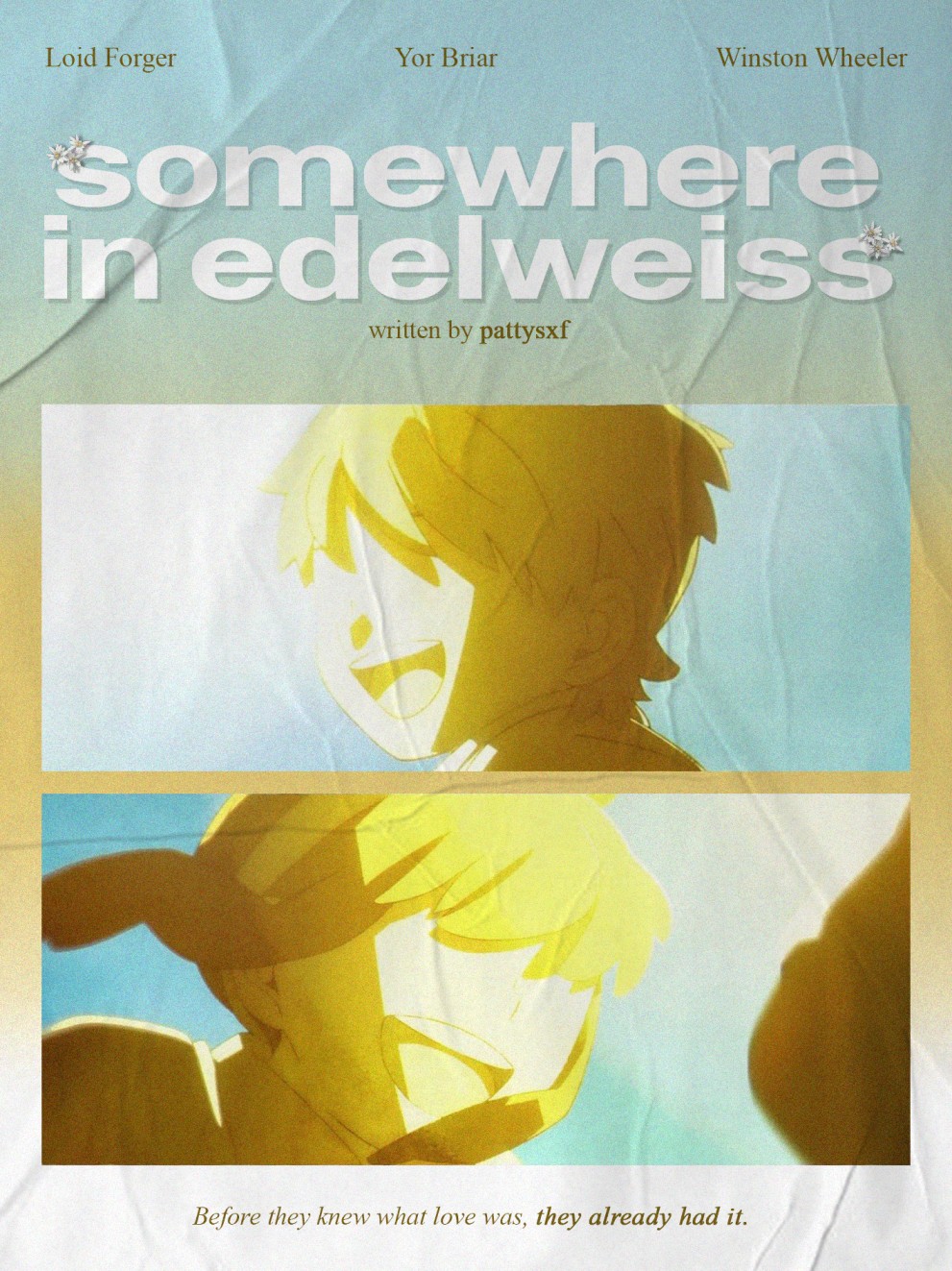

Chapter One - Before We Knew What It Was
“Sweetie, are you listening to Mommy?”
Loid looked up from his book, the sunlight glinting off his glasses. “Sorry, Mama.”
Jasmine smiled, her eyes meeting his through the rearview mirror. The hum of the car filled the silence, broken only by the soft rustle of pages as Loid closed his book and set it on his lap.
“Are you excited?” she asked, voice light. “I heard there are lots of kids in the village. You’ll make plenty of friends.”
Loid shrugged, gaze drifting back to the window. The world outside blurred into shades of green and gold.
“I just hope they like to read,” he murmured.
Jasmine laughed softly—the kind of laugh that made the car feel a little warmer. “I’m sure they will, sweetheart.”
She turned the wheel, the car following a winding road lined with trees in full bloom. For a moment, the radio crackled with a familiar tune—one his father used to play on quiet Sunday mornings—before fading back into static.
“We’re here,” Jasmine said at last.
Loid leaned closer to the glass. Outside, nestled between tall pines and white fences, stood a weathered stone engraved with curling letters:
Edelweiss Village.
“E–del–weiss?” Loid sounded it out carefully, the syllables awkward on his tongue.
Jasmine nodded. “That’s right. Edelweiss. It’s a flower from the mountains.” Her smile softened. “And your reading’s getting so good.”
Loid smiled faintly, though it didn’t quite reach his eyes. At his old school, teachers often said he was smarter for his age, an advanced learner. They’d tell his parents how lucky they were to have a son like him.
He wasn’t sure about that. If he really was their luck, then maybe they wouldn’t have had to move so far away. Maybe his father wouldn’t still be in Westalis.
His chest tightened. He already missed their old house—the sound of his father’s radio in the mornings, the faint smell of coffee that lingered in the kitchen long after sunrise.
The car slowed to a stop in front of a two-storey house with light blue walls and a white picket fence. Jasmine turned off the engine and looked back at him, her smile steady and reassuring.
“Well,” she said softly, “welcome home, Loid.”
Loid followed his mother up the short stone path, his shoes crunching against the gravel. The front door creaked as Jasmine pushed it open, revealing a small but bright living room that smelled faintly of pine and fresh paint.
The afternoon light streamed through the lace curtains, scattering golden patterns across the floorboards. A couch sat in the middle of the room, still wrapped in plastic, and beside it, a stack of boxes labeled Books, Kitchen, and Loid’s Room.
Loid’s eyes landed on the upright piano in the corner. Its dark wood was slightly scuffed, but the keys gleamed as if someone had polished them recently.
“Your father had it sent here last week,” Jasmine said, following his gaze. “He said it wouldn’t feel like home without it.”
Loid walked closer, his fingers hovering just above the keys. He remembered his father playing on quiet Sunday mornings, his mother humming along while making breakfast. For a second, it almost felt like they were all together again.
Jasmine placed the box on the table and smiled softly. “We’ll make new memories here too, okay?”
Loid nodded, though his chest ached a little. “Okay, Mama.”
“Well,” Jasmine said, tilting her head with a bright smile, “want to take a look at your new room while I make us some lunch?”
Loid adjusted his glasses and nodded. “Alright.”
Jasmine brushed a bit of dust off his shoulder before heading toward the kitchen. “It’s the last room at the end of the hallway, sweetie. You’ll know it when you see it.”
Loid slipped off his shoes and padded quietly down the wooden hallway. The floorboards creaked beneath his steps, echoing faintly in the otherwise still house. He passed by framed photos already hung on the wall—some of him as a baby, others from birthdays and family trips. But the most recent one, taken just a few weeks ago, had only him and his mother in it. His father’s absence stood out more than either of their smiles could hide.
He stopped in front of the door with a small sign that read LOID’S ROOM in his mother’s handwriting. Carefully, he turned the knob and stepped inside.
The room smelled faintly of new paint and lavender. His backpack and a few of his favorite books were already stacked neatly on the desk by the window. A soft blue curtain fluttered with the afternoon breeze, and sunlight poured in, spilling across the small bed and wooden floor.
Loid set his book on the desk, then walked toward the window. From there, he could see part of the village—the narrow path winding between cottages, the cluster of children chasing a ball down the road, their laughter ringing through the air.
He watched them for a long moment, unsure whether to wave or hide. He wasn’t used to places this quiet, this close-knit.
But when one of the kids suddenly looked up and noticed him, waving cheerfully, Loid froze—then, awkwardly, raised his hand and waved back.
Somehow, that small gesture made the room feel a little less empty.
That afternoon, once everything was finally unpacked, Loid asked his mother if he could read in the garden. With her help, they set up his small tent beneath the shade of an old oak tree, its white fabric fluttering gently in the breeze.
Soon, Loid was nestled inside, surrounded by the soft rustle of pages and the faint scent of grass. A neat little stack of books sat beside him—his companions for the afternoon.
Loid was halfway through the first chapter when something heavy thudded against the pages of his book.
He flinched, startled, as the object rolled onto the grass beside him—a soccer ball, scuffed and faintly muddy. Blinking, he looked up from his tent to see a boy sprinting across the yard, waving both arms wildly.
“Sorry! Sorry! That was totally an accident!”
Loid adjusted his glasses, carefully brushing a speck of dirt off the page. “It’s alright,” he said softly, though his heart was still beating fast.
The boy pushed open the small wooden gate between their yards and jogged toward him, stopping a few feet away, panting. He had short, sun-streaked blonde hair and bright blue eyes that gleamed with mischief. His face was a little longer than Loid’s, his skin kissed by the sun, and when he grinned, Loid noticed his two front teeth were chipped—like he’d taken one too many tumbles but never stopped smiling anyway.
“Man, I didn’t mean to hit your book,” the boy said, scratching the back of his head. “You okay?”
“I’m fine,” Loid replied, glancing down at the ball. “You play soccer a lot?”
“Every day!” the boy said proudly. “I’m Winston. I live right next door—” he pointed to the house on the left, a white one with a red roof and a bicycle leaning against the fence. “I saw you earlier through the window! I waved, do you remember?”
Loid blinked. “Oh. That was you?”
“Yup!” Winston said with a grin. “Guess you’re my new neighbor now. Welcome to Edelweiss!”
Loid hesitated, then nodded. “I’m Loid.”
“Well, Loid,” Winston said, trying to spin the ball on one finger but failing, “you’ve officially survived your first day here. Most people don’t get a soccer ball to the face until their second week.”
Loid wasn’t sure if that was meant to be comforting, but Winston’s grin was so wide and genuine that he couldn’t help but smile back.
“Do you play?” Winston asked suddenly.
Loid shook his head. “Not really. I like reading more.”
“That’s okay,” Winston said, tossing the ball in the air and catching it behind his back. “You can still hang out with us. We play behind the park every afternoon. You can even read there if you want—I don’t think the others would mind.”
Loid considered it for a moment, his fingers brushing the worn edge of his book. “...Maybe I will.”
“Cool!” Winston said, already backing away toward the fence. “See you around, book guy!”
As Winston jogged off, Loid watched him go, the sun dipping low behind the rooftops. He wasn’t used to people like Winston—loud, bright, and full of energy—but something about him made Edelweiss feel a little less strange.
When Loid looked back down at the faint smudge on his book, he found himself smiling. Maybe, just maybe, he’d made his first friend here.
Two months passed in a blur of unpacked boxes, new routines, and warm afternoons. A week after school started, Edelweiss no longer felt like a strange new place—it felt like home.
Loid and Winston, as fate would have it, ended up in the same class and the same row, two seven-year-olds with very little in common except for the fact that they lived next door. Their teacher often said they were like day and night—Winston with his restless energy and endless grin, and Loid with his quiet curiosity and careful manners.
Still, the two got along better than anyone expected.
Winston always arrived at school with grass stains on his knees and a soccer ball under his arm. Loid, on the other hand, came with neatly combed hair and a book tucked under one arm.
“Do you ever not read?” Winston asked one morning, leaning over Loid’s desk as he flipped through a thick volume about the solar system.
Loid didn’t look up. “Do you ever sit still?”
Winston laughed, unbothered, and somehow that became the rhythm of their friendship—a balance of noise and quiet, motion and stillness.
At recess, Winston dragged Loid into games he didn’t fully understand. The first time Loid agreed to join a soccer match, he spent most of it standing awkwardly in the corner of the field until the ball accidentally rolled his way. Winston yelled for him to kick, and Loid—startled—did exactly that. The ball soared past everyone and right between the makeshift goalposts.
Winston’s jaw dropped before he broke into a cheer loud enough to startle the birds from the trees.
“See?! I told you you’d be good at this!”
Loid blinked, then smiled for real—one of the few times Winston had ever seen him do so.
After that, Loid still preferred reading under the shade of the oak tree, but sometimes, when Winston came knocking on his door, soccer ball in hand and mischief in his grin, Loid would sigh and close his book.
“Fine,” he’d say, pretending to be reluctant. “Just for a few minutes.”
“Which means an hour,” Winston would laugh, already running ahead.
And in return, Winston sometimes joined Loid in quieter moments—lying on the grass as Loid pointed out constellations from his book, or sitting in the tent as Loid read aloud from fairy tales. Winston rarely understood everything, but he liked the sound of Loid’s voice when he got excited about something.
In the evenings, when the sun dipped behind the pines, they’d talk through the fence between their houses. Winston would brag about the goal he scored that day; Loid would share a new word he’d learned. Sometimes, they just sat in companionable silence, watching the fireflies flicker between their yards.
It wasn’t the kind of friendship anyone planned—but it worked. Somehow, in that quiet little village called Edelweiss, a loud, sun-haired boy and a soft-spoken bookworm had found each other.
When winter break came, Loid was crouched by the living room, fumbling with his shoelaces. He bit his lip, trying to recall the exact loop-and-pull technique Winston had taught him—the one that was supposed to make tying shoes “three times faster,” according to his friend.
The doorbell rang once.
Then again.
"Sweetie, can you get that for me?" his mother called from the kitchen.
Loid sighed. He and Winston were supposed to meet up and head to the park to play with the other kids, so it was probably him. But Winston never rang the doorbell. Ever since they became friends, he’d made it a habit to just stroll right in like he owned the place.
Another impatient ring.
“Comin’!” Loid called out, standing carefully and giving his laces one last tug before shuffling toward the door, half-expecting to find his best friend grinning on the other side.
Loid twisted the knob and pulled the door open—only to pause.
It wasn’t Winston.
Standing on the front step was a girl who's probably a year younger than him, wrapped in a puffy red coat that looked a size too big for her. A woolen scarf nearly swallowed half her face, and a few strands of her dark hair—almost black, glossy under the winter light—peeked out from beneath her hat. Her eyes were large and red, the kind that seemed to shine like polished glass, though right now they were wide with nervousness.
She clutched a small tin box tied with a green ribbon, holding it tightly against her chest as if it were a shield. For a second, she just stood there, frozen in place like she’d rehearsed something but forgot it the moment the door opened.
“Um… hi?” Loid said carefully.
The girl startled a little, then quickly bowed—so fast her hat nearly slipped off. “H-hello! I… I just moved next door!” she stammered, her voice soft but trembling with effort. She lifted the tin like it explained everything. “My Mama made cookies—told me to give 'em to you!"
“Oh,” he managed, glancing at the tin, then back at her. “Um… thanks?”
She nodded quickly, her gloved hands fidgeting with her coat. “You’re welcome.” There was a brief silence—awkward, but not unpleasant. The girl’s breath came out in little white clouds, and she rocked slightly on her heels as if waiting for him to say something more.
Loid hesitated, then stepped aside. “Do you… want to come in? It’s cold.”
Her eyes widened. “Oh—n-no, that’s okay! I should go back before Mama worries.” She smiled—small and shy, but it reached her eyes. “Bye!”
“Loid? Do we have a visitor?”
Before the girl could turn away, Loid’s mother appeared in the hallway, wiping her hands on a kitchen towel. Her expression softened the moment she saw the small figure standing on their doorstep.
“Oh, hello there!” Jasmine said, her voice as warm as the sunlight spilling through the window. “Aren’t you just the sweetest thing? What’s your name?”
The girl blinked up at her, clutching her coat a little tighter. “Y–Yor,” she said softly. “Yor Briar. We just moved next door.”
Jasmine’s smile widened. “It’s lovely to meet you, Yor. I’m Mrs. Forger—and this is my son, Loid.”
Loid gave a small, polite nod, unsure what else to do. Jasmine caught the tin her son was holding and giggled.
“Oh! And thank you for these,” Jasmine said, pointing at the tin gently. “Did you bake them with your mama?”
Yor shook her head quickly. “She did! I just helped with the sprinkles.”
“Well, that’s still very important,” Jasmine said with a wink. “Would you like to come in for a bit, sweetheart? I can make some hot cocoa for you, you look cold.”
Yor’s eyes darted between Jasmine and Loid, uncertainty flickering on her face. “I… Maybe next time. I have to help Mama clean the kitchen.”
“Of course,” Jasmine said kindly. “I hope you visit again.”
Yor nodded, bowing again—careful this time not to lose her hat—and scurried down the steps toward the house on the right.
Jasmine watched her go, her smile lingering. “What a polite little girl,” she murmured.
Loid, curious, lifted the lid of the tin. Inside were neatly arranged cookies—some pink, some white, each dusted with sugar that caught the light like tiny crystals. He picked the smallest one, hesitated for a moment, then took a careful bite.
It was soft and buttery, sweet in a way that reminded him of birthdays and quiet afternoons. His lips curved into a small, almost surprised smile.
“They’re good,” he murmured to himself, glancing toward the window where the dark-haired girl had disappeared moments ago.
“Want to take them with you to the park?” his mother asked, kneeling to fix the collar of his coat.
Loid looked down at the tin in his hands, fingers brushing over the lid. He thought for a moment, then gave a small shake of his head.
“I… I want to eat them all by myself,” he said quietly, almost as if confessing a secret.
Jasmine’s smile softened, the corners of her eyes warm. “Alright, sweetheart. Just don’t spoil your appetite before dinner.”
Loid nodded, still holding the tin close to his chest. As his mother turned away, he glanced toward the door again. The pale blue fence of the house next door peeked through the snow—and for some reason, thinking about the girl who had stood there earlier made him smile without realizing it.
“Hello.”
Loid looked up from his book, his breath faint in the crisp winter air. He was seated on one of the benches in their front yard, bundled up in a thick coat and scarf. A small blanket covered his legs, and his book rested open on his lap. Despite the lingering cold, he liked reading outside—the sound of the wind rustling through the pine trees made the pages feel more alive somehow.
He blinked in surprise when he saw who was standing by the fence. It was the girl from a few days ago—the one with the cookie tin.
She stood just behind the low white fence, her gloved fingers gripping the top rail as she peeked in shyly. Her red scarf looked almost too big for her, swallowing half her face, and her dark hair framed her pale cheeks. When she lifted her head, Loid caught the brightness of her wide red eyes—curious and uncertain all at once.
“Yor,” Loid said after a moment, closing his book gently.
Her eyes widened. “You remember my name.”
Loid nodded. “You brought cookies.”
Yor’s cheeks turned pink. “Oh! R-right. Mama made more today, but, um…” She shifted her weight, boots crunching against the frost. “I saw you sitting alone, so I thought… maybe I could say hi.”
Loid tilted his head slightly. “Hi.”
Yor blinked, then smiled—a small, brave curve of her lips. She stared at him for a few seconds, then asked softly, “C-can I come in? Just for a bit? I’ll be quiet.”
Loid hesitated, then nodded once. “Okay.”
Yor pushed the small gate open and carefully stepped inside, brushing snow off her boots before walking over. She stopped beside the bench, looking at him as though waiting for permission again.
“You don’t like the cold?” Loid asked.
“I do,” she said quickly, shaking her head, “but Mama says I’ll get sick if I stay outside too long.” She glanced at the book in his lap, eyes shining. “You must really like books if you’d rather read than play.”
He looked down at the pages, tracing a gloved finger along the text. “They make things quiet,” he said simply. “And they make sense. Even when everything else doesn’t.”
Yor thought about that for a moment. “That’s nice,” she said softly. “I don’t understand books much, but I like when Mama reads me stories about princesses.”
“What kind?”
“The ones where they meet someone kind and brave,” she said, smiling faintly, “and they dance in castles and live happily ever after.”
Loid frowned slightly. “That doesn’t sound very realistic.”
Her smile faltered. “Oh.”
He immediately panicked. “But—but maybe that’s okay,” he said quickly. “Some things don’t need to be real to be nice.”
That earned him a soft laugh. “You talk like a grown-up,” she said, amused.
Loid frowned again. “People say that a lot.”
“I think it’s cool,” Yor replied, stepping closer to peek at the book in his lap. “What’s this one about?”
He turned it so she could see the cover—a deep blue sky dotted with stars, an illustrated boy holding a telescope. “It’s about constellations. They’re stories in the sky. Want to see?”
Yor’s eyes widened. “Stories in the sky?”
Loid nodded and opened the book to a page filled with drawings of bright, dotted patterns. He began explaining the stories behind each one—Orion, Cassiopeia, Lyra—his voice careful and clear. Yor listened intently, her mittens clasped together as she leaned closer, eyes sparkling with wonder.
The afternoon light dimmed into a soft orange glow, snow catching the last of the sun. For a while, neither spoke. The air was cold, but the silence between them felt warm somehow—quiet, like the start of something neither of them had words for yet.
When Loid looked up again, Yor was still watching him, smiling faintly.
“You should tell more stories,” she said quietly. “You make them sound real.”
Loid blinked, caught off guard by the sincerity in her tone. Yor smiled at him—wide, a little uneven, revealing a tiny smudge of chocolate between her front teeth. He almost told her about it, but stopped himself. She looked too happy, too absorbed as she leaned closer, tracing one of the stars in the book with her mittened finger.
“That one looks like a flower,” she whispered, her breath visible in the frosty air. “If I were a star, I’d want to be that one.”
Loid followed her gaze. He didn’t say it out loud, but he thought she already was.
"Who are you, and why are you with my best friend?"
Loid looked up just in time to see Winston stomping toward them across the park, cheeks flushed pink from the cold and eyes narrowed in suspicion. His soccer ball was tucked under one arm, and in the other hand he held a half-eaten meat bun wrapped in paper, steam still rising from it. Snow crunched beneath his boots as he stopped right in front of Loid and Yor, glaring like a guard dog ready to defend his territory.
Loid sighed, already recognizing that tone—Winston’s territorial voice.
Yor startled and took a nervous step back, her gloved hands clasped tightly in front of her. “I–I’m sorry!” she stammered, her breath puffing white in the air. “Mama said I could hang out with Loid since we’re friends—”
“But I’m his friend!” Winston shot back, a crumb of bread flying off his lip as he spoke.
Loid exhaled through his nose, pinching the bridge of it like someone far older than seven. “Winston,” he said patiently, “both of you are my friends. Be nice to Yor.”
That made Winston pause. He frowned, chewing thoughtfully on his last bite of bun as he sized her up. “Yor?” he repeated slowly. “Did you just move in?”
Yor nodded quickly, shoulders hunched under his stare. “W-We just moved here,” she said softly. “I live beside Loid. The one with the pink fence.”
Winston blinked, and then his eyes widened. “Wait—you’re the cookie girl?”
Yor tilted her head. “Um… yes?”
In an instant, Winston’s expression brightened. The suspicion disappeared as fast as it came. “Oh! Your Mama gave me cookies the other day! They were amazing!” He grinned, showing his chipped front teeth. “Do you have more?”
Yor blinked again, then gave a tiny, awkward laugh. “N-not right now…”
“Next time then!” Winston said cheerfully, wiping his hands on his coat. He glanced at Loid with a triumphant look, as if making friends with Yor had been his idea all along.
Loid couldn’t help but smile faintly—Winston’s dramatic mood swings, Yor’s timid laughter, and the way the snowflakes clung to both of their hair made the moment oddly peaceful.
“See?” Loid said. “Not so hard to be nice.”
Winston huffed but didn’t argue. “Yeah, well,” he muttered, kicking at the snow, “maybe she can play soccer with us sometime.”
Yor’s eyes brightened. “I—I can try,” she said softly, her breath clouding the air.
And that was how the three of them—Loid, Winston, and the shy girl from the pink-fenced house—spent their first afternoon together, surrounded by snow, laughter, and the quiet warmth of something new beginning.
Winston, naturally the loudest, declared that they were going to build the “best fort in all of Edelweiss.”
Loid brought logic — “If we build the walls too thin, they’ll collapse,” he reasoned, already sketching a rough plan on the snow with a stick — while Yor brought determination, and surprisingly strong arms for her size.
“Yor, you’re supposed to stack them, not throw them!” Winston yelled as a clump of snow hit him square in the chest. Yor gasped, mortified, but Loid just chuckled softly.
“I think she’s better at defense,” he said, and Winston rolled his eyes.
They worked until the sun dipped low, the air biting at their cheeks and turning their fingers numb inside damp mittens. What began as a simple snow pile turned into something resembling a fortress — crooked, uneven, but theirs. They added tiny flags made from cookie wrappers and popsicle sticks, Winston proudly naming it Fort Friendship while Loid corrected, “It’s not a fort if it collapses under one sneeze.”
By the end of the afternoon, their mittens were soaked, their noses red, and their laughter echoing faintly against the quiet houses of Edelweiss Village.
When Jasmine peeked outside, she saw the three of them huddled close together inside the lopsided fort, sharing a thermos of hot cocoa she had brought out earlier. Winston was laughing about something that probably wasn’t that funny, Yor was shyly smiling behind her cup, and Loid looked… peaceful.
For once, his book lay closed beside him — forgotten in the snow.
The snow that evening fell thicker than usual, blanketing Edelweiss Village in soft white silence. Warm lights glowed from every window, and the faint sound of carols drifted through the air. Inside the Forgers’ cozy living room, a small pine tree stood proudly near the window — a little crooked, but covered with shiny ribbons and handmade ornaments from three pairs of clumsy hands.
Loid adjusted one of the paper stars on the tree while Winston tried to balance on a chair to hang the final ornament at the top. “Careful,” Loid warned, holding the chair steady.
“I am careful,” Winston said, wobbling dramatically before triumphantly hanging the ornament. “See? Perfect!”
Yor clapped softly, her red mittens still on even though they were indoors. “It’s really pretty,” she said, eyes bright as the lights reflected in them. “Like something from a storybook.”
“Because I decorated most of it,” Winston boasted, puffing out his chest.
“You spilled half the glitter on the floor,” Loid pointed out.
“And it looks fantastic, doesn’t it?” Winston shot back.
Jasmine appeared from the kitchen, laughing as she set down a tray of cookies shaped like stars and bells. A gift from Dahlia, Yor's mother, “Alright, you three,” she said warmly, “before you start arguing about who gets credit, why don’t you help me set the table?”
The three scrambled to obey — Yor carefully arranging napkins, Loid lining up the cups by size, Winston sneaking a cookie when he thought no one was looking (he was, in fact, very obvious).
When dinner came, it was simple but perfect — roasted chicken, mashed potatoes, and a pie that filled the whole house with the warm scent of cinnamon. The sound of laughter and clinking silverware wrapped around them like a blanket, drowning out the quiet hum of winter beyond the frosted windows.
The Forgers’ living room had never felt so full. Winston’s parents had brought extra bread and hot chocolate, while Yor’s mother arrived with a tray of homemade cookies that looked almost too pretty to eat. The adults chatted easily over wine and stories about the village, while the kids sat at the smaller table nearby, sneaking glances at the desserts they weren’t supposed to touch yet.
Loid sat quietly for a moment, taking it all in. It was the first Christmas he could remember that didn’t feel quiet or small. Back then, it had always been just him, Mama, and Papa — though sometimes Papa was called to the hospital, leaving only the two of them to share dinner by the tree.
He used to think Christmas was supposed to be peaceful. But now, as Winston tried to steal Yor’s last piece of pie and she swatted his hand away with a muffled “Hey!” — Loid realized maybe it was supposed to be loud. Messy. Full of warmth and noise and people who made the house feel alive.
Jasmine was laughing at something Winston’s father said. Yor’s mother was showing her how to make the perfect pie crust. The whole room seemed to glow a little brighter, filled with the smell of food and the sound of familiar voices.
And even though Papa wasn’t there, Loid didn’t feel sad this time.
Not when Winston was laughing through a mouthful of crumbs.
Not when Yor leaned over to offer him the last cookie with that shy, gentle smile.
For once, Loid wasn’t just content.
He was happy.
Afterward, they gathered back near the tree. Winston played with his soccer ball even indoors (“Just one kick!” he promised — a lie), Loid read from one of his Christmas storybooks, and Yor listened, chin resting on her knees, her eyes shining with wonder.
When the clock struck midnight, they went outside. Snow was still falling, soft and slow. Winston threw the first snowball, of course, and Loid retaliated before Yor joined in, giggling so hard she slipped on the snow.
Jasmine watched from the doorway, her scarf wrapped around her shoulders. The children’s laughter carried through the quiet village, echoing off the snowy rooftops.
Later, when they were too tired to move, the three sat together on the porch steps, wrapped in a single blanket.
“Merry Christmas,” Yor whispered sleepily.
“Merry Christmas,” Loid echoed.
Winston grinned, leaning back against the steps. “Best Christmas ever.”
“Why can’t I come?” Yor asked, watching Loid neatly tuck his new notebooks into his backpack—a gift from his Mama. The bag still smelled faintly of new leather, and the tags hung loosely from one of the zippers.
“Because,” Loid said as he zipped it up, “you’re not going to school yet. Your Mama said next year, remember? Winston and I will be ahead of you for a while.”
Yor sighed, her fingers absentmindedly tugging at the edge of his bedsheet. “But… what if you and Winston forget about me?”
Her voice came out small, the kind that made Loid pause mid-motion. He turned to look at her—her cheeks slightly puffed in a pout, her feet swinging just above the floor as she sat on the edge of his bed.
He frowned a little. “We won’t forget you,” he said simply, as if the idea itself didn’t make sense.
“But you’ll be gone the whole day,” she said softly, her voice wavering just enough to make him glance up again. “And you’ll make new friends, and then when I go to school, you won’t want to play with me anymore.”
Loid adjusted his glasses, thinking hard — because she looked like she was really sad. “That’s not true,” he said after a moment, his tone firm, logical. “Winston’s my best friend. And you’re my friend too. Friends don’t forget each other.”
Yor looked unconvinced, still tracing invisible lines on his blanket.
“Tell you what,” Loid added, kneeling down to grab one of his notebooks. He tore out a blank page and wrote something carefully at the top before folding it twice and handing it to her. “Here.”
She blinked at the paper. “What is it?”
“It’s a promise,” he said. “When you go to school next year, we’ll walk together. Every day.”
Yor hesitated, then smiled — the small, shy kind that made her eyes look even brighter. “Promise?”
“Promise,” he said.
Just then, Winston’s voice rang out from outside the room—loud and impatient as always.
“Loid! Come on! We’re gonna be late!”
Loid slung his bag over his shoulder, giving Yor one last look before heading for the stairs. She followed him quietly, her small footsteps echoing after his.
In the living room, Jasmine was already waiting by the door. Yor immediately went to her, wrapping her arms around the woman’s leg as she looked up at Loid with glassy eyes.
“Winston’s mama will take you both to school, okay? Behave,” Jasmine said warmly, glancing at the boys before adding with a teasing smile, “Especially you, young mister.”
Winston puffed out his chest. “I am always behave!” he declared proudly—earning a laugh from both mothers and an eye roll from Loid.
Then Winston noticed Yor clinging to Jasmine’s leg, her lower lip trembling. His grin faded as he turned to Loid, frowning. “Oy! Why’d you make Yor cry?!” he accused, giving Loid a light punch on the arm.
Loid scowled, rubbing the spot. “I did not!” he shot back, glaring at his friend. “She’s just sad because she can’t come with us.”
Yor sniffled softly, confirming Loid’s words—and Winston, suddenly looking guilty, scratched the back of his neck.
“Ah,” Winston said, his voice smaller now. “Well… that’s okay. You can still play with us after school!”
Yor looked up, her eyes brightening just a little. “Really?”
“Yeah!” Winston grinned, puffing his chest again as if making a royal decree. “We’ll tell you everything that happens! And maybe…” He turned to Loid, “we can even teach her what we learn, so when she goes to school next year, she’s already the smartest kid there.”
Loid raised a brow but smiled faintly. “That’s actually not a bad idea.”
Yor’s lips curved into a shy smile. “Then… promise?” she asked, holding out her pinky.
Loid blinked, then linked his with hers. “Promise.”
Winston quickly shoved his hand in too. “Hey! Me too!”
Their three pinkies tangled together awkwardly—Winston’s too firm, Yor’s too gentle, and Loid’s perfectly in between.
Jasmine and Winston’s mother watched from the doorway, exchanging amused glances as the trio sealed their tiny pact.
“Alright, little scholars,” Jasmine said, crouching to fix Loid’s shirt. “Time to go before you really are late.”
As Loid and Winston stepped outside into the cold morning air, Yor waved from the porch.
Loid turned once before the gate and waved back. “See you later, Yor!”
Yor beamed, the sadness in her eyes gone—replaced by something warm and certain. “See you later, Loid!”
The Briars’ backyard had never looked so magical. Pink streamers hung from the fence, fairy lights twinkled across the bushes, and a small paper banner read “Happy 7th Birthday, Princess Yor!” in big, glittery letters. The smell of vanilla frosting and freshly baked cookies filled the crisp spring air.
Yor twirled near the little stage her Mama set up, her blue gown puffing around her knees, the satin catching the sunlight. She looked every bit like Sleeping Beauty—her hair tied with a pink ribbon, a cardboard crown slightly crooked on her head.
“Wow,” Winston said dramatically as he strutted over in his black cape, holding a stick he’d stolen from the garden. “If I’m the evil fairy, I should at least get my own throne.”
“You don’t get a throne,” Loid said flatly, tugging on his velvet vest. His costume had clearly been put together by someone who cared too much—his Mama. He looked like a tiny prince, cape pinned perfectly, boots polished.
Winston crossed his arms. “What’s the point of being Maleficent if I can’t be cool?”
“You get a staff,” Loid said, nodding toward the stick. “That’s pretty cool.”
Winston narrowed his eyes, then smirked. “Fine. But only because I’m letting you win this time, Prince Loid.”
Loid rolled his eyes, but before he could respond, Yor giggled. “You both look really nice.”
Both boys froze, caught off guard by her sudden sweetness. Winston immediately grinned and puffed his chest. “I know I do.”
Loid glanced down at his gloves, cheeks faintly pink. “You look… nice too, Yor.”
Her smile widened. “Thank you.”
The party soon began in full swing—kids from the neighborhood gathered around for games, snacks, and the big event: the fairy tale play Yor’s Mama had helped them rehearse. Winston took his “villain” role far too seriously, delivering his lines with loud, exaggerated flair. Loid, ever composed, tried to keep the story on track, while Yor played her part perfectly—graceful, shy, and radiant.
When Loid leaned down to “wake” her from her pretend slumber with a tap of his glove against her hand, the crowd of parents awwed loudly. Winston groaned behind them, muttering, “Ugh, gross. I’m turning her back into a frog next time.”
After the laughter died down, they all ran toward the dessert table. Yor sat between them as everyone sang, the candles flickering in front of her. She closed her eyes, made a wish, and blew them out in one breath.
“What did you wish for?” Winston asked immediately.
Yor shook her head, smiling. “Can’t say, or it won’t come true.”
Loid smirked. “Then it must be something important.”
“It is,” Yor said softly, looking between the two boys before biting into her cake. “Really, really important.”
Neither Loid nor Winston pressed further. They didn’t need to. The way she smiled—bright and content—was enough to make the moment feel like magic all on its own.
Every week, the Forgers’ yard became their little world. It was the biggest one on the block—wide enough for running, playing tag, or setting up the “headquarters” of whatever imaginary mission Winston had come up with that day.
This time, however, Winston showed up at Loid’s gate dragging his father behind him.
“Mr. Forger! Can we borrow your hammer?!” Winston shouted before Loid even got a word out.
Loid blinked, clutching the smaller tent he’d already unpacked. “Winston, why’d you bring your Papa? I already have a tent.”
“Yeah,” Winston said, hands on his hips, “but yours is too small for the three of us. I can’t even stretch my legs in there!”
“It’s not that small,” Loid muttered.
Winston’s Papa chuckled, setting down the folded canvas he had been carrying. “Sounds like we’ll just have to make a new one, then. Something bigger for all of you.”
And so, the backyard transformed into a miniature construction site—ropes, poles, and laughter scattered everywhere.
“Pull the rope tighter!” Winston said, frowning as the pole wobbled dangerously.
“I am pulling,” Loid grunted, his small hands red from the effort.
Yor held the other end, biting her lip in concentration. “Maybe it needs… friendship power?”
That made Winston snort. “It needs actual power.”
The pole tilted again, nearly toppling over, and Yor squeaked as Loid jumped to catch it. “Winston!” Loid scolded. “You didn’t tie it properly!”
“I did! You just don’t know how knots work!”
“Do too!”
Their bickering only stopped when Winston’s Papa knelt beside them, chuckling. “Alright, before one of you ties me into a knot, let’s fix this.”
With a few quick adjustments and a firm tug, the canvas finally stood upright—a proud, sturdy tent in the middle of the Forger yard.
All three kids cheered like they’d just built a fortress.
Once it was up, they crawled inside with snacks, coloring books, and flashlights—even in the middle of the day. The space smelled like grass and cookies, with sunlight filtering through the cloth walls. Loid lined up his books neatly in one corner, Yor arranged the snacks (with the apple juice Loid had brought), and Winston declared himself “Captain” of whatever adventure they were having that week.
“Today,” he said, holding up a stick like a sword, “we’re explorers on a secret mission!”
Yor gasped dramatically. “What kind of mission?”
“The kind where no one leaves until snack time,” Loid deadpanned, earning a giggle from Yor and a groan from Winston.
By the time Winston’s Papa peeked in to check on them, all three were lying on their bellies, drawing maps on old newspaper sheets and whispering plans about buried treasure.
The tent became their castle, their spaceship, their pirate ship—whatever their imaginations decided it to be. And in the middle of it all, surrounded by laughter and the smell of warm grass, they were just three kids who never wanted the afternoon to end.
It was one of those golden afternoons that felt endless—the kind that smelled of cut grass, grilled food, and summer laughter. The Forgers’ yard was alive with chatter. Folding chairs were arranged in a loose circle beneath the shade of the acacia tree, and the long picnic table overflowed with food the mothers had brought: sandwiches, fruit salad, grilled corn, and lemonade that glistened in glass pitchers.
The Wheelers, the Briars, and the Forgers had all gathered together—a familiar sight in the neighborhood whenever the kids found a new reason to celebrate. This time, it was simply because the weather was too perfect to waste indoors.
Yor’s Mama, who is pregnant with their second child, sat beside Mrs. Wheeler, exchanging recipes between giggles, while Winston’s Papa was busy telling a story that had both women laughing. Yor’s Papa, meanwhile, leaned back in his chair, watching the children from a distance with an amused smile.
Loid, Yor, and Winston were sprawled across the grass, busy arranging toy soldiers, sticks, and rocks in what they called their “mission base.” Every few minutes, they’d erupt in bursts of laughter as Winston changed the rules again.
“Yor, you’re the captain this time!” Winston declared.
“But I was captain last time,” Yor protested, though she was grinning.
“That’s why you’re the best one,” he replied matter-of-factly.
Loid sighed in mock defeat. “Then what am I supposed to be?”
Winston thought for a second, eyes lighting up. “You’re the engineer. You build the base.”
Loid’s lips twitched. “Fine. But next time, I’m captain.”
The adults watched them with fond smiles, and Yor’s Papa finally spoke, his voice warm with nostalgia. “You know, watching them like that reminds me of when my brothers and I used to build forts in our yard. We didn’t have fancy toys back then, so we built our own fun.”
Mrs. Wheeler smiled. “What did you build them with?”
“Wood scraps, mostly,” he replied with a small laugh. “And a lot of imagination. We even had a treehouse once—nothing fancy, but it was ours. I think it stood for years before the rain finally took it down.”
Yor’s Mama turned to him, amused. “You’re getting ideas again, aren’t you?”
He chuckled, leaning forward. “Maybe I am. Those three could use something like that. A little place of their own.”
Jasmine Forger looked surprised but delighted. “A treehouse?”
“Why not?” he said, already glancing toward their yard across the fence. “We’ve got that big narra tree behind our house—it’s sturdy, shaded, and close enough that you can hear them from here. I can handle the building part.”
Winston’s Papa grinned. “And I can help with the tools. Haven’t built one since I was a kid.”
“Count me in for painting,” Yor’s Mama added.
Before long, the conversation turned into plans—who would bring what, how to make it safe, and when to start.
Across the lawn, the children had stopped playing and were now listening, curiosity lighting up their faces.
“Wait—what are you building?” Loid asked, running over.
“A treehouse,” Yor’s Papa announced with a grin. “If you three promise to help, of course.”
Yor gasped. “Really?”
Winston threw his hands in the air. “A real one? With stairs and windows?”
“If we do it right,” Yor’s Papa said, “maybe even a flag.”
The three kids exchanged wide-eyed looks—the kind that only children could share when something magical was about to begin.
And so, by the end of that afternoon, the Forgers’ laughter drifted into the Briars’ yard, carried by the promise of sawdust, paint, and a new adventure waiting to take shape among the branches of an old narra tree.
Whenever their families went to the park together, Winston was always the first to sprint off—his soccer ball tucked under his arm, already yelling for other kids to join him before the adults could even finish unpacking the picnic basket.
Loid, on the other hand, preferred quieter company. He stayed behind, sitting cross-legged beside Yor at the edge of the meadow while the sun poured over them like warm honey. The two of them sat close, their shoes buried halfway in the grass, the hum of cicadas weaving through the air.
“These are for the crown,” Yor said softly, clutching a handful of daisies, buttercups, and tiny pink blooms she had carefully gathered.
Loid frowned as he inspected one. “They’re too small,” he said matter-of-factly.
Yor giggled. “Then you just have to make more.”
With a quiet sigh, he began helping her, his small fingers clumsy at first as he tried to twist the stems the way she did. Yor leaned in, watching him with a kind of admiration she didn’t yet know how to name. He furrowed his brows, tongue peeking slightly from the corner of his mouth in concentration.
“You look funny when you’re serious,” she teased.
“I’m not funny,” he muttered, still focused on the flowers.
“Yes, you are,” she said with a little grin.
They sat there for what felt like hours—Loid weaving, Yor choosing the prettiest flowers to add. Occasionally, Winston’s voice would echo from across the park, shouting, “Goal!” followed by a chorus of cheers, but neither of them seemed to hear.
When they finally finished, Yor held up the crown proudly. “See? It’s perfect!”
“It’s crooked,” Loid said, though his voice softened when she frowned.
“Then you fix it,” she said, holding it out to him.
Loid hesitated, then reached over and placed the flower crown gently on her head, making sure it sat just right. The petals brushed her bangs, and the sight made something unfamiliar flutter in his chest.
“There,” he said quietly. “Now it’s perfect.”
Yor beamed. “Your turn!”
Before he could protest, she grabbed the remaining flowers and quickly fashioned a second crown—messier this time, but made with the same care. She stood on her tiptoes and placed it on his head, her fingers brushing his hair.
“There,” she said, copying his tone with a grin. “Now you’re perfect.”
Loid’s ears turned a faint pink, but he didn’t move to take it off. Instead, he smiled—a rare, genuine kind of smile that reached his eyes.
When Winston came running back, sweaty and grass-stained, he stopped mid-stride and burst out laughing. “What are you two supposed to be? Flower king and queen?”
Yor placed her hands on her hips. “No, we’re—”
Loid cut in, deadpan, “Don’t say it.”
But Yor said it anyway, grinning from ear to ear. “We’re royalty!”
Winston snorted and ran past them again, muttering something about “royal weirdos,” but the two didn’t mind. They stayed in the grass a little longer, side by side, their crowns of wildflowers glowing softly under the late afternoon sun.
And later, when their parents called them for snacks, Yor tugged Loid’s hand and whispered, “Don’t take it off yet.”
He didn’t.
Yor was the kind of friend who noticed the small things. She always brought mosquito repellent patches in her little bag and would stick them on Winston’s sleeve and Loid’s collar before they started playing.
“Just in case,” she’d say seriously.
“Do I look like a bug magnet to you?” Winston would complain.
“Yes,” both Loid and Yor would answer in unison.
Loid, in turn, had his own quiet gestures. He always carried an extra pack of apple juice in his backpack, even when he swore he forgot.
“Is that for me?” Yor asked the first time he handed one over.
He shrugged. “You like apples.”
She smiled so brightly that he started bringing them every time after that, no questions asked.
Of course, Winston couldn’t go long without chaos. He loved pranking the two—switching their favorite snacks, jumping from behind the bushes yelling “Boo!”, or switching Loid’s book pages around when he wasn’t looking.
The worst was the time he tied their shoelaces together when they were in the Wheelers' yard.
Loid stood up first and immediately pulled Yor down with him.
“Winston!!”
Winston laughed so hard he fell backward into the grass. “You two should see your faces!”
Loid glared, brushing dirt off his sleeve, while Yor tried (and failed) to stop giggling. “It’s not funny,” Loid muttered—but the small smile tugging at his mouth said otherwise.
They grew up—between treehouse meetings, flower crowns, pranks, and shared apple juice boxes.
Even if they didn’t realize it then, those small, ordinary days were becoming something extraordinary: the kind of memories that would last far beyond the fleeting years of childhood.