Work Text:
William Jakrapatr had never believed in the kind of friendships people wrote songs about.
Perhaps it was because he had spent most of his life alone—not physically, because there had always been people around him, classmates filling rows of desks, relatives gathering during holidays, professors who knew his name because he consistently ranked at the top of every class—but emotionally, there had always existed an invisible distance between William and the rest of the world, a carefully maintained barrier built from years of quiet routines and guarded silences. He preferred books to conversations, libraries to parties, and the familiar comfort of solitude to the unpredictability of people. It was simpler that way. Safer.
University, he had assumed, would be no different.
On the first day of his freshman year, William arrived forty minutes early to his introductory literature lecture, dressed neatly in a pressed white shirt and dark jeans, a notebook already open on his desk as he reviewed the syllabus that had been emailed weeks prior. The lecture hall was still mostly empty, the soft murmur of arriving students blending with the distant hum of air conditioners, and for a brief moment, as sunlight streamed through the tall windows overlooking the campus courtyard, William allowed himself to believe that this year would proceed exactly as he had planned.
Quietly.
Predictably.
Without incident.
Then Est Supha arrived.
The lecture had already begun when the doors burst open with enough force to make nearly everyone in the room turn around. A boy stood in the doorway, slightly breathless, dark hair hopelessly disheveled as though he had just lost a battle against the morning wind, a camera hanging carelessly around his neck and an apologetic smile stretched across his face.
"Sorry, Professor," he said, entirely unapologetic. "I got lost."
The professor sighed the exhausted sigh of a man who had already decided that this student would be the source of many future headaches. "It's the first day, Mr. Supha. I'll let it slide."
"Thank you, sir," Est replied brightly before scanning the room.Unfortunately for William, the only empty seat left happened to be the one beside him.Without hesitation, Est hurried down the stairs and dropped into William's chair.
William stared. "You're sitting in my seat," he said after a moment.
Est blinked."Oh"
William waited.
"So?" Est asked.
"So, that's my seat."
Est looked around at the nearly identical rows of chairs before turning back to William with a grin so effortlessly charming that William disliked him immediately.
"Then you can sit next to me."
It wasn't a request.
William spent the rest of the lecture trying very hard to ignore him.It proved impossible.
Est tapped his pen against the desk whenever he became bored, scribbled little stars in the margins of his notebook instead of taking actual notes, and somehow managed to whisper an endless stream of commentary despite William's increasingly obvious attempts to discourage conversation.
"Do you think professors secretly enjoy making students suffer?" Est whispered twenty minutes into the lecture.
William continued writing.
"I think they do."
Silence.
"My name's Est, by the way."
Silence.
"You don't talk much, huh?"
William finally looked up. "No."
Est's smile widened as though he had just accomplished something extraordinary.
"Great. We're friends now."
William had never heard a more ridiculous statement in his life.
And yet, somehow, Est meant it.
Over the following weeks, William discovered that Est possessed an alarming inability to respect personal boundaries. He appeared everywhere. In the library, where he would collapse dramatically across the chair opposite William and complain about assignments while stealing fries from William's lunch. Outside lecture halls, waiting with two iced coffees despite William never asking for one. At the campus bookstore. The cafeteria. The convenience store near the dormitories.
At some point, William stopped questioning it.
At some point, he started waiting for it.
Their friendship grew quietly, almost imperceptibly, woven together through countless ordinary moments that, years later, William would remember with painful clarity. Midnight walks to twenty-four-hour convenience stores because Est suddenly wanted instant noodles at two in the morning. Long study sessions that inevitably dissolved into conversations about dreams, fears, and futures neither of them had yet lived. Rainy afternoons spent hiding beneath the rooftop shelter of the arts building while Est photographed storm clouds and insisted that every picture told a story.
"Pictures preserve things," Est explained one evening, camera raised toward a sunset painted in shades of gold and amber. "Moments disappear too quickly. I don't want to forget."
William had looked at him then—at the sunlight caught in his hair, at the sincerity softening his features—and thought, absurdly, that forgetting Est would be impossible.
He said nothing.
He rarely did.
Est never seemed to mind.
Spring arrived during their second year.
The campus transformed almost overnight, trees awakening in bursts of green while warm breezes carried the scent of blooming flowers through pathways crowded with students preparing for midterms. It was Est who discovered the hill entirely by accident during one of his spontaneous explorations.
"Come with me," he demanded one Saturday afternoon, appearing outside William's dorm room with his camera and an expression that meant resistance was futile.
"Where?"
"It's a surprise."
"I have an assignment."
"You can suffer academically later."
Against his better judgment, William followed.
The climb was longer than expected, leading them beyond the main campus buildings, past abandoned sports fields and narrow dirt paths overgrown with wild grass. William complained exactly twice. Est ignored him both times.
When they finally reached the top, William understood why.
Standing alone against the pale blue sky was a cherry blossom tree.
It was older than anything surrounding it, its branches wide and weathered, pale pink petals drifting lazily through the spring air like fragments of forgotten dreams. Beneath it sat a worn wooden bench, half-hidden beneath years of fallen blossoms.
"It's beautiful," William whispered before he could stop himself.
Est smiled.
"I knew you'd like it."
For a long moment, neither of them spoke. They simply stood beneath the blossoms, listening to the wind move softly through the branches overhead.
Then Est held out his hand.
"Promise me something."
William looked at him. "What?"
"No matter what happens to us after university—whether we move to different cities, get busy, or life becomes complicated—let's come back here every spring."
William stared at the outstretched hand before taking it.
"Okay," he said quietly.
Neither of them knew then that some promises were destined to outlive the people who made them.
———————
If someone had asked William Jakrapatr when exactly he had fallen in love with Est Supha, he would not have been able to answer.
Love, he would later realize, had not arrived all at once. There had been no singular moment, no dramatic revelation accompanied by fireworks or music swelling in the background as romance novels often promised. Instead, it had settled quietly into the spaces between ordinary days, weaving itself so naturally into the fabric of William's life that, by the time he recognized it, it had already become inseparable from him.
Perhaps it had begun during their second year, on a rainy evening when William had developed a fever just days before final examinations. He had fully intended to suffer through it alone, armed with painkillers, lecture notes, and stubborn determination, until someone had begun pounding relentlessly on his dorm room door.
William had opened it to find Est standing there, drenched from the rain, carrying three plastic bags filled with medicine, soup, fruit, and enough snacks to survive an apocalypse.
"You didn't answer your messages," Est had scolded, pushing past him into the room. "Your roommate said you hadn't left all day. Honestly, William, if you're dying, the least you could do is inform your best friend."
"I'm not dying."
"You look terrible."
"I have a fever."
"Exactly."
William had expected Est to leave after dropping off the supplies.
He hadn't.
Instead, Est had stayed the entire night, forcing William to eat, changing the cold compress on his forehead every hour, and eventually falling asleep in the uncomfortable chair beside William's bed sometime after midnight, his head resting awkwardly against folded arms.
William had woken at dawn to find sunlight spilling across the room and Est still asleep beside him.
For reasons he had not understood at the time, his chest had ached.
Or perhaps it had begun during their third year, when William had casually mentioned missing his grandmother's cooking during a conversation weeks earlier, only to find Est waiting outside his afternoon lecture with homemade lunchboxes.
"My mother helped," Est had admitted sheepishly when William stared.
"You made this?"
"Yeah."
The food had been terrible.
William had eaten every bite.
Or perhaps—and this was the possibility William tried hardest not to think about—it had begun beneath the stars.
Stargazing had become something of a tradition between them over the years. Whenever academic stress threatened to overwhelm them, Est would drag William to the rooftop of the engineering building, armed with snacks, blankets, and an unreasonable amount of enthusiasm.
"You're overthinking again," Est said one night during their final year, lying flat on his back as he gazed up at the endless expanse of stars above them.
William turned his head. "How do you know?"
"You make this face."
"What face?"
"This one." Est furrowed his eyebrows dramatically.
William rolled his eyes. "I don't make that face."
"You absolutely do."
Silence settled comfortably between them, no longer awkward as it had been years earlier. They had long since mastered the art of existing together without the need to constantly fill every quiet moment.
The city stretched beneath them, glittering with thousands of lights.
"Are you scared?" Est asked suddenly.
William frowned. "Of what?"
"Graduating."
William considered the question.
"A little."
Est hummed softly. "Me too."
It was the first time William had ever heard uncertainty in Est's voice.
"What are you scared of?" he asked.
Est remained silent for so long that William thought he might not answer.
"That things will change," he finally admitted. "Everyone always says university friendships don't last. People move away, get jobs, fall in love, start new lives." He paused before adding quietly, "I don't want to lose this."
William knew exactly what he meant.
He felt it too.
The approaching end of university lingered over their final year like an invisible countdown, each passing day carrying them closer to a future neither of them felt entirely prepared for. The thought of no longer seeing Est every morning, no longer sharing meals, conversations, or spontaneous adventures with him, filled William with a strange and inexplicable sense of grief.
It frightened him. Because friendships were not supposed to feel like this.
One evening, only weeks before graduation, William finally understood.
He had been sitting alone in the library when he happened to glance out the window overlooking the campus courtyard. Est was standing outside, laughing at something another student had said.
It should have been an entirely ordinary sight.
Instead, William found himself thinking, with startling clarity, that if someone else ever made Est happier than he could, he would still want Est to choose happiness.
The realization struck him with all the force of a collapsing star.
He loved him.
Not as a friend.
Not as the person who had accidentally wandered into his life four years ago and refused to leave.
He loved Est completely.
And it terrified him.
William spent the following weeks avoiding the truth as best he could. He answered messages later than usual. Declined invitations. Buried himself in coursework despite having already secured excellent grades.
Est noticed immediately.
"You've been weird lately," he announced one afternoon.
William nearly dropped his coffee. "I'm not weird."
"You are. You've barely spoken to me all week."
"I've been busy."
Est narrowed his eyes suspiciously. "Liar."
William looked away.
Because he was.
The problem was simple...he loved Est too much to risk losing him. Confessing would change everything. If Est didn't feel the same, William would lose the most important person in his life. If Est did....William couldn't allow himself to consider that possibility.
Graduation arrived in a blur of celebrations, photographs, and tearful farewells.
A week later, as spring painted the campus in soft shades of pink once more, Est texted him.
Meet me at our tree?
William almost said no.
Instead, he went.
The hill looked exactly as it always had.
Cherry blossoms drifted lazily through the afternoon air, gathering around the old wooden bench in delicate pink waves. Est was already there, sitting beneath the tree with his camera beside him.
"You came," Est said softly.
"Of course I did."
For a moment, neither spoke.
Then Est laughed nervously.
"William, do you remember our first day?"
William nodded.
"You stole my seat."
"You were very rude about it."
"You deserved it."
Est smiled, but there was something fragile beneath it.
"I've been trying to figure out how to say this for months."
William's heart stuttered.
"Say what?"
Est looked up at him then, and William suddenly understood why poets compared love to sunlight. Because Est had always looked like dawn.
"I think," Est said quietly, "I've been in love with you since the day you asked for your seat back."
The world stopped.
William stared at him.
Est laughed shakily, though tears had already begun gathering in his eyes.
"You don't have to say anything. I know this is sudden and I don't want things to become awkward, but I couldn't graduate without telling you because if I spend the rest of my life wondering what would have happened if I'd just been brave enough—"
He never finished.
Because William was crying.
And a second later, he was kissing him beneath a rain of cherry blossoms.
For the first time in his life, William allowed himself to believe in forever.
𐙚 ⋆。˚ ♡ ˚。⋆ 𐙚
Three months after graduation, William found himself living a life he had once believed existed only in daydreams.
The apartment he shared with Est was small, tucked away on the fourth floor of an aging building a few streets away from the city center, but to them it was perfect. The kitchen was barely large enough for two people to stand in comfortably, the bathroom door refused to close properly unless it was kicked twice, and the water heater possessed a deeply personal grudge against mornings. Still, every imperfection somehow made the place feel more like home.
Perhaps it was because they had built that home together.
The living room was cluttered with books stacked haphazardly on every available surface, photographs Est had insisted on printing and framing covered the walls, and an alarming number of potted plants occupied nearly every windowsill despite William's repeated insistence that eleven plants were excessive for two people.
"They make the apartment look alive," Est had argued while carefully watering a fern he had named Sir Leafington.
"Plants don't need names."
"Everything needs names."
"The cactus tried to stab me."
"You hurt his feelings."
William had simply sighed.
Est had taken that as permission to buy two more plants.
Living with Est was, William had discovered, an exercise in surrender.
Not the painful kind, but the soft, inevitable kind that came from loving someone so thoroughly that their habits slowly became woven into the fabric of your own life. William no longer minded waking up to find Est sprawled diagonally across the bed, stealing ninety percent of the blanket while somehow remaining convinced that he was the victim. He no longer questioned why there were always half-finished rolls of camera film scattered across the apartment or why the refrigerator contained more iced coffee than actual food.
This was simply life now. And William loved it.
Their first anniversary was approaching. The realization still felt surreal.
One year.
One year since a confession beneath falling cherry blossoms had transformed a friendship into something deeper, something so precious that William still occasionally caught himself staring at Est and wondering how he had become lucky enough to be loved by him.
To celebrate, they had planned a week-long trip to the countryside where spring arrived later and cherry blossoms bloomed against mountain landscapes. Est had spent nearly a month researching every detail, compiling lists of places they absolutely had to visit.
William had walked into the living room one evening to discover spreadsheets.
Color-coded spreadsheets.
"Should I be concerned?" William had asked.
Est looked up from his laptop, offended. "Excuse you, this is organization."
"You made an itinerary."
"An efficient itinerary."
"There are time slots."
"There are also backup plans."
William had laughed.
"You know vacations are supposed to be relaxing, right?"
"They are relaxing. For you. I do all the planning."
"You enjoy planning."
"I do," Est admitted immediately. "But that's not the point."
The morning began like countless others before it.
William woke first, as he usually did.
Soft sunlight filtered through partially drawn curtains, painting warm streaks across the bedroom walls. Beside him, Est remained fast asleep, face buried halfway beneath a pillow, dark hair falling messily over his forehead.
William lay there for a moment, simply watching him.
There had once been a time when William believed he would eventually grow used to this—to waking up beside the person he loved, to sharing a home, to the quiet intimacy of ordinary mornings.
He never did. Every day still felt miraculous. As though happiness had somehow mistaken him for someone else. Est stirred. Slowly, one eye opened. "Why are you staring at me?" he asked, voice thick with sleep.
"I wasn't."
"You were."
"I was making sure you were still alive."
Est frowned. "That's romantic."
"You drool in your sleep."
"You're lying."
"I'm not."
"You love me."
William smiled despite himself.
"I do."
Est grinned immediately.
"See? Crisis solved."
Breakfast was a chaotic affair as usual.
Est insisted on making pancakes despite possessing only a vague understanding of measurements and an alarming tendency to improvise recipes. William eventually intervened after discovering Est attempting to substitute cinnamon for baking powder.
"You cannot just replace ingredients because you feel like it."
"Cooking is art."
"Cooking is chemistry."
"You're ruining my creative process."
"Your creative process nearly poisoned us."
They ended up eating toast instead.
Around eight-thirty, Est disappeared into the bedroom to get dressed while William remained at the dining table answering work emails. Their new jobs had kept them busier than expected, and although William genuinely enjoyed his work, Est had recently begun complaining that he spent too much time staring at screens.
A few minutes later, Est reappeared wearing one of William's old university sweatshirts.
William raised an eyebrow.
"Again?"
Est looked down innocently.
"What?"
"That's mine."
"It's ours now."
"You own perfectly good clothes est."
"None of them smell like you."
William felt warmth rise immediately to his face.
Est laughed.
"Cute."
"I'm taking it back."
"No, you're not."
"Est."
"Too late. Shared property."
Some arguments had long since become traditions.
Near the front door, Est searched frantically for his keys while balancing a cup of coffee in one hand and his camera in the other. "Have you seen my wallet?" he called. William looked toward the kitchen counter.
"It's next to the fruit bowl."
"Oh."
A pause.
"Found it."
Another pause.
"Actually, no, that's a banana."
William shook his head.
"It's under the banana."
"Oh."
Est sounded delighted.
"You're incredible."
"I know."
By the time Est finally located everything, nearly twenty minutes had passed. "You don't have to leave so early," William said as Est slipped on his shoes. "I know, but I still need to pick up our train tickets before visiting my mother."
William nodded.
"Tell her I'll stop by this weekend."
"I will."
For a brief moment, neither moved.
Then Est stepped closer, cupped William's face gently between his hands, and pressed a soft kiss against his lips.
"I'll be back before lunch," he murmured.
William smiled.
"Drive carefully."
"Always."
Est flashed him one last grin before stepping through the doorway. The apartment fell strangely quiet after he left. William returned to his emails.
At 10:47 a.m., his phone rang.
The number was unfamiliar. Normally, he would have ignored it. This time, for reasons he would never fully understand, he answered.
Everything changed.
"Is this Mr. William Jakrapatr?"
William frowned slightly, shifting the phone between his ear and shoulder as he absentmindedly continued typing.
"Yes?"
"Sir, I'm calling from St. Gabriel Hospital."
Something in the woman's voice made William stop. His fingers hovered motionlessly above the keyboard. For a brief, inexplicable moment, the apartment felt unbearably silent.
"I'm sorry," he said slowly. "I think you have the wrong number."
"Sir, are you listed as the emergency contact for Mr. Est Supha?"
William's heart stuttered.
"Yes."
A pause.
"Mr. Supha was involved in a traffic accident this morning. He was brought to our emergency department approximately thirty minutes ago. We need you to come to the hospital immediately."
William did not remember standing.
One moment he was seated at the dining table, sunlight still spilling warmly across the wooden floor, Est's unfinished coffee cup resting beside the sink exactly where he had left it, and the next he was on his feet, car keys clutched so tightly in his hand that the metal edges bit painfully into his skin.
"What do you mean accident?" he asked, though the words sounded strangely distant, as though someone else had spoken them. "How bad is it?"
The woman hesitated.
"Please come as soon as possible, sir."
The line disconnected. For several seconds, William simply stood there. The world around him remained unchanged. Outside the window, students crossed the street laughing amongst themselves. Somewhere in the neighboring apartment, someone was playing music. The kettle on the stove began to whistle softly.
Everything was normal. So normal that William almost convinced himself there had been some mistake.
Est was fine.
Of course he was fine.
Est had promised to be back before lunch.
William grabbed his jacket and left. The drive to the hospital should have taken twenty minutes. He could not remember a single second of it afterward. Later, people would ask him how he had gotten there so quickly.
He would never know.
He only remembered red traffic lights that seemed to last forever, hands trembling violently against the steering wheel, and the increasingly desperate need to hear Est's voice.
At some point, he called him.
Once.
Twice.
Five times.
Eight.
Each call went unanswered.
By the time William reached Hospital, he could barely breathe.
The emergency department was bright.
Too bright.
White walls.
White floors.
White lights.
Everything felt unnaturally clean.
A nurse approached him almost immediately.
"Mr. Jakrapatr?"
William nodded.
The nurse's expression changed.
It was subtle.
Almost imperceptible.
But William saw it.
Pity.
People only looked at you like that when something terrible had already happened.
"No," William whispered immediately.
The nurse blinked.
"No?"
"He's okay," William said, the words tumbling out before she could speak. "There must be some misunderstanding. Est is fine. He just left home. We had breakfast together this morning."
The nurse's eyes softened.
"Please come with me."
William followed because he did not know what else to do. The consultation room was small. There was a doctor waiting inside. He would remember him for the rest of his life—not because of his face, which faded with time, but because he was the man who divided William's life into before and after.
The doctor introduced himself.
William did not hear his name. He explained that Est had sustained severe injuries. He did not hear that either.
The only words that remained, even decades later, were these–
"We did everything we could."
Everything after that disappeared beneath a deafening silence. William stared at the doctor. Then he laughed. It was not a pleasant sound.
"No," he said. The doctor remained quiet.
"No," William repeated, shaking his head. "That's impossible."
"I'm very sorry."
"You're wrong."
"Mr. Jakrapatr—"
"You're wrong," William said again, louder this time. "You have the wrong person."
Because people like Est did not die.
They couldn't.
Est was sunlight and laughter and midnight convenience store runs. He was photographs taped to refrigerator doors and badly made pancakes and warm hands reaching for William's in crowded places.
He was twenty-two.
Twenty-two-year-olds were not supposed to die.
The doctor said something else.
William never heard it.
The next thing he knew, he was being led down a hallway.
The room was quiet.
Too quiet.
Hospitals, William would later learn, possessed many different kinds of silence.
There was the ordinary silence of waiting rooms and late-night corridors.
And then there was this silence.
The unbearable kind.
The final kind.
Someone opened the door.
William stepped inside.
Est looked asleep.
That was William's first thought.
He looked as though he had simply fallen asleep after another exhausting day, and for one beautiful, devastating second, William genuinely believed he could wake him.
"Est," he whispered.
Nothing happened.
William took another step.
"Est."
Still nothing.
His hand trembled as he reached out, fingertips brushing against cold skin.
Cold.
Est was always warm.
Always.
William had spent years memorizing the warmth of him—the warmth of his hands, the warmth of his forehead pressed against William's shoulder during movie nights, the warmth of his body curled beside him every night.
This was wrong.
Everything was wrong.
William sank slowly into the chair beside the bed. Somewhere deep inside him, something broke.
But no tears came.
Not then.
Not when Est's parents arrived.
Not when he called his own family.
Not when hospital staff gently explained paperwork.
William moved through those first hours like a ghost. Everyone kept telling him to be strong. He hated them for it. Because strength implied choice. And William had never felt more helpless in his entire life.
————————
Grief, William would later learn, was a profoundly strange thing.
It did not arrive all at once.
There was no single moment when sorrow descended upon him completely, no dramatic collapse beneath the crushing weight of loss as novels and films so often portrayed. Instead, grief came in waves—silent, merciless waves that pulled him under without warning and left him gasping for air in their aftermath.
In the beginning, however, there was only numbness. The days following Est's death passed in fragments. William remembered paperwork. An endless amount of paperwork.
Forms to sign. Documents to collect. Questions to answer.
Everywhere he went, people spoke softly around him, their voices lowered as though grief had somehow rendered him fragile enough to shatter beneath ordinary volume.
"We're so sorry for your loss."
"Please accept our condolences."
"Est was such a wonderful person."
William heard those words so many times that they eventually lost all meaning.
Wonderful.
Kind.
Bright.
Gone.
The last word was the only one that mattered.
The funeral was held three days later.
The morning arrived gray and overcast, the sky heavy with rain that never quite fell. William stood in front of the bathroom mirror for nearly twenty minutes, staring at his own reflection with detached confusion.
He looked terrible.
His eyes were bloodshot from lack of sleep, dark circles bruising the skin beneath them. He had not eaten properly in days. He had barely slept. None of it seemed important. The black suit hanging beside the wardrobe belonged to Est.
William had borrowed it countless times before—during university presentations, formal dinners, and once for a wedding they had attended together during their final year.
"You look better in it than I do," Est had complained dramatically.
"That's objectively untrue."
"I don't know. You're pretty handsome, William."
William wore the suit anyway. It still smelled faintly of Est's cologne. For several unbearable seconds, William stood motionless in the bedroom, eyes closed, breathing in the familiar scent.
Then he nearly took it off.
Because wearing it felt wrong.
The funeral home was already crowded when William arrived.
People filled every row of seats.
University friends.
Professors.
Neighbors.
Relatives.
Colleagues from Est's new workplace.
There were so many people.
William found himself irrationally angry about it.
How could all these people possibly understand what they had lost?
They knew pieces of Est.
Versions of him.
But William had known everything.
He had known that Est hated tomatoes but loved tomato soup. He had known that Est always cried during animated movies, no matter how many times he watched them. He had known that Est unconsciously reached for William's hand in his sleep.
He had known the exact shade of Est's eyes in morning sunlight. He had known the sound of his laughter from another room. And now he would spend the rest of his life carrying knowledge that no longer had anywhere to go.
The ceremony passed in a blur. People spoke. William remembered none of it. Someone recounted childhood memories. Someone else spoke about Est's kindness. A university friend shared a story that made several people laugh through their tears.
William sat in the front row beside Est's parents and stared at the photograph resting beside the white flowers.
It was one of Est's favorite photographs of himself. At some point during the ceremony, Est's mother quietly reached for William's hand. He looked down. She was crying silently.
William realized with sudden horror that he had not cried once.
Not at the hospital.
Not while making funeral arrangements.
Not now.
Nothing.
It was as though his body had simply refused to acknowledge reality.
After the ceremony ended, people approached him one by one.
They embraced him.
Spoke softly.
Offered condolences.
William thanked them automatically.
Hours passed.
Eventually, the crowd began to thin.
As evening approached, only close family remained.
William found himself standing alone near the altar, staring at Est's photograph.
"You promised you'd come back before lunch," he said quietly. His voice broke on the last word. Someone touched his shoulder. It was Est's mother. She looked impossibly tired.
Without speaking, she handed William a worn camera bag. William recognized it immediately.
Est's camera.
The camera he had carried everywhere for years. The camera that had documented nearly every important moment of their lives together.
William stared at it.
"I can't," he whispered.
"You should keep it," she said gently. "He would've wanted you to."
William looked at her helplessly.
"He took it everywhere."
"I know."
She smiled sadly.
"He took so many pictures of you."
That was enough.
William lowered his head and finally cried.
Not quietly.
Not gracefully.
Years of carefully maintained composure collapsed all at once.
He cried with his entire body, shoulders shaking violently as grief finally tore through him, raw and devastating and endless.
Est's mother held him while he broke apart.
When William eventually returned home that evening, the apartment was dark.
Silent.
Empty.
He stood in the doorway for a long time.
Nothing had changed.
Est's shoes still sat beside the entrance.
His coffee mug remained in the sink.
A sweatshirt lay carelessly draped over the couch where Est had left it two days earlier.
For one impossible, irrational moment, William expected him to emerge from the bedroom complaining about traffic and asking what they should order for dinner.
Instead, there was only silence.
William slowly walked into the kitchen. His phone lay on the counter.There was one unread message.
It had been sent at 9:14 a.m.
Don't forget, we still need to buy snacks for the trip. Also, remind me to show you something tonight :)
William stared at the message.
Then, with trembling fingers, he opened their conversation and typed:
Come home.
The message remained unread.
It always would.
———————
People left.
That was the first thing William noticed.
Not immediately.
At first, there had been an endless stream of visitors.
Friends stopped by carrying homemade meals that William never ate. Former classmates sent messages filled with condolences and promises that they would always be there if he needed anything. Family members called every day, their voices carefully gentle, asking whether he was sleeping, whether he had eaten, whether he wanted company.
For the first few weeks, the apartment was rarely empty.
Then life resumed.
As it always did.
People returned to work. Classes continued. Deadlines accumulated. Birthdays were celebrated. New memories were made.
The world, William discovered with growing resentment, possessed a remarkable capacity for moving on. His did not. Days bled into one another until time itself became meaningless.
William stopped going to work.
At first, his manager had been understanding.
"Take as much time as you need."
Then
"Please let us know when you feel ready to return."
Eventually
"We're concerned about you."
William never answered.
Sleep abandoned him almost entirely.
Some nights, he lay awake until sunrise, staring at the empty half of the bed beside him, unable to comprehend how a space once occupied by another person could suddenly feel so impossibly vast. Other nights, exhaustion won, but sleep offered little comfort. Est appeared constantly in his dreams—laughing, speaking, reaching for him—only for William to wake and discover that grief had followed him into consciousness.
The apartment remained untouched.
William could not bring himself to move anything.
Est's toothbrush stayed beside his own. His favorite mug remained on the kitchen counter. The sweatshirt he had left on the couch stayed exactly where it had fallen.
Weeks passed.
Dust slowly began gathering on surfaces.
William barely noticed.
Sometimes, in the quiet moments between midnight and dawn, he would hear a noise from another room and, for one fleeting second, believe.
A floorboard creaking.
Keys rattling.
The distant sound of laughter drifting from the television left running in the background.
His heart would leap.
Est's home.
Then reality would return.
Each time, it felt like losing him all over again.
One evening, nearly a month after the funeral, William found himself standing in front of the refrigerator.
He could not remember why.
Inside sat containers of food people had brought over during the previous weeks.
Most had spoiled.
Among them was a slice of strawberry cake.
William stared at it.
It had been purchased two days before Est's accident. They had intended to eat it after dinner.
Their first anniversary.
The date had come and gone unnoticed. William had forgotten.
His knees gave out without warning.
He sank slowly onto the kitchen floor, still clutching the refrigerator door, and began to cry.
Hours later, long after tears had run dry, William's gaze drifted toward the dining table. Two leather journals rested there.
He had almost forgotten about them.
Est had bought them shortly after they started dating.
"We'll write letters every year," he had said excitedly, placing one journal into William's hands. "Then, when we're old and wrinkly, we'll read them together and laugh about how dramatic we were."
William had laughed.
"You're assuming we'll become old and wrinkly."
"Obviously," Est had replied. "I'm planning to annoy you for at least another sixty years."
William had not touched the journals since the funeral. Now, with trembling hands, he reached for his. The leather felt familiar. Painfully so.
For several long minutes, he simply stared at the blank pages.
What exactly was he supposed to write?
Where did someone begin after the end of the world?
Eventually, William uncapped a pen.
The words came slowly.
Painfully.
But they came.
Hi, Est.
He stopped.
His vision blurred immediately.
He wiped his eyes and tried again.
Hi, Est.
Spring came again.
You missed it.
The cherry blossoms bloomed three days ago. The tree on the hill looked beautiful. You would've taken at least fifty pictures and complained that I never smile properly in photographs.
William paused.
For the first time in weeks, he felt something other than emptiness.
It wasn't relief.
Relief implied healing.
This was something quieter.
Smaller.
As though, for a brief moment, the impossible distance separating him from Est had narrowed.
He continued writing. He wrote about the funeral. About the unbearable silence of the apartment. About the fact that he still slept on only one side of the bed because the thought of occupying Est's space felt wrong.
He wrote until sunrise.
When he finished, twelve pages had been filled. William closed the journal carefully.
Then, for reasons he could not explain even to himself, he drove to the hill behind their university.
Spring had arrived.
The cherry blossom tree stood exactly as it always had.
Unchanged.
Petals drifted lazily through the morning air.
William sat beneath it for a long time.
Finally, he placed the letter at the foot of the tree.
"Hi, Est," he whispered into the silence.
No one answered.
Still, William returned the following spring.
And the spring after that.
And the one after that.
Because promises, he would learn, did not end simply because the person you made them with was gone.
Grief never really went away.
People liked to say time made it easier, but William knew that was only partly true. Time did not erase the pain. It only taught him how to live with it.
Some days were quiet and manageable. Other days, the loss came back so strongly that it felt fresh again, as if no years had passed at all.
The first year passed in fragments.
Summer arrived.
Then autumn.
Winter followed.
The seasons changed with cruel indifference, as though the world had not lost someone irreplaceable.
William eventually returned to work because existing required money, because bills continued to arrive, because life, no matter how unwanted, insisted upon continuing. His colleagues welcomed him back gently, their smiles careful, their condolences lingering awkwardly between conversations.
No one mentioned Est.
William understood that they were trying to be kind. He hated them for it. Because silence felt worse. Silence suggested forgetting. And forgetting was the one thing William refused to do.
By the second year, people had stopped asking how he was.
They asked instead whether he had been busy lately, whether work was going well, whether he had any plans for the weekend. It was easier for everyone that way.
The apartment lease expired in late October.
William had known for months that he could no longer afford the rent alone, yet the realization still felt devastating when he stood in the middle of the living room surrounded by half-packed boxes.
Leaving meant admitting that Est was never coming home. He postponed it for as long as possible. Weeks. Then months. Eventually, necessity won.
Packing proved impossible.
Every object carried a memory.
The blue mug with the chipped handle that Est insisted on using despite owning several perfectly good alternatives. The blanket they had bought during a spontaneous trip to a night market. The collection of postcards pinned to the refrigerator door.
William spent nearly an hour holding a faded movie ticket stub before finally placing it inside a box marked Keep.
Most boxes received the same label.
On his final night in the apartment, William sat alone on the living room floor.
Everything else had already been moved.
The rooms echoed strangely.
Empty.
Unfamiliar.
For the first time since Est's death, William allowed himself to sleep in the center of the bed. He cried himself to sleep.
The third year was somehow worse.
By then, the sharp edges of grief had dulled enough that people assumed he was healing. They were wrong. Healing implied progress.
William merely grew better at pretending. He learned how to smile when appropriate. How to laugh at jokes. How to answer I'm fine automatically whenever someone asked how he was doing.
No one questioned it. People rarely do.
The panic attack happened on an ordinary Tuesday.
William had stopped at a small café near his office during lunch, intending only to buy coffee before returning to work. He had been standing in line, absently checking emails, when music drifted softly through the speakers overhead.
A familiar melody. One of Est's favorites.
William froze.
They had listened to that song constantly during university. Est used to sing along loudly and terribly whenever it played, replacing half the lyrics with William's name simply to annoy him.
"You're ruining the song," William would complain.
"I'm improving it."
"You're objectively not."
"Love makes you biased."
The memory arrived so suddenly, so vividly, that William forgot where he was.
Forgot how to breathe.
The next thing he knew, he was outside sitting on the pavement, hands shaking uncontrollably while a concerned stranger asked whether he needed an ambulance.
William went home early.
That night, he wrote a seventeen-page letter.
Hi, Est. I heard our song today.
I still can't listen to it without missing you.
By the fourth year, birthdays had become unbearable.
William stopped celebrating entirely. His own birthday passed unnoticed. So did Est's. He still bought a small strawberry cake every year on the day Est would have turned older.
He never ate it. Instead, he carried it to the cherry blossom tree and left it there beside his annual letter. "You always said strawberry cake tasted better outside," he would say softly.
The cake was always gone by morning. William liked to imagine Est had found it somehow.
The fifth year brought change.
Unwelcome change.
His mother suggested, gently at first and then with increasing concern, that perhaps it was time to sort through Est's belongings.
"He wouldn't want you living like this forever."
William knew she was right. That knowledge changed nothing.
Still, one rainy afternoon, he opened the first box.
Inside lay pieces of an unfinished life.
Camera film.
Receipts.
Books filled with Est's notes in the margins.
Polaroids.
Hundreds of them.
William smiled despite himself.
Est had documented everything.
There were photographs of midnight convenience store runs, blurry selfies taken during road trips, pictures of sunsets, sunrises, meals, friends, strangers, and countless candid photographs of William looking profoundly unimpressed.
At the bottom of the box, William discovered something else.
A small velvet case.
His hands trembled before he even opened it.
Inside rested a silver ring.
Simple.
Elegant.
Beneath it lay a folded note in Est's handwriting.
For our fifth spring together.
William stared at the words for a very long time. Then he closed the box. He never told anyone about the ring. From that day onward, he carried it in his coat pocket everywhere he went.
The sixth year took Est from him again.
His mother passed away quietly in her sleep during early winter. At the funeral, relatives approached William and said the same things they had said six years earlier.
"She's in a better place."
"Time heals."
"Be strong."
William accepted their condolences politely.
Later, standing alone beside her grave, he realized with startling clarity that Est had truly become unreachable.
His mother had loved Est like a son. She had remembered him. Spoken about him. Shared stories. With her gone, another witness to their love had disappeared.
William wrote the longest letter he had ever written that spring.
Thirty-two pages.
He ended it with a single sentence.
I am terrified that one day I will be the only person left who remembers you.
————————
Seven years after Est's death, William still returned to the cherry blossom tree every spring with another letter tucked carefully inside his coat pocket.
By then, it had become part of his routine. He worked, slept, and kept going, one day at a time.
He was twenty-nine years old. Older than Est would ever be. The realization never failed to unsettle him.
Sometimes, while looking in the mirror, William would catch sight of the faint lines beginning to appear around his eyes and wonder what Est would have looked like at twenty-nine. Whether he would have finally learned how to cook without nearly setting the kitchen on fire. Whether he would still insist on naming every plant that entered their home. Whether he would still steal William's clothes despite possessing an entire wardrobe of his own.
There were no answers.
Only absence.
The discovery happened on a rainy Saturday afternoon.
William had spent the morning cleaning his apartment, a task he normally postponed until absolutely necessary. Rain tapped softly against the windows while music played quietly in the background, filling the otherwise empty rooms with something resembling company.
Near noon, he decided to sort through the final unopened box of Est's belongings. It had remained untouched for seven years. Not because William had forgotten about it. He hadn't. He simply hadn't been brave enough.
The box sat in the back of his closet, tucked behind winter coats and old suitcases, as though hiding it might somehow lessen its significance.
Dust coated the cardboard.
William stared at it for several minutes before finally carrying it into the living room.
Inside, he found exactly what he expected.
More photographs.
More camera equipment.
Old university notebooks filled with doodles and hastily copied lecture notes.
Movie tickets.
Postcards.
Memories.
William smiled sadly as he sorted through them.
Near the bottom of the box, however, something caught his attention.
A leather journal.
William frowned.
He recognized it immediately.
Est had bought them during their final year at university, insisting that they write letters to one another every year and read them together when they grew old.
William still used his. Est's remained untouched. At least, William had always assumed it had.
Curious, he picked it up.
A folded envelope slipped free and landed softly on the floor.
William froze.
The envelope was cream-colored, slightly worn with age.
His name was written across the front.
William.
The handwriting was unmistakable. For a moment, William forgot how to breathe.
Slowly—so slowly that it almost hurt—he bent down and picked it up.
His hands were shaking.
No.
Not shaking.
Trembling.
Violently.
Because he knew that handwriting.
He had spent years memorizing it.
He had fallen in love with it in university libraries and lecture halls, on sticky notes left on refrigerators and postcards mailed during family trips.
It was Est's.
William sank onto the couch.
The apartment suddenly felt too small.
Too quiet.
Outside, rain continued falling steadily against the windows.
William stared at the envelope for nearly ten minutes before opening it.
Inside was a letter. Several pages long. The paper had yellowed slightly with time. William recognized the date immediately. It had been written three weeks before the accident.
He began to read.
My dearest William,
If you're reading this, then something has got terribly wrong, because under absolutely no circumstances would I willingly let you find this before I'm old, gray, and still stealing your sweaters.
I know this is dramatic. You always said I'm dramatic. You're right, by the way
The reason I'm writing this is because my mother told me that life can change in an instant, and while I plan on annoying you for at least another sixty years, I think there are some things people should never leave unsaid.
So here they are
Thank you. Thank you for asking for your seat back on our first day of university. Thank you for letting an impossibly annoying stranger become your best friend.
Thank you for loving me. William, loving you has been the easiest thing I have ever done.
William stopped reading.
Tears blurred the words immediately.
He pressed the heel of his hand against his eyes before continuing.
I know you. Better than anyone
Which means I also know that if something happened to me, you would try to carry it alone. Please don't. Grief isn't meant to be carried by one person. Talk to people. Let them love you. Let them stay and please, please don't stop living because I left.
Travel. Take photographs, even though you complain about them. Eat strawberry cake. Watch sunsets. Laugh. Fall in love again if you can. I mean it. You deserve a life filled with love, even if I'm longer there to give it to you.
William's vision blurred completely.
He had to pause several times.
By the time he reached the final page, tears were falling freely
There's one last thing. Do you remember our tree? Of course you do. You remember everything. Promise me you'll keep visiting it. Every spring. And if the blossoms bloom before I do, wait for me there
I'll find you. I always do.
Forever yours,
Est
William sat motionless long after he finished reading.
The rain eventually stopped. Evening settled quietly over the city. Still, William remained exactly where he was, Est's letter clutched tightly against his chest.
Seven years.
Seven years of writing letters to someone he believed would never answer.
And all along, Est had left him one in return.
William cried harder that night than he had at the funeral. Because grief had taught him how to survive without Est. But Est's letter reminded him, with devastating clarity, how deeply he had once been loved.
The following spring, William climbed the hill carrying two letters instead of one.
The first was his annual letter.
The second was worn soft at the edges from being read too many times.
He sat beneath the cherry blossom tree as petals drifted around him, unfolded Est's letter, and began reading aloud.
For the first time in years, when William looked up at the blossoms overhead, he smiled.
Small.
Fragile.
But real.
And somewhere deep within the quiet ache of his grief, something shifted.
Not healed.
Not mended.
But softened.
As though, even after all those years, Est had somehow found his way back to him one last time.
♡——————♡
Time, William discovered, was a peculiar thing.
People often spoke about it as though it moved in a straight line, carrying everyone steadily forward, farther and farther away from the people they had once been. William had never found that to be true.
Because some days, at seventy-eight years old, he still woke up expecting to hear Est humming in the kitchen.
Some days, he still reached for the right side of the bed.
Some days, he still forgot.
And forgetting, even momentarily, remained the cruelest thing of all.
The years after finding Est's letter passed quietly.
William never fell in love again. He tried. Or rather, he allowed himself to try.
There had been dinners arranged by concerned friends, gentle conversations over coffee with kind people who made him laugh, and once, years later, a woman from work who had looked at him with unmistakable affection and asked if he would like to go out with her.
William had said no.
Not because he believed loving someone else would betray Est. Est himself had forbidden such thinking in his letter.
No.
The truth was much simpler.
William had already experienced the kind of love people spent lifetimes searching for. Anything else would have been unfair—to the other person and to himself.
So he remained alone.
Not lonely.
Never lonely.
Because loneliness implied emptiness, and William had never truly been empty.
Grief occupied too much space for that.
As the years passed, the world changed around him.
The old university expanded.
Buildings were renovated. New cafés appeared where familiar bookstores had once stood. The convenience store where Est had insisted on buying instant noodles at two in the morning eventually closed and became a pharmacy.
Friends married.
Had children.
Then grandchildren.
One by one, they grew older together.
William watched from a quiet distance.
And every spring, without fail, he climbed the hill.
Some years, the journey was easy.
Other years, work kept him away until late afternoon.
Later still, age made the climb difficult. His knees began hurting in his sixties.
By seventy, he required a walking cane.
By seventy-five, the journey took nearly three times as long as it once had.
Still, he went.
Always.
Because promises, once made beneath cherry blossoms, were not easily broken.
The tree had grown older alongside him.
Its trunk had thickened considerably over the decades, branches stretching wider with each passing year. The old wooden bench beneath it had been replaced twice by the university administration, though William privately believed the originals had been better.
Est would have complained about the newer ones.
"No personality," he would have said.
William smiled every time he thought about it.
On the morning of his seventy-eighth spring, William woke before sunrise. Outside his bedroom window, dawn painted the sky in soft shades of gold and pale pink.
His hands trembled slightly as he buttoned his coat.
Age had taken many things from him.
Steady hands.
Strong knees.
Sharp eyesight.
But not memory.
Never memory.
On the dining table lay a leather journal.
The cover was worn smooth from decades of use.
Inside were fifty-six letters. Fifty-six years of conversations with someone who could no longer answer. Beside it rested Est's letter, equally worn. William still carried it everywhere.
He suspected he always would. The climb up the hill was slower than it had ever been. Halfway there, William stopped to catch his breath.
The city stretched below him, larger now than it had been during his university days, filled with buildings and roads and lives entirely unknown to him.
So much had changed.
And yet, when he finally reached the top, the cherry blossom tree remained.
Waiting.
Just as it always had.
William lowered himself carefully onto the bench. The blossoms were beautiful that year. Petals drifted softly through the spring air, collecting around his feet like pale pink snow.
For a long while, William simply sat.
Then he opened the journal. The first letter was dated one week after Est's funeral.
The ink had faded.
Hi, Est. Spring came again.
William smiled sadly.
He turned page after page.
Letters about promotions.
Letters about sleepless nights.
Letters about grief.
Letters about joy.
About fear.
About birthdays and funerals and friendships and lonely winters.
About the world Est had missed.
About the life William had continued to live.
Eventually, he reached the final blank page.
With trembling fingers, William uncapped his pen.
He began to write.
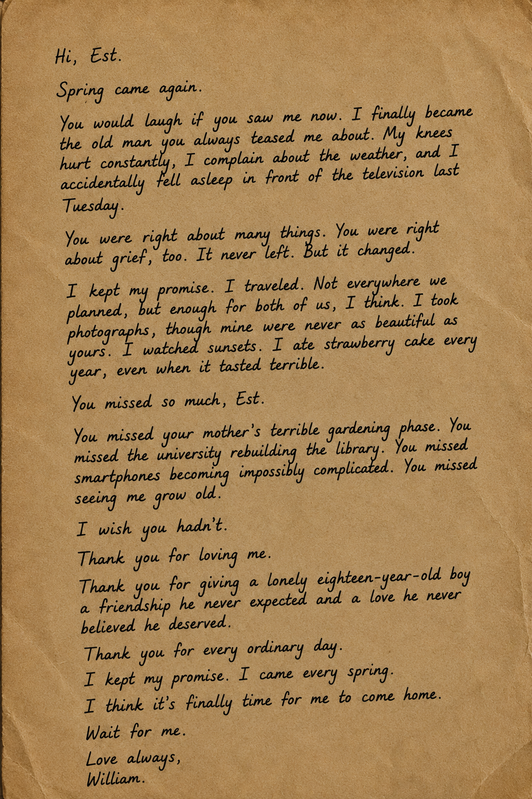
Hi, Est.
Spring came again.
You would laugh if you saw me now. I finally became the old man you always teased me about. My knees hurt constantly, I complain about the weather, and I accidentally fell asleep in front of the television last Tuesday.
A soft laugh escaped him
You were right about many things. You were right about grief, too. It never left. But it changed.
William paused, looking up at the blossoms overhead.
I kept my promise. I traveled. Not everywhere we planned, but enough for both of us, I think. I took photographs, though mine were never as beautiful as yours. I watched sunsets. I ate strawberry cake every year, even when it tasted terrible.
His vision blurred.
He continued writing anyway.
You missed so much, Est.
You missed your mother's terrible gardening phase. You missed the university rebuilding the library. You missed smartphones becoming impossibly complicated. You missed seeing me grow old.
I wish you hadn't.
A tear landed on the page.
William did not wipe it away.
Thank you for loving me.
Thank you for giving a lonely eighteen-year-old boy a friendship he never expected and a love he never believed he deserved.
Thank you for every ordinary day.
By the time he reached the final lines, the sun had begun setting.
Golden light filtered through the blossoms.
William smiled.
I kept my promise. I came every spring.
I think it's finally time for me to come home.
Wait for me.
Love always,
William.
William closed the journal.
Then, with great care, he placed it beside Est's letter beneath the tree. The wind stirred softly Petals drifted around him And for the first time in seventy-eight years, William no longer felt alone.
That night, William Jakrapatr passed away peacefully in his sleep.
When spring returned the following year, a group of university students climbing the hill discovered two weathered leather journals resting carefully beneath the cherry blossom tree.
Inside the first journal were fifty-six letters, each beginning with the same words
"Hi, Est. Spring came again."
Inside the second was a single letter, written in a different hand.
No one knew who had left them there.
The journals were eventually returned to the university library, where they were preserved quietly, their origins remaining a mystery. Yet, over the years, the story of the two unknown lovers spread across campus, passed from one generation of students to the next like a cherished secret.
Some began leaving flowers beneath the tree.
Others left letters of their own.
The old cherry blossom tree became known as the Promise Tree, a place where people came to remember those they loved and to make promises they hoped would last a lifetime.
And every spring, when the blossoms bloomed and the evening sun painted the hill in shades of gold and pink, students would sometimes swear they could hear laughter drifting through the petals.
Gentle. Familiar. Happy.
No one ever saw them clearly.
Only fleeting glimpses—a pair of young men sitting beneath the tree, shoulders brushing, one holding a camera while the other looked at him with quiet, endless affection.
And perhaps it was only the wind.
Or perhaps, after fifty-six springs apart, William had finally found his way back to Est.
This time, neither of them had to leave.
Together, beneath the cherry blossoms, they remained.
Forever.
Williamest final letters-