
Chapter Text
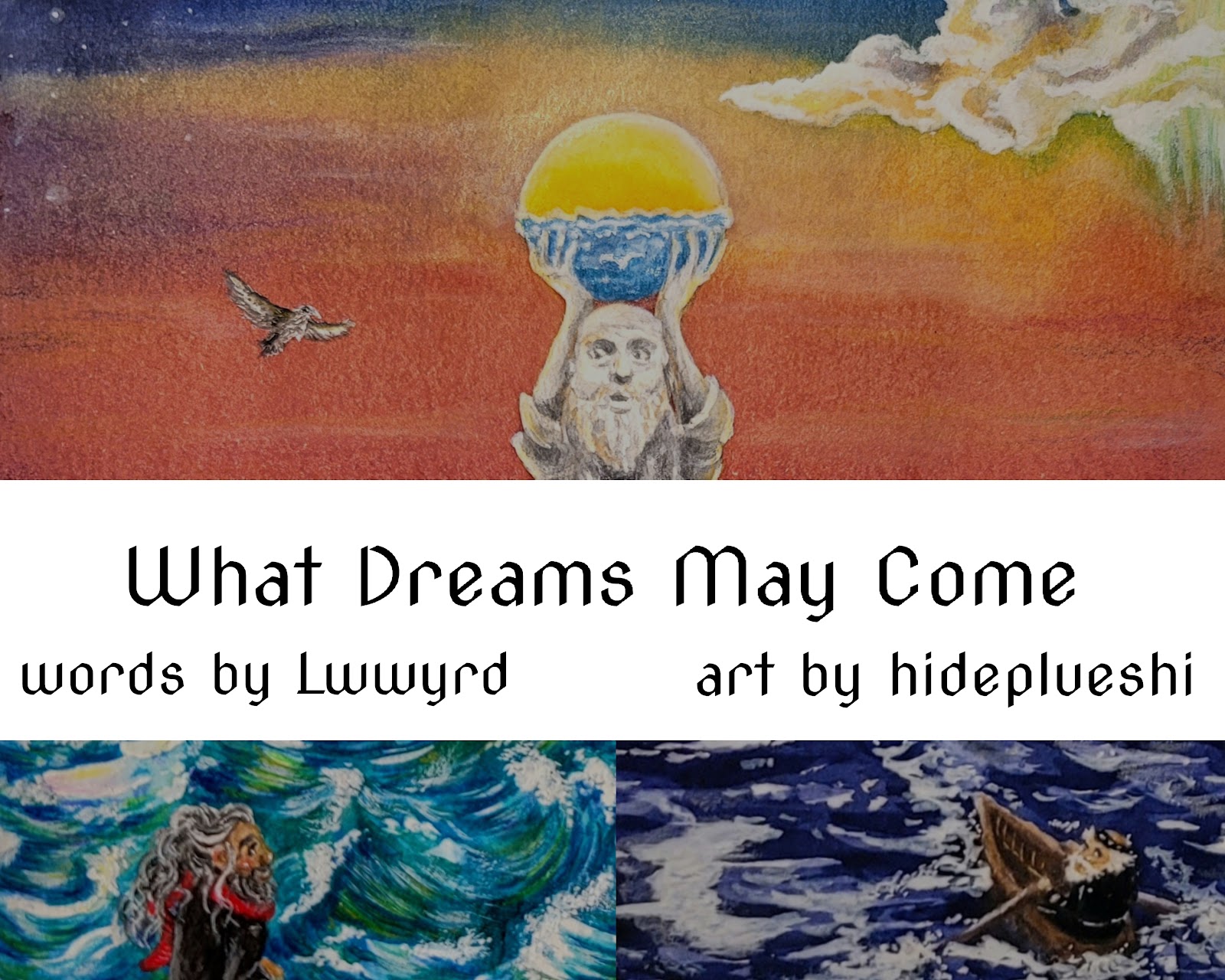
The R/V William Dampier, flagship of the New England National Oceanographic Institute, rode the calm waters eastward into the Atlantic. Bermuda receded from view, barely a dark smudge in the prevailing blue. Back there, sparse clouds would be banking against the low hills, promising a brief but nonetheless welcome rain shower at the end of warm day. Here, though, out at sea, the sky remained clear, the air fresh.
Nathaniel Buttons stood at the stern railing of the main deck, farewelling the last of the island. It would be a while before they saw land—real, dry land—again, and so it was time to bid goodbye to the last of the shorebirds who had been pacing them, swooping down almost to the surface of the water, skimming the waves, then rising high, riding and gliding in their wake. The gregarious, harbor-loving gulls had left hours ago, of course, but the skuas had lingered. One or two of them had perched for a time beside him, one even daring to approach more boldly and stand on his shoulder. His dark feathers caressed Nathaniel’s cheek and long, pale hair.
“You best head back, too,” he told him now. “You’ll nae want to wander so far from shore that you’ll not be able to find home again.” The skua squawked his objection. “Aye,” Nathaniel conceded with a nod, “there’ll be fish out there, and other birds to steal from, you young pirate. But.. Well, I’ll not force you. Truth is, I’d be glad of your company—and of your aid, too—if you’ve a mind to stay.”
It wasn’t the sort of thing a respected Institute Fellow noted on his c.v., but Nathaniel held the dewy-feathered subjects of his scientific studies closer than most of his human colleagues. Like them, the ornithologist felt most at home when he was at sea—and especially when he could send his own thoughts, his soul, flying over the salt surge. For Nathaniel’s Hebridean family had been sea witches for countless generations before the rise of Western science. Generations had raised winds, and quieted them; they had read and followed the paths of bird and whale. And they had bargained, made pacts with—and if necessary, sacrifices to—the Ocean he served and loved as he had never loved any human man or woman.
He turned now, his avian companion pacing him, and began to walk forward along the starboard deck, feeling the slight swell of the waters beneath the ship’s keel. Despite all the modern stabilizers, he could still, could always sense the motions and movements, the tides and torrents of the open sea.
Once he got forward, he looked ahead: it would be leagues yet before the first sargasso shearwater appeared. Those were the birds he was out here to study—and to parlay with. No research should be conducted without consent, after all: some of his fellow scientists forgot that, if in their human arrogance they had ever known it to begin with.
This expedition was headed into the center of the Sargasso Sea, into the heart of what some called the Bermuda Triangle, and what others believed the last vestige of lost Atlantis. Even at the end of the first quarter of the twenty-first century, and despite all the advances of human technology, the Sargasso Sea maintained its mystery. It was an anomaly, the only sea without a bordering land mass. So were its resident birds, a species that seemed never to touch dry land: rarely if ever visiting any further inland than the most tide-battered, surf-drenched cliffs, shearwaters made their true home on the floating seaweed islands of the sea within the ocean.
Yes, Nathaniel thought, he and the shearwaters were alike in being creatures of the ocean world, lovers of its beauty and its danger. They could teach him much that he needed to know if he was able to satisfy fully the desires and dreams he had harbored since boyhood. But he had work to do in the human world as well, and not just the science. Nothing happens without a reason, Nathaniel thought, considering the two Institute colleagues with whom fate had joined him for this voyage.
“I heard a legend once,” Ed Teach, the expedition’s leader, had remarked to him some days back, when they had left their home port and first entered open water, well before they had docked in Bermuda, “about a bird that lives its entire life without ever touching land, always in the air, always at sea.” They had been talking about shearwaters, but his voice had echoed with a wistful melancholy of sorts. It had been the voice, Nathaniel had thought, of a sailor who had yet to find his polestar.
Both he and the other one, the ichthyologist known by everyone at the Institute as Fang, seemed to be foundering, adrift and becalmed, caught in the slow currents and tides of time and destiny. He had suspected the day he had come aboard that fate and the Ocean that all three of them served in their own ways required his aid on their behalf. It would be fair exchange for what he suspected he must require of them.
The skua circled above, bidding one last farewell to his comrades now pacing the distance back toward land. He dipped and danced on the slight breeze, sang out his delight, and came back to rest on the railing. Nathaniel turned his head and returned the bird’s gaze. “Well, if you’re staying, you’d best take a name.”
The skua cocked his head.
“Aye, most humans are too free, too quick to name themselves. We know what it means, what power that knowledge grants. But if we are to be together, fledgling, it’s a risk we must take.” He paused, then solemnly held out his arm. “I’m Nathaniel.”
The skua accepted the invitation, hopped on to his wrist, then made a sound between a squawk and a coo.
“Karl it is, then. I’ve known others of that name; they all proved themselves good friends.”
One deck above them, Ed Teach stood at the bow above the pilot house. It felt good finally to be fully underway.
The journey south from their New England home port and the Institute had been just busy enough to keep him occupied. As lead scientist, he had to coordinate and organize the spaces and schedules for the other researchers as well as overseeing the work of his own two interns. Such administrative tasks bored him and made him restless, so he tended to procrastinate and grumble. The science was where the fun was, but these days even his research sometimes felt like mere routine, without drama, without life.
Ed sighed. The lightest breeze, like an invisible lover’s fingers, brushed his graying hair back as he scanned the seemingly empty expanse of ocean before them.
This wasn’t his first expedition, not by a long shot, nor even his first as leader. Had he really ever been as young and eager as his interns? And now… Sometimes he could barely even remember their names, and he knew he was hardly a model of patient, fatherly care, though he hoped he wasn’t half the dick his own father had been.
Fang was better at all that, so it was probably fortunate that he and his own pair of assistants—a third student intern and an Institute postgrad working on eels, was it?—had boarded up north as well. The big, burly man looked fierce enough—not to mention that nickname, for fuck’s sake—but he had a gentle, even sentimentally sweet temper. Ed envied him that sometimes; he had since the first time they had sailed together. It was good to have him aboard again.
The third scientist who had boarded with them, though, he was certainly an odd one. Somehow fate had never made them part of the same expedition before, but their bird guy—Nathaniel Buttons, known as the Gull Whisperer—was notorious around the Institute. Ed had seen him on the dock before they boarded, standing at the foot of the gangway surrounded by a flock of birds he could have sworn were bidding him bon voyage.
The other researchers, selected from a variety of universities and research consortiums, were good people, competent and reliable. He’d sailed with one of the marine geophysicists before, and he recognized a few others from passing encounters at conferences, as well as knowing their work from their project proposals, of course. They had joined the ship in Hamilton, along with a larger than usual contingent of “citizen-scientists,” as the Institute’s public-facing administration called the avid amateurs who helped defray some of the costs of the voyage by being willing to pay for the experience of assisting the professionals. Ed hoped they wouldn’t prove more trouble than they were worth and would stay out of his way. All of them, Ed thought with a sad smile as he fixed his gaze on the horizon, would ultimately be little more than ships that pass in the night. There was no point in getting close to any of them.
Except, perhaps, the eclipse guy.
This voyage would coincide with a solar eclipse with totality only visible from the middle of the Atlantic, and this heliophysicist was by no means the only one to make a blatant attempt to finagle a berth and a view. Ed’s first thought had been to reject his proposal along with those of all the other solar scientists: what had their research to do with oceanographic exploration? But Admin had thought it was a good idea to include one of the them, and Fang—and even Buttons—had concurred. So Ed had grumbled, but acquiesced. He’d taken another look at the proposals.
And this guy… He wasn’t the biggest name in the field, with the most prestigious background and university affiliation, though a quick background check, and the most glancing read through the meticulous data collection and rigorous analysis of his publications had made it clear that he knew his shit. And he obviously knew his competition, and Ed had been struck by the cynically ironic cheekiness of his application’s tone. There was something—was piratical the right word?—about it.
And then, when Ed first saw him boarding the ship yesterday, when they first spoke to one another after the initial briefing… Well, he was dead sexy, for a start: about his own age or maybe a bit older, with similarly silvering hair but a beard more neatly groomed than Ed’s own scruff. And the vestiges of a cool English accent, too, more working class than pompously posh. Beyond that, though, there had been something else about him, something weirdly familiar, a presence supplying an absence, filling a void Ed had never even consciously noticed. It was as if they were each other’s missing half. And that was something not a little exciting. Something Ed hadn’t felt in a long time.
Alone in his cabin several decks below both his Institute colleagues, Fang sat back and closed the lap top on which he had been answering his email. Time for a break, he thought: a mug of something warm, or maybe it was late enough in the day for a beer.
He glanced over at his bunk—he’d claimed the lower one, and marked that claim with his phone charger, a small pile of books, and (most importantly) photographs of his dogs. He missed them already, was already looking forward to returning home to them.
For now, though, this ship would be home. His cabin mate—a phycologist, their seaweed guy, as Ed would call him—seemed nice enough. Married with a couple of kids, his photos suggested. Quietly preoccupied with playing video games when he wasn’t working. Bit of a loner, maybe, he thought, not unlike himself. But Fang wasn’t looking to him for company: he would have his own work, and the supervision of his assistants, to keep his mind off the loneliness that overcame him from time to time.
Yes, he decided with a nod to himself. He would visit the mess hall and cheer himself up with a mug of tea. The World Cup was over, but maybe there would be a game of some sort on the television. Or something else to watch, a documentary perhaps, even if it was one he had seen a couple of times.
Maybe he would run into Ivan there.
Ivan was a stable part of the permanent crew, the chief technician for the underwater drones and the submersible, and wrangler of the ship’s small fleet of zodiacs. They’d sailed together on a number of these expeditions, and had become friends over the years. It had felt so good to see him on deck by the gangway, a broad smile on his face, waving an enthusiastic welcome as Fang stood on the dock inventorying his pile of luggage and equipment. Ivan was a constant presence even when barely felt or seen, like the moon passing through its phases, waning to an absence he only noticed in retrospect, but always waxing again after.
And maybe, Fang thought, maybe they would see each other more frequently in the future. Now that the Institute had appointed him to a fulltime research position as a Fellow, Fang would be leaving his professorship upstate and moving down to the coast. Maybe they…
Fang stood up. Yes, he would go up to the mess hall. And if Ivan wasn’t there, he’d go down to the boat bay and look for him there.
Ed turned as he heard a noise behind him, interrupting his wandering thoughts. The eclipse guy. What was his name? Hands, that was it. Seeing him prompted another fugitive moment of happy half-recognition.
Ed watched him set about consulting his phone—a compass app? GPS?—to find alignments and making notes in a small black book. He was working, obviously. Certainly not looking for Ed. Alas. But perhaps he felt Ed’s eyes on him as he bustled about, because he looked up suddenly. “Sorry. Didn’t mean to disturb—”
“Nah. You’re good. Setting up already?”
“Planning at least. Putting together a mobile solar observatory takes a bit of time. Need to have everything ready, run a few trial observations and establish some baselines before we’re in position for the main event. I like to be prepared.”
Ed nodded.
“And I—” Hands began again, somewhat hesitantly. “I know you will have a roster of assignments for the volunteers already. But last night, after the introductions and all, I—well, I thought I might ask you for a couple of them—just the ones who seemed particularly keen and able—to help me on the day. They’ll most likely be out here during the eclipse anyway, so—”
“No, that’s fine. Actually—yeah—thanks. Good plan. Should have thought of that. I’m counting on you to organize the big day, after all, what with you being the expert and all.”
“I could give them all some instruction, too, in the basic how-to tips and safeguards for photographing the sun safely? And I might even guide them through some dark sky photography as well? I thought I’d ask the sailing master—that’s what you call the captain, right? Technically, when there’s an expedition leader aboard?—anyway, thought I’d ask him to dim the lights up here tonight, take them through a bit of basic astronomy?”
“Sure. But you don’t have to. That’s going above and beyond what you signed up for.”
Hands tensed up a little. “Just paying my way. I was really lucky to get this berth. Totality over the open ocean limits the opportunities for observations, and—”
“I wasn’t –” Ed hastened to reassure him. “No. I mean—That’d be great.” He smiled more broadly. “Good thinking. Value-added, like: every satisfied volunteer a potential benefactor, and the Institute can always use their money. Love that.” He took a couple of steps toward him, closing the distance. “And you can vet them for me, yeah? I’d be grateful for the help in sorting them out. Cool. Great. See, I had a feeling when we met that we could work well together.”
They were standing side by side now.
Hands relaxed and smiled back. “It looks like the sky will be nice and clear tonight. And well, I know we’re still in long-range forecast territory, but the viewing conditions for the eclipse look good.” He cocked his head to one side. “They will be, won’t they?”
“I’ll take your request under consideration,” Ed laughed, “and see what I can do.”
“Thanks. I’d appreciate that. That is your department, after all, isn’t it? I mean, not just as expedition leader. You study the interactions of atmospheric conditions and weather patterns with ocean currents? I read that PLOS article you wrote on recent changes in mid-Atlantic storm patterns this time of year.”
“Yeah. Something like that.” Ed warmed with the thought that Hands had been interested enough to look that up. Of course, it made sense that he would have: just due diligence, not necessarily anything more personal. Maybe, Ed conceded, it was just wishful thinking. Maybe he was just looking for a sign that his own burgeoning interest might be returned. He searched for something else to say, to keep the other man by his side, to keep them connected. “And you do solar storms, right? So… the aurora? Read that there’s a chance…”
Hands shrugged. “Well, solar activity has been unusually strong lately. Unlikely to see anything tonight, though. No storms or coronal flares in the last 48 hours. And even if there were, we’re too far south for anything beyond a band of red along the horizon line.” The matter-of-factness in his voice faded a little, and he looked away. Ed remembered, back when he was a much younger man, sailing on an expedition to the far north, beyond the Arctic Circle. He remembered the lights, the beauty, the awe. He heard a shadow of a similar memory, a similar desire for mystery and wonder in Hand’s voice when he spoke again. “Not like what you would see nearer the pole,” he murmured so quietly it was all but a whisper. “The dancing swirls and spirals. Green, maybe blue, purple even.
”
“Yeah, but even so,” Ed replied. “That’d really be something, wouldn’t it? If we had an aurora this far south, and the eclipse, all on one cruise? Hey, any chance they could happen at the same time? That the lights and the stars would both be visible at totality?”
“A non-zero chance, I suppose.” Hands shrugged. “Wouldn’t get my hopes up.” Ed watched him as he finally—and perhaps, Ed hoped, reluctantly—looked down at his notebook and prepared to go back to work.
“Guess not. But this has been a year for… I don’t know what to call them. Portents? Wonders? I mean, a lunar eclipse at the beginning of the year. A bunch of meteorite fireballs. Two comets visible at once in April, not to mention the conjunction of Venus and Jupiter so bright in May and June, and then their alignment with more planets. All the solar storm activity. And now the eclipse—a particularly long one, they say.”
“Totality for a bit over six minutes, yeah.”
“And there’ll be a meteor shower that night, too, won’t there?”
Hands looked back at him with a sort of amused fascination. “Yes, but—” He shook his head. “Planetary motions and meteor showers and eclipses: all cyclical. So’s solar activity: predictable on the macro, if not the microscale. And we have better instruments to see comets and predict their appearances. Plus now everyone and their brother has a phone with a camera: fireballs are showy fuckers, but falling satellite debris and meteorites are fairly common. The conjunction was notable mostly for being visible despite so much urban light pollution.” He took a deep breath. “You’re a scientist, Dr. Teach. You know the difference between causality and correlation, coincidence and synchronicity. So you surely don’t believe in this woo-woo rubbish? You’re not about to suggest some occult significance in the path of totality passing through the Bermuda Triangle, are you? Or some bollocks about the stars ‘turning aright’ and Atlantis rising from the waves as the Kraken awakens and—”
“That’d be Cthulhu, not the Kraken,” Ed laughed. “And it’s Ed. Please. And you’re Israel, right?”
“Not religious enough to carry that off,” he grimaced. He paused a long moment, examining Ed’s face closely and carefully. “Friends call me Izzy.”
“Izzy it is, then.”