
Work Text:
No More Shall We Part
A one-shot inspired by Slow Horses 4x06
Catherine has spent the night at Slough House, where everything happened and, therefore, where everything has to be undone. There are two bodies in Jackson's office that can't leave through the door the way people do, or enter any record the way people do; she stays there that night, where terrible things happened, because someone has to take care of things.
Jackson wasn't there for the worst of it. He had things to do, things only he could take care of: he stopped by Molly's, who put a few envelopes into his hands, and took care of Sam, because someone had to take care of Sam. He returned to Slough House almost at dawn, the envelopes tucked under his arm and wearing his usual expression of displeasure, which is basically just his face.
Diana Taverner arrives mid-morning and shuts herself in the kitchen with Jackson to discuss the terms of what happened. From the back, Catherine hears the words compensation, and family, and a figure. She listens as Marcus Longridge's life is translated into a number, and as Jackson negotiates that number so it won't be quite so miserly.
"I'd invite you into my office to discuss it," she hears Jackson say, "but there were two bodies in it until an hour ago."
They came for the bodies. Quiet, efficient men, with bags and protocols, climbing the stairs as though they were removal men, because in a way, that's what they are. Catherine makes them tea. They don't know what to do with the tea — no one coming to remove bodies expects to be offered tea — but she makes it anyway, because it's what she knows how to do, because tea is the one thing she thinks she might be able to get right today.
And then there's everything else, which is endless: the reports, the official version, the absurdity of the administrative machinery that comes with death, that thing no one tells you — that when someone ceases to exist, what remains is an astonishing number of forms. Catherine sorts them, files them, holds the whole situation together, as always. And at some point during the day, she finishes picking up the broken glass scattered across the floor, because her hands need something to do that isn't trembling.
When the light begins to fade again, she is still standing. She hasn't eaten. She hasn't sat down. And she realises she can't remember the last time she actually slept.
Jackson appears in the corridor with his car keys in his hand.
"Get your things," he says.
"I haven't finished with—"
"Get your things. Come on."
Something in his tone makes her look up. It's not a work order. It's something else, older, without a name.
She, who under any other circumstances would have asked where and why, simply picks up her things and follows him. The day has been far too long to argue with Jackson Lamb.
The air outside is cold. Catherine fastens her coat as they walk towards the yellow car. Out of nowhere, she thinks of Marcus, still unable to believe he's gone; some stubborn part of her is still expecting to see him turn the corner, complaining about the vending machines.
When she gets into the car, Jackson starts the engine without saying anything. He drives like a man who has been alive for too long to be afraid of death: badly, calmly, with one hand.
For the first few minutes, they don't speak. Catherine looks out the window.
Marcus.
The gunshot.
Patrice.
The sound.
Coe's expression.
It all comes back whenever she keeps her eyes closed for too long. So she doesn't close them.
Catherine waits for the obligatory question, and the question never comes; perhaps because Jackson knows her too well. Knows the way she becomes very still when everything inside her is making too much noise. And he has enough experience with silences of his own to recognise when someone needs company.
He turns onto a street that doesn't lead to her house.
Catherine frowns.
"Where are we going?"
"To get some food."
"It's almost ten."
"Then it's dinner. Christ, Standish, try to keep up."
She looks at him.
"You didn't tell me we were having dinner."
"You didn't ask."
"Because I thought you were taking me home."
"I could take you home."
"And?"
"And I'm hungry."
"You're always hungry."
"Exactly. I'm a creature of habit."
Catherine looks out the window again.
At a street she knows, he double-parks outside a fish-and-chip shop with its neon lights still on.
"Out you get," he says, without moving.
Catherine lets out a long sigh and gets out. She orders two fish and chips because it's the only thing her mouth is capable of articulating. She comes back out with the hot, greasy package pressed against her chest, and the smell — vinegar, salt, oil — does something strange to her stomach, something that almost, almost resembles hunger, the first thing resembling hunger she's felt all day.
She gets back into the car. Jackson has already lit a cigarette with the window closed, out of sheer spite.
"You could open it," she says.
"I could."
He starts the car again.
It takes three traffic lights for Catherine to realise they're going the wrong way.
Her house is north. They've been deliberately heading south of the river for a while now. She recognises the bridge, the crooked streetlamp, the outline of a cluster of buildings that have nothing to do with her orderly neighbourhood and its neatly trimmed hedges.
"Jackson."
"Standish."
"This isn't the way to my house."
"How observant."
She sets the food on her lap carefully, as though it is the only thing left in the night she can still control.
"Why are we going to your house?"
He doesn't answer immediately. He takes a long drag. The ember reflects off the windscreen for an instant.
"Do you have a problem with my house?"
"I didn't say that."
"You said it with that face."
Catherine looks at him in profile. There's something almost imperceptible in his expression: exhaustion, more than exhaustion, that particular kind that appears when someone has spent too many hours surrounded by death and still doesn't know what to do with the life left afterwards.
Then Catherine understands. It's not just about her. He doesn't want to be alone tonight either, and somehow, that makes it easier.
"We're not going back to that, Jackson," she says. Quietly. Without drama, which is how real things are said.
And then Jackson does what he always does whenever any truth gets too close.
"Going back to what?"
Catherine looks at him.
"You know."
"No, Standish. I haven't the faintest idea what you're talking about."
"Jackson."
"For God's sake, Standish," he says, flicking the ash onto the floor of the car, which is where ash lives in this car. "A man kindly invites you to dinner and you're already imagining him naked." He clicks his tongue. "Stop projecting your repressed appetites onto me."
"My repressed appetites?"
"I don't know. You're the one who just assumed coming to my house means something."
"Because we have a past."
"A very respectable past."
"Not particularly."
Catherine looks at him.
"We're not talking about this."
"Fine by me."
"Good."
"Although you started it."
"I didn't start anything."
"Of course. Don't worry. You've only come over so you can hold my chips while I drive."
Catherine looks out the window again; the terrible thing, the absolutely unbearable thing, is that a laugh escapes her: short, involuntary, half-stifled, the first thing that has come out of her all day that doesn't feel heavy.
"You're disgusting," she says, her eyes wet, though she's no longer entirely sure why.
"And you're hungry. I can tell."
He turns the corner; they've arrived.
The door is the same: frosted glass, the handle that has to be lifted slightly before turning because it has always, always stuck. Catherine knows this. Her hand knows it too, and that hurts tonight — that her body remembers a house her life gave up some time ago.
At the end of the wet street, above the rooftops of the low houses, the towers by the river gleam in the distance, indifferent, as they always have been. Jackson opens the door and doesn't turn on the light. He doesn't need to: Catherine's hand finds the switch by itself, to the left, at exactly the same height as always, and presses it before she even realises she's done it.
And then she sees the house.
It's the same house; that's the problem. The same shelves reaching all the way to the ceiling, crammed with books and records; the same reel-to-reel tape machine that hasn't worked since before they knew each other.
Catherine looks at the sofa, the same worn brown leather sofa, sagging in the exact spot where he collapses every night, because he sleeps there, always slept there when she wasn't around to drag him to bed.
Catherine remembers nights when they ended up watching films until far too late, remembers arguments, breakfasts. One morning when Jackson had made tea and complained for twenty minutes because she'd moved a stack of magazines three centimetres.
It's the same house, but now it's dead.
Because when she used to come here, this was something else. Untidy, yes — Jackson hadn't been tidy for a single day of his life — but alive: the mess of a man inhabiting a place, not the mess of a man slowly rotting inside it.
Now the dining table has disappeared beneath a sediment of newspapers, ashtrays and bottles. Now, propped against the wall, the plant — her plant, the one she watered, the one she kept alive — is dry and brown, a cascade of dead threads, a memorial to something that stopped being cared for on the day she stopped coming.
The mess has the exact shape of her absence.
Catherine turns towards him.
"You didn't clean anything?"
"No."
"Since when?"
Jackson shrugs.
"Since you've been gone."
She looks at him.
Jackson takes off his coat and throws it towards the sofa, misses, then walks towards the kitchen as though he hasn't said anything important.
Catherine doesn't follow immediately. There's something in those four words that remains suspended in the room.
Since you've been gone.
"I should've guessed it would be a disaster," she says quietly, and she couldn't say whether she's talking about the house, or him, or herself.
"It's not a disaster."
"Jackson."
"Don't start. I didn't bring in a cleaning crew, and I'm not apologising for the décor. Eat and leave the psychoanalysis out of it."
Suddenly she isn't listening to him anymore, because her feet — her feet again, her body remembering everything she'd rather forget — have carried her, without permission, to the corner where the turntable sits. An old silver Technics. The only surface in the entire house without a speck of dust. And Catherine understands what that means before she's ready to understand it: that there is one thing, just one, in this dead house that he still touches with his hands.
Beside it, in the record box, in the same place as always, first in line, the way you keep close at hand the things that matter, is the record.
Her record. The one she gave him.
And the house dissolves.
Months ago — it doesn't matter how many — it is night, the house is untidy but alive, and Catherine is standing in front of this same turntable with this same record in her hand, carefully taking it out of its sleeve.
"I brought you something," she said when she arrived. "It's a little depressing, but I think you'll like it."
"Depressing music's the only good kind."
She reads the title on the cover quietly, almost to herself, as she lowers the needle: No More Shall We Part. She doesn't know yet — how could she? — the cruel joke the future is playing on her with that record in her hands.
A slow piano begins, and over it Nick Cave's voice, low and rough, in a song that is nothing more than a hand held out to someone who is too alone: come here, you didn't have to be so alone, come here with me.
"It's not Adele," he says behind her, mockingly.
"No one said it was Adele."
"Thank God. I'd have to throw you out."
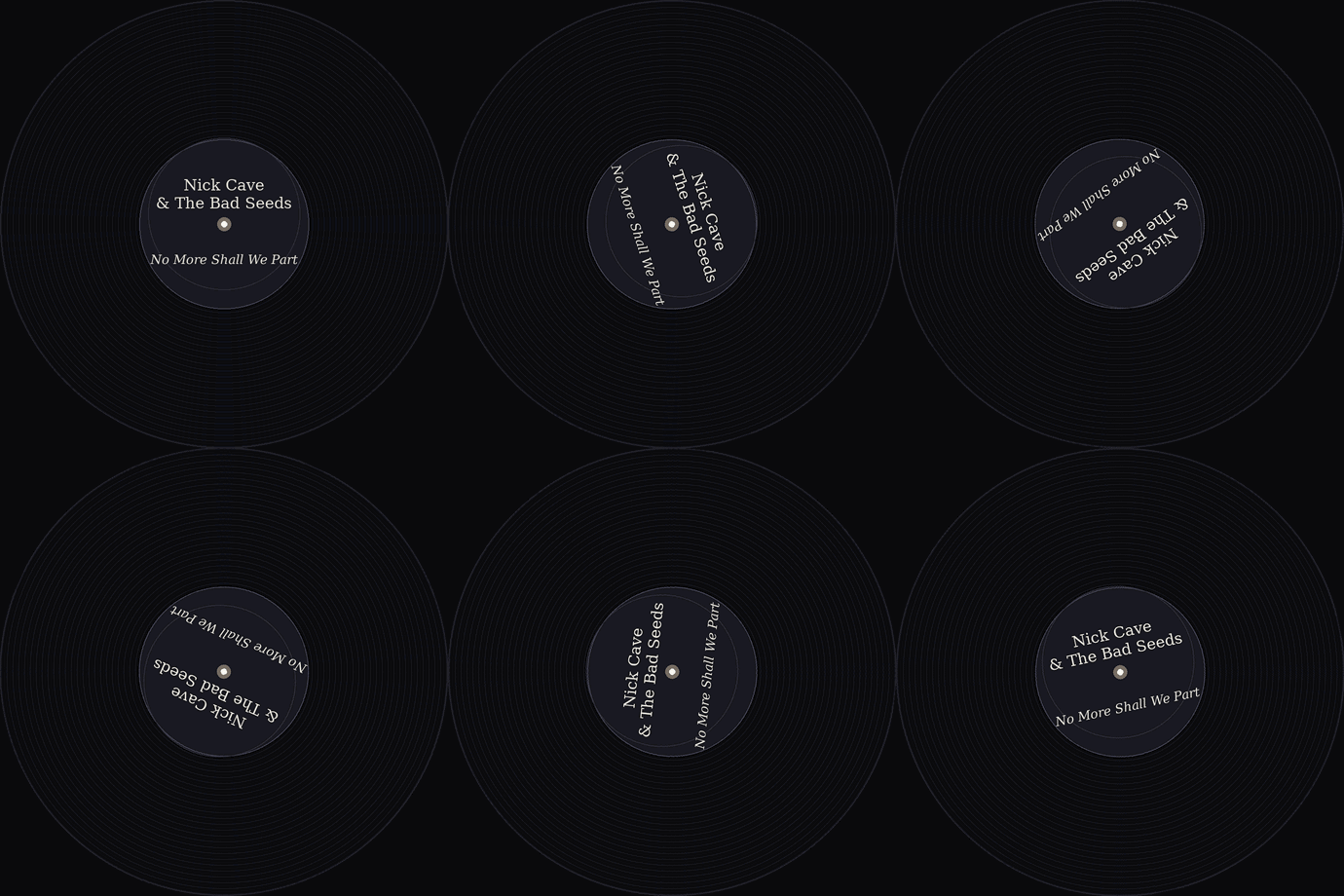
Nick Cave
& The Bad Seeds
No More Shall We Part
SPEED ADJUST
Technics
And then, without warning, without anything announcing it, Jackson's arms wrap around her waist from behind. He's heavy, awkward, smells of cigarettes and whisky and himself, and rests his chin on her shoulder for a moment before kissing her neck, just beneath her ear, where she's ticklish and he knows it perfectly well, because Catherine laughs and shrinks away and protests, "Stop," she says, without the slightest desire for him to stop.
She turns in his arms. They look at each other, dance slowly, without music that really invites dancing; barely swaying in the middle of a warm, cluttered room. His eyes are closed. Her face is against his chest. They don't say anything. They don't need to. It is the quietest and fullest moment of their entire lives, and neither of them knows yet that they are going to spend the rest of their days trying not to remember it.
The record is heavy in Catherine's hands. The house is dead again, just like Marcus, and the towers still shine in the distance, indifferent, on the other side of a dirty window.
Catherine says nothing. She lowers the needle.
But she doesn't play the song they danced to; she couldn't. She lets the stylus fall where the record falls by itself, worn from being played so many times in this house: and what fills the dead living room isn't a hand held out, but a letter. A piano, Nick Cave's broken voice behind it like a chorus of ghosts, a man pouring himself entirely into a love letter to someone who is no longer there, who may never arrive, half plea and half prayer.
I hold this letter in my hand
A plea, a petition, a kind of prayer
I hope it does as I have planned
Losing her again is more than I can bear
...
Whispered on the wind
Come back to me
Nick Cave & The Bad Seeds, «Love Letter» (2001)
[YouTube / Spotify]
Beside the sofa, Jackson has gone very still. They don't dance. Of course they don't dance. Neither of them says a word. But the record is playing, and he knows which one it is, and she knows that he knows, and on the cover, between her fingers, the promise they both broke is still printed there: No More Shall We Part. For four minutes, the house holds both things at once, what they were and what they are, without a seam between them.
"Eat," he says at last, his voice a little hoarse. "It's going to get cold."
They eat out of the paper, with their fingers, sitting on the same old leather sofa, with Nick Cave filling the spaces neither of them is going to fill with words. The fish is crisp and the chips are far too salty and, without question, it's the best thing Catherine has eaten in weeks. Jackson eats like an animal. She passes him a napkin, he ignores it, and she leaves it beside him anyway, because there are things you do without hope.
They talk very little, and when they do, they talk around Marcus, which is the only way to talk about someone on the same day they've been taken away in a body bag. Jackson makes some outrageous remark about the dead and their lack of consideration, and Catherine laughs again, only for the laugh to break halfway through, and he doesn't look at her, and that not looking is the closest thing to a hug this man knows how to give.
The record ends. Neither of them gets up to play it again or put something else on. The silence that remains isn't frightening anymore. It's more of a tired silence.
"Are you coming back?" he says at some point, without fully opening his eyes.
She knows he means Slough House, the stairs, the tea, tomorrow, the long and ridiculous habit of keeping that place standing. And she knows too — they both do, the record lying silent on the turntable having just made it painfully clear — that there is another question underneath it, older, without a name, one he will never ask and she will never answer, because they aren't going back to that. She said so in the car. The dead plant against the wall says it too.
"I'm coming back," she says. To Slough House. Not to the other thing.
"Good," he says, and closes his eyes completely, as though the matter had never meant anything to him, as though he hadn't stood waiting in the hallway for her to collect her things, as though he hadn't driven halfway across the city in an appalling yellow car so he wouldn't have to ask her while looking her in the face. "Someone has to make the tea."
"Someone has to make the tea," she repeats.
Catherine takes off her shoes — an act of surrender that surprises even her — folds her legs beneath her on one end of the sofa she knows by heart, and at some point between one sentence and the next, without permission, without realising it, she falls asleep for the first time in what feels like an entire year.
When she wakes, much later, she'll have the checked blanket he will have draped over her without saying a word, and he'll be in the armchair with an empty glass in his hand and his eyes open in the darkness, not because he's watching over her, not exactly.
In this house that once belonged to both of them and now belongs to no one, with the dead plant against the wall, and the record lying still on the turntable, there's no need to play it again, because they both know it by heart, every note, right to the very end.