Chapter Text
** Prologue
The air above the Principia was thick with the scent of pine, blood, and cheap wine, but nobody in the Senate house was drinking.
Centuries before the 21st century—before the concrete of California swallowed the gold of New Rome—the Legion had a simple motto: Strength in Order. Order was the lifeblood of the Twelfth Legion. It was the sharp edge of a gladius, the locked shields of a testudo, the cold, unyielding weight of Roman law.
Then came the First Madness.
He had been a legate loved by his men, a son of the ocean whose swordplay was as fluid as the tides and whose loyalty was unquestioned. For five years, he bled for the eagle. On the sixth, during a campaign through the torrential rains of the Pacific Northwest, something in his eyes, the same unnerving sea-green as any of his future half-siblings, snapped.
No one ever found out why. Some said he heard voices echoing from the depths of the Pacific; others claimed the sheer pressure of his father’s dark kingdom had shattered his mind.
In the dead of night, while his cohort slept in their leather tents, the son of Neptune didn't draw a sword. He raised his hand, and the groundwater beneath the encampment boiled violently to the surface. He drowned ninety men in their bedrolls, choking them on their own supply lines, before swimming into the sea and disappearing forever.
He left behind a legion missing its iron spine, and a seed of doubt planted deep within the soil of the valley.
Decades passed. The scars scabbed over. The legion moved, rebuilt, and buried its dead. Time, as it always does, softened the edges of terror—until she walked through the calpurnian gates.
She was sixteen, with eyes the color of a storm-tossed sea and a voice like honey spun from gold. When the Senate saw her power, they rejoiced. A daughter of Neptune, but one untouched by the sea’s violence. She didn't summon floods or shatter the earth; her power lay in her vocal cords. It was a siren’s call, a rare, haunting gifts that could force a bloodthirsty fury to drop its claws or compel an army to lay down their spears. The Praetors hoisted her on their shoulders. They called her a blessing.
They were wrong.
The siren’s song didn't just calm monsters; it unravelled minds. Slowly, insidiously, she wove her melody into the ears of the senior officers. She didn't want a seat in the Senate; she wanted absolute, unquestioned devotion. Within two years, she had turned half the Third Cohort into mindless, hollow-eyed husk-slaves who obeyed her every whisper. When a rogue faction of Telchines attacked the borders, she didn't defend the camp. She sang a song of treason, opening the trenches from the inside and leading her mesmerized army straight into the hands of the enemy.
When the Senate finally executed her followers and burned her memory from the records, the fear was no longer a seed. It was a forest.
A century later, the forest bore more poisoned fruit.
Another boy arrived. Quiet, skittish, with salt-crusted hair. The camp kept him at arm's length, watching his every move. But he didn't attack the legion. He didn't try to conquer New Rome. Instead, the curse turned inward. On a moonless night, the boy dragged his own mortal mother down to the edge of the Little Tiber. In a horrific act of violence that left the shore painted crimson, he sacrificed her to the dark trenches of the Pacific—and then, without a single tear in his sea-green eyes, drove his own dagger through his heart.
After that, the whispering stopped being a whisper. It became a doctrine.
The Curse of Neptune.
It wasn't just bad luck. It was an inevitable, monstrous decay encoded into the very divine ichor of the ocean god. Minerva gave wisdom; Mars gave fury; Neptune gave a creeping, black madness that twisted its children into monsters. To bear the sea god’s blood was to carry a ticking clock toward slaughter, betrayal, or madness.
The Romans thought they had seen the worst of it. They were foolish.
Decades later, during a golden era of peace, young demigods began to disappear from the barracks. First, a Lares went silent. Then a recruit from the Fifth. Then two veteran legionnaires from the First. Panic gripped the city. Sentries were doubled, patrols swept the hills, but no monsters were found at the borders.
The culprit was living among them.
The fourth son of Neptune was quiet, studious, and spent his days in the aqueducts and reservoirs beneath the city. When the Praetors finally breached his locked quarters beneath the barracks, they found him writing in a journal bound in human leather. He didn't fight. He simply looked up, his eyes milky and unblinking, and confessed.
He hadn't killed them. Not yet. He had dragged them down to a hidden, air-pocketed cavern beneath the depths of San Francisco Bay—a horrific underwater laboratory.
When the legionnaires raided the sub-aquatic lab, seasoned centurions threw up on their own boots. The son of Neptune had been conducting dark, grotesque experiments, attempting to graft the gills and scales of abyssal sea-monsters onto human flesh to create "immortal aquatic soldiers." He had stripped their voices, mutated their limbs, and submerged them in black, pressurized water tanks.
He was executed by damnatio ad bestias, thrown to the sea-serpents, but the damage was irreversible.
From that day forward, the children of Neptune were no longer just tragic. They were taboo. They were outlawed in spirit, if not yet by written law. The legion swore that if another child of the ocean ever dared to set foot in the valley, they would be met with drawn iron, not open arms.
Decades passed. The 21st century arrived.
The sun was setting over the Valley of the Barons, painting the sky in violent shades of purple and gold. The guards at the outer fortifications of Camp Jupiter were on high alert, their lorica segmentata gleaming in the dying light.
Then, the boundary wards flared.
Through the fog of the outer hills came two figures.
The sentries raised their pilums, their knuckles white against the wood. "Halt!" a centurion bellowed, his voice cracking with sudden, subconscious dread.
Out of the mist stumbled a boy. He couldn't have been more than twelve years old. He was bruised, bleeding from deep lacerations across his chest, his clothes torn to shreds, and his dark, messy raven hair soaked in sweat and grime. Kneeling beside him, gasping for air, was a terrified, shivering faun with a broken horn.
The boy wasn't looking at the guards. He wasn't looking at the golden eagles or the imposing stone walls. His hands, caked in dirt and dried blood, were gently supporting the faun's head, trying to press a torn strip of his own shirt against the creature's bleeding leg.
"Please," the boy rasped, his voice raw and raspy. "He's hurt. Help him..."
The guards didn't move forward to help. They froze.
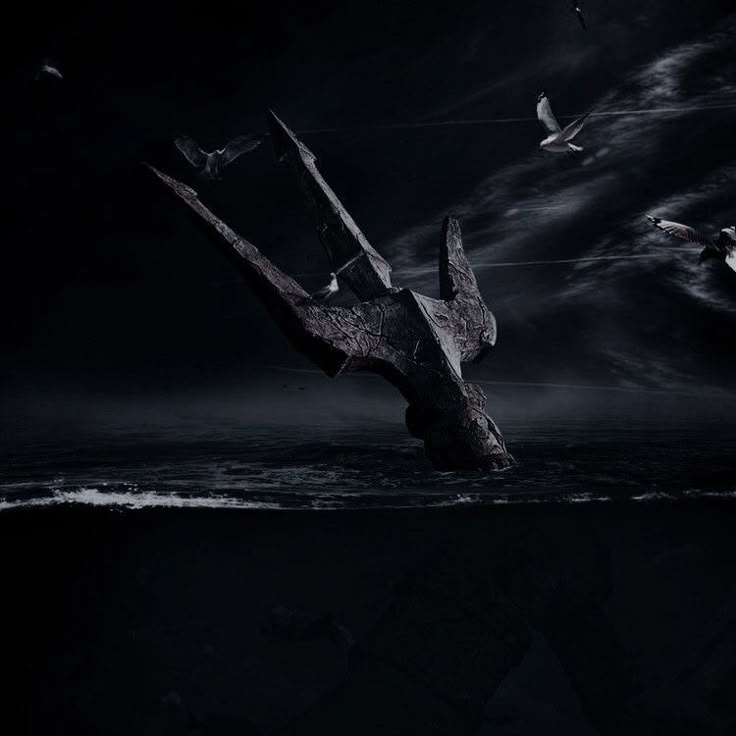
Above the boy’s head, floating in the dusk air with a sickly, ethereal green light, materialized a glowing spectral image. Three prongs. A dark shaft.
A trident.
The faun, coughing up blood, looked up at the sentries with wide, terrified eyes. Before he collapsed unconscious onto the dirt, he choked out the words that shattered the evening silence:
"A... a son of Neptune has come..."
The sentries didn't look at the boy's torn hands. They didn't see the way he instinctively shielded the wounded faun with his own small, frail body. They didn't see the exhaustion etched into his face, or the desperate, terrified plea in his startlingly bright, sea-green eyes.
They only saw the ghosts of drowned cohorts. They heard the faint, haunting melody of a siren's betrayal. They smelled the copper stench of a mother's blood on the riverbank, and saw the mutated horrors of the deep.
The curse had returned. And as the guards slowly raised their swords, their eyes burning with deep-seated hatred and fear, they didn't see a twelve-year-old child who needed saving.
They saw their own doom.
**~End of Prologue~**