Work Text:
The One Who Stays
A one-shot inspired by Slow Horses 2x01
By that point, the house was no longer Jackson's alone.
It was still a shipwreck of clutter, yes, but in the last few months something had slipped through the cracks: a second mug, a scarf draped over the arm of a chair, a novel lying face-down on the side of the bed that, until not so long ago, had belonged to no one. The house had made room for her.
They were lying on their sides, facing each other, so close Catherine couldn't see all of his face, only pieces of it: the glint of one eye, the edge of his nose, the unruly grey of his hair. She traced the line of his shoulder with her fingertips, without any particular aim, simply for the pleasure of touching him, and he had one broad, warm hand resting on her hip, squeezing it every now and then for no reason, as if checking a figure he already knew.
“They called from that company,” she said against his shoulder. “The private security one.”
“Mm.”
“They wanted a reference for River.” She searched for his eye in the dark.
“And?”
“And you spoke well of him.”
“I didn't speak well of him.”
“I heard you.” She was already laughing, quietly, her laughter caught between them. “With these ears. You said, and I quote, that he was ‘one of the least useless.’”
“That isn't speaking well of him. That's an insult with qualifications.”
“For you, ‘one of the least useless’ is a declaration of love.” She jabbed a finger into his ribs and he let out a sound that didn't quite qualify as a complaint.
“Take that back. Right now.”
“You could have buried it in a sentence. You do that for fun. And instead you said something decent about the grandson of the only living man you genuinely can't stand.” She brought her forehead against his. “You're going to have to live with that.”
“I said it to get him out of here,” he muttered, already defeated, his mouth almost against hers. “The sooner some idiot in a suit takes him off our hands, the sooner he stops breathing my air.”
“Of course.”
“It's not what you're thinking.”
“I'm not thinking anything.” She brushed the corner of his mouth. “I'm enjoying myself. That's different.”
He pulled her towards him, closing the last bit of space between them, grumbling something about how insufferable she was, and she laughed again against his neck, and for a while there was no Slough House, no Cartwrights, just the warmth and the hands and the murmur of two people who had been doing this for far too many nights.
The phone rang sometime after eleven.
Catherine felt his body change before he even reached for it on the bedside table: his hand went still on her, his breathing caught for a second. No one called at that hour.
“Molly,” he said, more to himself than to her, and answered with his back to her, hunched over, withdrawing into that way she already knew and that never brought anything good.
She couldn't hear what Molly was saying. She heard what he said, which wasn't much: a name, a grunt, a “on a bus?” When he hung up, he sat for a moment on the edge of the bed with the phone in his hand, staring at it as though it had asked him a question he didn't know how to answer. The warmth of a minute ago had left the room as if someone had opened a window.
“A bloke I worked with,” he said, without waiting for her to ask. “In Berlin. A lifetime ago. They sacked him for being a drunk and telling stories.” He rubbed a hand over his face. “He's just died alone on a bus. Back row but one. They mistook him for someone sleeping.”
“And was he?”
“In a manner of speaking.”
He said no more. And in the silence that followed, Catherine allowed herself, for once, the thought she almost never allowed herself. That the man beside her was not young. That he abused himself deliberately every day, as though it were a job he had to do. That one of these mornings, the warm, heavy shape occupying half the bed would simply stop breathing, and that she had built whatever life she had left on top of a man statistically determined to go first. She saw it, for a second, like a bad dream: his mouth open, his eyes closed, an ordinary seat, and strangers walking past, thinking he was asleep. No one leaning down to check, no one saying his name.
She realised she had been taking care of him for years without calling it that. Taking his plates out from under the bed, arguing with him about cigarettes and whisky, staying awake until she heard him come through the door.
Catherine put a hand on his chest, where his heart was doing its stubborn work.
“I don't think I could do that, Jackson. Walk into a room one day and find you.” She swallowed. “I'd rather go first. I've thought about it, and I would. It's selfish, and I don't care.”
He looked at her in the dark without saying anything.
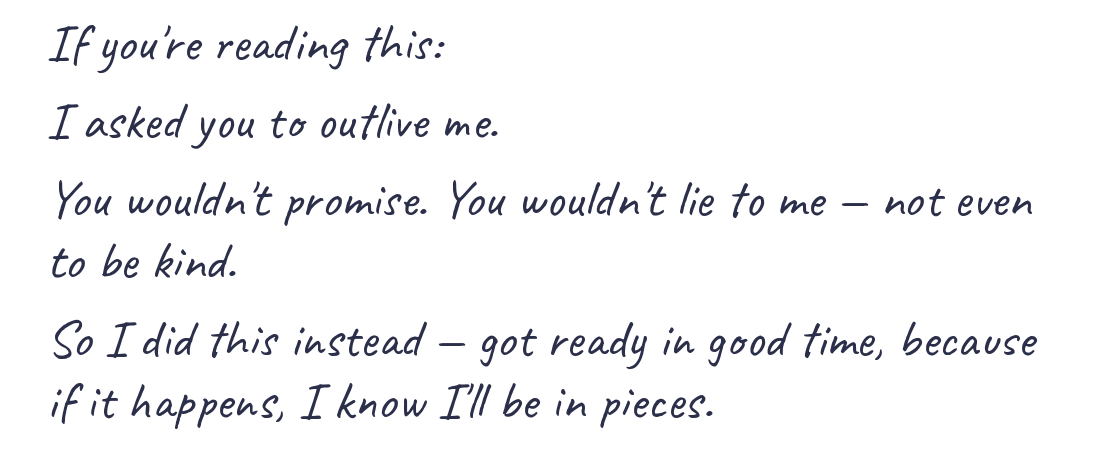
“So promise me you'll outlive me.”
“That's not how it works.”
“I don't care.”
“Catherine.”
“I don't want to see another body, and certainly not yours. This is your fault for bringing it up.”
“I didn't bring anything up. A woman with no legs just called me to tell me some idiot died on a bus. You're the one making it profound.”
They didn't speak about it again; and neither of them slept well that night. Then, sometime in the early hours, without turning on the light, she heard him get up.
“Where are you going?” she asked into the darkness.
She heard the sound of clothes, of a man getting dressed in a hurry.
“Morning exercise.”
“Jackson.”
“Standish.”
“It's about Dickie, isn't it?”
There was a pause in which he could have answered. Catherine looked at him.
“What?”
“You haven't slept.”
“Neither have you.”
“I'm not driving.”
Jackson grimaced.
“I don't need sleep to drive.”
“That's not reassuring.”
He finished fastening his trousers. Catherine watched him. There was something in his movements she didn't like, too quick, too determined, as if he had already started putting something back together in his head. He put on his shirt; she sat up, went over to him, and straightened his collar, an automatic gesture.
“Go back to sleep.”
“Come back soon.”
“I don't promise anything.” And before she could reply, he planted a short kiss on her lips.
Then came the familiar weight of his footsteps down the hall, down the stairs, the front door. He had left long before dawn.
That morning Catherine waited for him longer than she would have liked to admit.
She made tea, didn't drink it, sat watching the window change from black to grey to the dirty white of London mornings, and at some point grew tired of waiting for a man who already knew where he was and what he had gone to do. So she got dressed and went to work, because it was what she needed to do, because the empty house was worse than the office.
Slough House was without him too.
She noticed it from the landing, in the silence, which wasn't the silence of when he slept off a hangover upstairs, but the other kind, the hollow one. She stopped for a moment in the doorway of his office. Morning light came through the crooked blinds in blades, illuminating the dust suspended over the wreck of his desk: stacks of folders, the lamp, the old fan, the files no one was going to read. The empty chair still held the shape of him.
“Has anyone seen Lamb?” she asked, no one in particular, leaning over the banister.
No one answered. So she did what she always did: handed out the day's work, put the kettle on, took two calls meant for him and covered the gap with efficiency. Someone had to keep the place running while Jackson went to look a dead man in the face.
He came back sometime after eleven.
She heard him before she saw him: the door, the breathing, the weight of a man who couldn't be bothered to be quiet when he didn't want to be. When he passed her office, he smelled of disinfectant and something the disinfectant wasn't quite managing to cover. It wasn't the smell of work. This smelled of tiles and metal drawers.
“There's tea,” she said from the doorway.
“Wonderful. Tea.” He collapsed into his chair like a sack of potatoes. “Just what the morning was missing.”
She put the cup in front of him anyway. He wrapped both hands around it, and for a second neither of them said anything, and the not saying anything was almost a whole conversation.
“How was he?” she asked at last. The only question she allowed herself.
“Dead. Very convincingly dead.” He glanced at her. “I brought back a souvenir hat.”
“What?”
“The bloke who killed him left it behind.” He pulled the hat from his pocket and tossed it onto the desk between them, like a card laid on the table.
She looked at the hat. Then at him.
“Get the team together,” Jackson said. “We're going to find out who the bastard in the hat is.”
It was during the meeting that Catherine saw it first.
They were all crowded around Ho's screen, running through the images of the platforms and talking over one another — River, Louisa, Ho himself — when she, from the back of the room, said without anyone asking:
“That one.”
“Which one?” Ho didn't even turn around.
“The bald man. In the middle of the platform, heading north. His back is to the camera. No one keeps their back to a camera for that long by accident. He doesn't want to be seen.”
There was a one-second silence. River leaned towards the screen, and Louisa did too, and suddenly they were all rewinding to the bald man, talking over one another again, and no one — not one of them — turned to say anything to her. As though the bald man had appeared on the screen by himself.
It was River who put the rest together: the man who brushed Dickie's arm in the carriage, the arm Dickie scratched afterwards, the injection that passed for a heart attack in the autopsy.
That afternoon, Jackson ate, as he almost always did, at the Chinese downstairs.
The New Empire was practically empty at that hour, with the low red light from the wall fittings, the faded bamboo wallpaper, the red plastic tablecloths lined up in rows. Jackson occupied one by himself, in the middle of the room, with a bowl of noodles and his chopsticks. He took the fifty that River had just won against him in a bet that he himself had rigged.
“Cotswolds,” he told him, chewing. “Find out what the bald bloke was doing there, who he spoke to, whether he's still around. And don't fuck it up, see if you can manage to do one useful thing since you were born.”
River left almost happy, which was a rare sight. And Jackson watched him go, just for a moment, chopsticks suspended halfway to his mouth, with something on his face that, on another man, would have been pride.
Then, alone among the red tables, with the noise of the kitchen in the background and his own reflection in the window:
“Thanks, Mr Lao. Another portion of those prawn dumplings. Takeaway.”
He didn't say who they were for. He didn't need to. There was only one person in the world Jackson Lamb brought dinner home to.
When he arrived, Catherine was already home — at his house, which by then was theirs — barefoot, with Adele coming from the record player. Make You Feel My Love.
Jackson put the takeaway bag down on the table with an offended thump.
“No.”
“No what?”
“This.” He gestured at the air, as though someone had released a rat into the house. “I'm not having dinner with Adele in the background.”
“It's a beautiful song.”
“It's a Bob Dylan song. He wrote it in ninety-seven, and now the whole bloody world thinks it's hers.” He dropped onto the sofa, into his usual spot. “Fifty years of music and people discover Bob Dylan because of some singer who pulls a sad face.”
“Maybe people just needed someone to sing it like that.”
“Maybe people are idiots.” He said it without any force, and didn't get up to take the record off, which, for him, was a form of surrender.
Catherine took the prawn dumplings he'd brought for her, sat beside him, and now Jackson, of course, was eating half of them.
“You were right today,” he said suddenly, staring at the ceiling. “About the bald bloke on the camera. You spotted him first.”
She went very still.
“No one told you. Bunch of useless bastards,” he continued. “You did well.”
Catherine had to look towards the record player for a moment, until it passed.
“Why does it matter so much to you?” she asked eventually, carefully. “Dickie. You barely knew him. You worked with him thirty years ago and they sacked him for being a drunk. He wasn't your friend.”
Jackson took a while to answer. He left the empty container on the floor.
“He told the truth,” he said. “Thirty years ago: that he'd been kidnapped, that they'd got him drunk by force, that there was a bloke called Popov behind it all. No one believed him. They sacked him as a lunatic and he spent half his life as a joke, the drunk who saw Russian ghosts.” He rubbed a hand over his face. “And today I saw him on a slab and it turns out he was right from the beginning. He died alone.” The words came out bitter. “In the back row but one of a bus, without anyone ever telling him he was right. Not even me.”
“You couldn't have known.”
“That's not it.” And there, finally, his voice dropped to where the real weight of it was. “It's that this is how people like us die, Cat. Being right with no witnesses. Mouth open, in a seat, and some stranger who mistakes you for someone sleeping and carries on walking.”
And Catherine understood then, all of it from the night before. Why he'd left before dawn. Why Molly's call had driven him from the bed. It wasn't grief for a man he had barely known. It was the mirror. Dickie was the version of his own death in which no one came: the name no one claimed, the body no one collected, the tiled room no one entered to say this one's mine, I'm taking him home.
And she wanted to tell him: there wasn't a single version of his death in which he ended up alone; she'd made sure of that a long time ago.
“You're not going to die like that.”
“You can't know that.”
“Yes, I can.”
Jackson was silent for a while, staring at the ceiling.
“Why do you say that? What do you think you'll do if I die?”
“The same thing I'd do if anyone I lived with died.”
“What the fuck does that mean?”
“I have a folder.”
He turned his head.
“A folder?”
“Yes.”
“With what?”
“Your will, the house papers, the contacts, your work things…” She listed them off as if she were reading a shopping list. “Everything you'd leave behind without any instructions.”
He looked at her for a moment.
“You have a folder with my life in it?”
“I have a folder with everything I'd have to deal with if you died. It's not the same thing.”
“That's horribly romantic.”
“It's practical.”
“How long?”
Catherine didn't answer immediately. Because the folder had started as an administrative thing when she was his assistant, but when they put two lives under one roof, without quite realising it, it had grown.
“Since I realised someone was going to have to deal with it.”
Jackson huffed through his nose and looked back at the ceiling.
“And what have you put down for my records?”
“A list.”
“A list? What does it say?”
“That I should keep your favourites.”
“And what if you choose the wrong ones?”
“It won't matter. You'll be dead by then.”
He laughed. A short, hoarse laugh, the first of the day.
“Good.”
Then he stayed looking at her for a while, thinking about how wonderful she was, and something in him gave a little, like a door that had been closed for too long… Catherine had thought of him even beyond that, until when he would no longer be there, until when he could no longer need her.
She stood and held out her hand. He didn't go towards the hollow in the sofa where he usually fell asleep with an empty glass in his hand. He let her pull him up and followed her upstairs.
And that night, at least, no one slept in the penultimate row of anything.
J. LAMB · JL/CSIn the Event
of Necessitypersonal & confidential — executor onlyConfidentialFile Name: Jackson Lamb
Ref No: JL / CS
Executor: C. Standish
Updated: January 2016In the Event of Necessity — J. Lamb · close
of Necessity
Ref No: JL / CS
Executor: C. Standish
Updated: January 2016
Executor's use only
IN THE EVENT OF NECESSITY — J. LAMB
Personal & Administrative Records
Compiled and maintained by Catherine Standish, executor named herein
Confidential Ref. JL/CS · Last updated: January 2016
Contents
01 — Last Will & Testament
02 — House & Property
03 — Financial Affairs
04 — Personal Effects
05 — Music Collection
06 — Work & Security
07 — People to Notify
08 — Final Arrangements
— Personal (unfiled)

Last Will & Testament01
Document: Last Will and Testament of Jackson Lamb
Status: Pending review
Original held by: solicitor (see 03)
Executor: Catherine Standish (sole)
Primary beneficiary: Catherine Standish
Last reviewed: (overdue — see note)
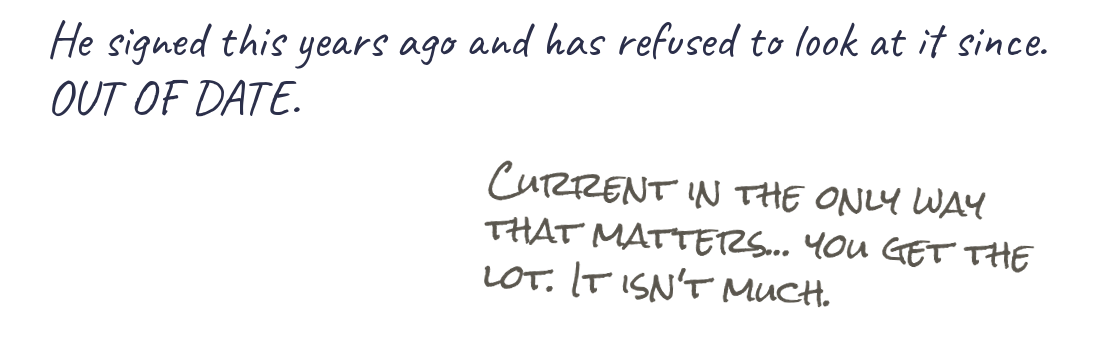
First steps for the executor
— Register the death. Obtain several certified copies of the certificate; you will need more than you expect.
— Locate the original. Do not rely on this copy.
— Apply for grant of probate.
— Secure all personal and professional effects before anyone else reaches them.
— Release nothing belonging to the Service (see 06).
House & Property02
Property: sole residence of Jackson Lamb
Tenure: Owned outright
Address: held separately, not in this folder
Keys accounted for: house · spare (with C.S.) · vehicle
Deeds: with solicitor (see 03)
To be dealt with
— Buildings & contents insurance — notify insurer
— Utilities — final meter readings, close accounts
— Council tax
— Securing and maintaining the property until settled
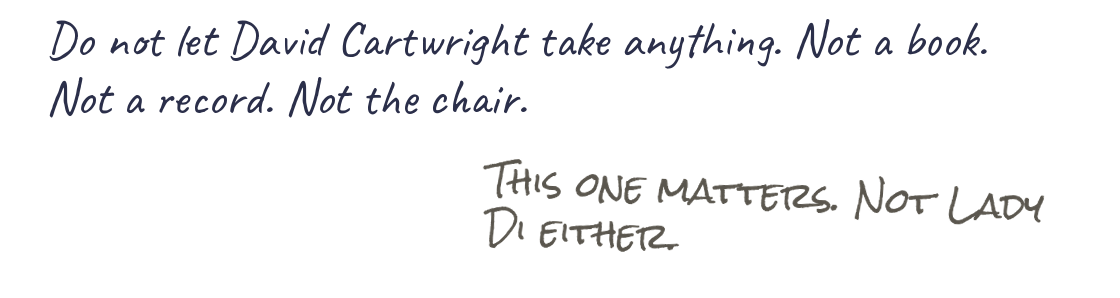
Belongings not to be treated as clearance
— The record player and the vinyl (see 05)
— The books
— The photographs — including the one from Berlin, 1989 (top drawer)
— Personal papers
Financial Affairs03
Bank: current account · savings
Pension: Service pension — provider details with solicitor
Life assurance: policy number held separately
HMRC / DWP: notify
Outstanding debts: none known — confirm with solicitor
Recurring payments to cancel
— Standing weekly order, New Empire

— Subscriptions, utilities, etc.
Action: cancel / transfer / retain as appropriate. Consult the solicitor before closing anything.

Personal Effects04
To be retained by Catherine Standish
— Wristwatch
— Personal photographs
— Selected books
— Letters and correspondence
— Clothing, as she sees fit
Requiring review before any disposal
— Office contents, Slough House
— Boxes in storage
— Uncatalogued papers
— Anything that looks like rubbish (it may not be)
Instruction: Nothing to be discarded on sight

Music Collection05
Format: vinyl, mostly · some cassette · nothing digital
Catalogue: None
Estimated size: considerable
Do NOT
— Sell the collection as a single lot
— Let anyone "tidy" or reorder it
— Throw out a record for looking damaged without checking the sleeve
Retain (C.S. to identify)
— His favourites
— Anything with writing on the sleeve

Work & Security06
Classification: Confidential
Contents may include
— Service documentation
— Operational material
— Contact details of serving personnel
— Material never returned to Registry
— Correspondence bearing protective marking
Important. Do not open, read, copy, photograph, remove or destroy any material bearing a protective marking. Hand nothing to anyone without confirmed authorisation.
Secure contact: M. Doran, Registry. She will know what is his, what is theirs, and what never officially existed.

People to Notify07
Priority 1 — appropriate Service authority
Priority 2 — M. Doran · S. Chapman
Priority 3 — Slough House

Final Arrangements08
Funeral / memorial:
— Burial or cremation:
— Music:
— Flowers:
— Reception:
— Arrangements to be made by: Catherine Standish

Personal · unfiled—
— PERSONAL