
Work Text:
Foreword
The story of “The Madness at Pond Street” relies heavily on the film Bride of Re-Animator, the short story “Herbert West—Reanimator” by H.P. Lovecraft, and the novel House of Leaves by Mark Z. Danielewski. While the entire work is derivative of these narratives, I have taken care to accurately credit direct quotes and concepts where applicable. –The Editor
1
The house on Pond Street has potential. Dan thinks of it in an optimistic new light from the onset. It’s a fixer-upper, a turn-of-the-century farmhouse with a patchwork ‘50s reno that’s fallen into disrepair again. But it’s somewhere to stay for a while and put his touches on, and he catalogs the projects as he stands outside in the crisp fall air—gutters to unclog and replace, a sagging rail on the wrap-around porch to bolster, shutters on the second story that need a paint job and a tweak back into place.
Of all the homes he’s had in the last few years, none have had such promise of permanence. Meaning, he and Herbert have never put both their names down on a mortgage before.1
Herbert is moving things inside the house in a hurry, but in the least efficient manner possible. It’s the same every time they move—he has to put everything in its place immediately, unpacking and setting up his equipment2 from top-to-bottom by function rather than helping bring all the boxes inside first. At the last rental, Dan had ended up moving most of the furniture by himself while Herbert organized the lab.
Dan is willing to cut him some slack today. As Herbert scurries across the threshold into the house, he trips and rattles the box of beakers in his arms.
Dan lifts his voice to cover the distance from where he’s standing under the lawn’s big tree. “You need a break?”
Herbert ignores him and disappears inside. He’s just recovered from an illness, some flu variant Dan thinks he picked up at the rental they had just managed to vacate. The basement there had been dangerously damp, affecting the experiments and Herbert’s patience. Trawling the Miskatonic Valley for a new house together, a clean, dry cellar had been Herbert’s top priority, and the Pond Street house3 had both a suitable basement and the benefit of privacy.
There isn’t another property within earshot. And it’s near an active country cemetery. A bit of a walk through a meadow to the north, but still. The bodies will be relatively fresh.
The wind sighs through the leaves over Dan’s head. In late October, the tree is flushed red and holds onto its leaves everywhere but the skeletal branches on the south side, closest to the house.
1 Inspired by House of Leaves, pg 385. “…both their names appear on the mortgage…” –Ed.
2 Our equipment.
3 Inspired by Herbert West—Reanimator, Part III: Six Shots by Midnight. “We chose our house with the greatest care, seizing at last on a rather run-down cottage near the end of Pond Street; five numbers from the closest neighbour…” –Ed.
2
They haven’t made progress with the re-agent. For the last year, it’s just been more aggressive reanimations, more tissue rejection, more experiments ended with bullets in the brain and heaps of unusable body parts to be buried, incinerated, or drowned. Last week, there had been setbacks during their experiments so catastrophic to Herbert that he had at last stopped, thrown his gloves to the floor, gone to their spare room and slammed the door.
The re-agent simply hadn’t been working at all. No motion in the body, no signs of life. Dan had chalked it up to a bad batch, but Herbert had taken it as a personal affront. Manic with irritation, he’d complained endlessly of the inconveniences and conditions in their lab, which had been the catalyst for them moving to the house on Pond Street.
Since they arrived two days ago, Herbert hasn’t gone down to the lab once.
The town of Bolton doesn’t have two openings at the hospital. Dan offers to take the job while Herbert works full-time in the lab at home, whenever he gets back to the work. Dan’s first shift starts the next day, so he spends time in the yard, raking leaves and compiling a list of materials to fix the porch. After he hits the shower and cleans up, he realizes there’s something else that needs to be done.
Herbert has separated them. Dan thinks it has something to do with regaining his focus, although Herbert claims he doesn’t want to share a bed with Dan in case he’s still sick. Whatever the reason, Herbert’s double mattress, bedside table, and desk are upstairs, while Dan is left alone in the ground-level master.
Without Herbert and his furniture in the room, there’s only the queen mattress and an overturned recycling crate to prop up Dan’s lamp. With a paperback flipped over on the floor, and an empty beer can on the other side across the expanse of tangled, threadbare sheets, all the tableau needs is a condom wrapper and a crooked band poster on the wall, and Dan could convince himself he’d stepped into his room from college.
Dan snorts and shakes his head. He goes upstairs to talk to Herbert. The same excitement is thrumming in him as during his inspection of the outside of the house. He needs to take care of this place, for Herbert’s sake and his. They’ve been together for a few years now. They both deserve boxsprings and bedframes and thoughtful decoration, and to live in a home together that doesn’t look like it belongs to kids or squatters.
Dan finds Herbert at his desk. There’s a magazine in his hands and the screen is lit up on his word processor, a newish machine they’d bought at a discount from an inventory upgrade at the last hospital. Dan is surprised and glad to see Herbert at his hobby1—he uses the word processor to relax between experiments, to type letters to the editors of scientific journals, refuting ideas or correcting mistakes in the articles.
But right now, the paper in the feed is blank. Herbert isn’t reading the magazine, but staring straight at the wall with a dark look on his face. It’s almost as if he’s listening to something.
And he hasn’t realized Dan is standing there. “Earth to space cadet,” says Dan. “Come in, space cadet.”
Herbert jumps. He isn’t happy to see Dan.2 His expression tightens, and there’s a flash of frustration in his eyes.
He lifts his glasses onto his head to rub his face. “What is it?”
“You feeling okay?”
Now Herbert’s tone constricts, all of him locking up and becoming brittle. “And if I wasn’t?”
Dan wonders what he’d hoped to achieve by coming up here. He’d been excited and wanted to talk to Herbert about his new revelation, that they ought to go into town and spend some money on secondhand furniture, maybe look at a rug or curtains, but the dream scatters with every passing second. Herbert’s flu symptoms are gone, but he’s still as ornery as he was when they moved in. Worse, even.
There would be no trip into town together right now. Dan would go by himself sometime after work.
He leans his head against the door jamb and puts his hands in his pockets. “Hey. Don’t be surly with me. I just want to make sure you’re alright.”
Herbert’s attention sharpens. After a moment, he says, “I’m fine.”
1 I don’t have hobbies. As with any pursuit, I consider this work.
2 A self-absorbed misinterpretation of my surprise at being interrupted while I was trying to understand the voices in the walls.
3
The next day, Herbert begins to waste time measuring the house.
Dan stifles a groan when he catches Herbert in the upstairs hallway with a tape measure again, on hands and knees as he marks the distance from his room. Herbert woke up convinced there was something strange about the layout of the house. During the night, he’d heard a noise from behind the wall, around the corner from the stairs on the main level. This was concerning enough, given Dan was already worried about rats, but then Herbert had made the suggestion that there was a secret room, a space built into the wall that defied the logic of the house’s dimensions, and somehow that was full of rats.
Or something that whispers. Whatever animal Herbert heard, he’s convinced it sounds like a murmuring human voice.
“I thought so,” says Herbert. The tape measure snicks as it rolls back into his hand. “I knew it. Dan, come look at this.”
Dan follows him downstairs. Herbert turns to the left and faces the dead-end, where the side of the stairs meets the wall. He raps a spot with his knuckles. There’s a small hole

there, large enough to stick a pinkie finger through. A termite hole, which hadn’t been listed on the inspection. Add it to the list, Dan thinks.
“The Impossible Wall,” 1 says Herbert. “Take note of the location. Notice its relation to the window on the landing of the stairs. Now, follow me outside.”
Dan obeys. Frost decorates the grass in the early morning and fog hangs in the trees. Dan had grabbed his barn coat from the peg by the door, but Herbert is only in his dress shirt and shoes, oblivious to the chill as he marches around the side of the house and lets out a continuous plume of breath from his lips like a steam locomotive.
“Look at the exterior wall here.” Herbert gesticulates with his whole body, so animated it makes his hair twitch. “It doesn’t match the floor plan inside. You can see it’s larger on the outside by at least a few feet.”
Already, Herbert’s cheeks and nose are getting pink. Dan asks, “Hey, how long are we going to be out here?”
“And on this side…” More crunching through frost around to the back of the house, leaving a second spry little trail of footprints. He’d been outside earlier that morning. “The window is inches to the left of where it should be. 4.7 inches. From the stairs, this window should be perfectly centered, but it’s not. Because of the Impossible Wall.” He moves to the house and retrieves a pencil from his shirt pocket, tongue caught between his lips as he makes a mark on the siding.
Dan takes the opportunity of stillness to remove his coat and put it on Herbert’s shoulders. He can’t resist the urge to stroke a circle on his back. Between Herbert’s illness and foul mood, they haven’t touched each other in a week.3
“I’ll take care of the rats,” says Dan. “How about I make breakfast? Fried eggs and toast?”
Herbert shoots him a scathing look. “This is important.”
There’s something wrong about all of this, something that unsettles Dan. Herbert rarely misappropriates his energy or scientific curiosity, but it’s obvious that he’s redirecting his frustration with their work onto another problem.
But why this problem? Why couldn’t he help Dan measure wood for the porch or unpack the house, like Dan had suggested? Why invent a futile challenge that doesn’t have a solution and keep frustrating himself?
A selfish thought—clearly Herbert is going through something—but if he needs something to do, why not pay attention to Dan?
Herbert has found him worthy of interest before. In between breakthroughs, as a distraction, as stress relief, whatever he needs to call it, Herbert has made Dan the center of his experimentation, analyzing his physical and mental responses to stimuli. Herbert cooks for him to see what food he likes. Herbert converses with him to gauge his interests. In these interludes, Herbert will acquiesce to him, go on a date, accept any invitation, because he’s measuring Dan, and it’s an exciting test.
His hands on Dan, exploring. Waking Dan up in the middle of the night. Strapping him down to the table, working his fingers inside.
Dan makes a fist on Herbert’s back. He thinks about kneeling in the carpet of frozen leaves and begging to be observed instead of the house.
Maybe one will lead to the other. “You should put your tape-measuring skills to use on the shutters,” Dan says. “I’m going to get up on the ladder and do the top floor.”
Herbert twirls the pencil in his hand. His gaze is hard, aimed somewhere at the foundation.
“It’s been five years,” he says.
“Since…” Dan waits, and when Herbert doesn’t continue, he takes the plunge and states the obvious. “Since you started working on your experiments.”4
Herbert ignores him and paces back through the grass to the front of the house. His retreat seems calculated, and he looks militant in the shape of Dan’s coat.
1 Inspired by the “Five and A Half Minute Hallway” in House of Leaves. Dan and Herbert’s tension, and the early hope placed in the house to resolve their relationship, partially parallels the trials of Karen and Navidson, the spouses in the novel. —Ed 2
2 Dan and I are true partners, not idiots on the verge of divorce or whatever this implies.
3 Because Dan remembers touch only in forms he relates to sexual intimacy, he’s forgetting when he helped me up by the hand from the floor upstairs, or the day before when I took his arm to show him the corner where the wall extrudes, and where it doesn’t line up with the floor plan above. When he was napping on the couch that same day, I tucked his hair back from his brow. He had cut it recently and I
4 Dan’s not innocent himself of bias to find a solution to a problem. If he’d counted back to my time in Zürich, he’d realize it’s been much longer. Five years ago, however, marks the date I convinced him to assist me in my work by promising him fame and immortality, a contribution to our partnership that I had failed to provide.
4
The drive to the hospital is 40 minutes away and cuts through farmland at the edge of Bolton, where old mills and factories transition to fields. Dan’s first day at work is nondescript. There’s a placid easiness to the country hospital that both soothes him and concerns him about having enough to do. But it’s these feelings of uncertainty, the newness of his daily routine and face-time with unfamiliar colleagues, wondering as he always does if they can see through his veneer to the man underneath, that put him in a strange mood.
He’d swapped his car for a truck a couple years ago when they’d moved further from the city and the bed became handy for carting corpses. As he drives home on macadam roads, he sees a sign for a farm, and then another. A cluster of pumpkins, a hay bale and a scarecrow attached to a Halloween spider’s web advertise a harvest festival. It’s Friday afternoon after his shift, and the festival is in full swing.
He follows two cars in front of him into the parking lot, hearing the rocks crunch under the truck as the wheels slow, and before he knows exactly what he’s doing, he’s standing in line and accepting a pink tear-off admission ticket in exchange for two dollars and fifty cents from his wallet.
The farm smells like fried food and the earthiness of livestock. Booths with county-fair facades are set up around picnic tables. Fair rides, a corn maze, and a sitting area around a live band bustle with kids and couples and families. Everyone is in denim and flannel, muddy boots and jackets. People move past him with wheelbarrows full of plump pumpkins, returning from their trip to the patch. The gourd du jour seems to be a silly varietal that looks like it has warts.
He smiles, remembering when he wasn’t alone in a place like this.
He remembers a thigh pressed to his during the train ride out to the patch, the fuzz of her sweater against the inside of his arm as he walked with her tucked against his side. A caramel apple covered in candy that they chewed in tentative bites, passed between them over a paper tray as they both laughed and wondered why nostalgia had convinced them to buy it in the first place.
They give it up and buy hot apple cider. Meg holds the cup in her gloved hand. She smiles. Her perfume clings to his face from where he nuzzles between her neck and shoulder. The sun comes out from a cloud to make cornsilk brilliance of her hair.
It all hits him like a blow to the head.
Dan staggers to the picnic tables and drops to the nearest seat.
Guilt creeps up after the shock and grief, and the mixture thickens in his throat until he’s hyperventilating, trying to catch his breath while he stares at the balding patch of grass between his sneakers where a bottlecap has been pressed into the dirt. He still misses her, but his brain usually steers him away from the grief with a reminder of how bad it had all gone in the end, and then he just feels ashamed.
But right now, his failsafe isn’t functioning. It’s just memories, memories, memories. Good ones, too. He pinches the bridge of his nose and rubs tears between his forefinger and thumb, hoping no one takes too much notice of the adult man in the suit having a moment at the picnic table between the lines for corndogs and apple fritters.
And it only gets worse. After he escapes the parking lot, the mood clouds him the rest of the drive home. Anger sets in. He feels heavy. He thinks about Herbert, how his arrival in Dan’s life took them on the path that led to Meg’s death. How Herbert’s work has come to a standstill after everything Dan’s gone through to trust the results would make it all right in the end.
He thinks about how he could keep driving the truck past the road to the house and leave Herbert behind.
Dan parks at the end of Pond Street and stumbles inside, banging harder than he means to through the screen door. He hates that he’s thinking about Herbert like this. He needs a powerful hand to sweep his thoughts away, to whisk him on a different mental journey. He’s so desperate for a conversation with Herbert that he’d even listen to more insanity about the layout of the house and the “impossible wall” under the stairs. Hell, at this point, he’d get out a damn tape measure and start checking Herbert’s math.
“Herbert?”
No answer. He waits a moment, listening, then calls again.
He can’t remember exactly, but the porch had seemed different, as if some tools were gone from where they’d laid them out for a trip across the meadow. Herbert must have gone to the cemetery. Hopefully he’d be back before dark.
Pain comes up on Dan again in a wave that clenches the muscles in his chest and throat. If something happens to Herbert, he’ll have nothing left.
Dan can’t make it to his room. He roars. He lashes out with a hand and strikes the unwashed glass carafe of their coffee pot where it sits near the sink, which explodes against the opposite wall. He falls into the chair at the kitchen table. Before he realizes what’s happening, he’s crying into his hands.
He sobs. He lets the pain contort his body, even as some social rule in the back of his mind is pinging him, urging him to sit up and be stoic. He’s a grown man, crying like a child into his palms before he collapses into his folded arms.
But it feels good. A fulfillment of the sickness that had come over him at the farm. There’s something right about getting it out, like purging his stomach.
After a while, the sobbing lets up like rain. He’s still wheezing into the fabric of his sleeves, but the spasms are coming less frequently. It’s quiet enough that he can hear the house. The fridge purring in the kitchen, a whisper of wind picking up in the trees outside.
And the squeak of a shoe on wood. A groan as weight rocks back on the stairs.
Dan looks up. Herbert is standing on the bottom stair, where he can see into the kitchen.
Panic flares in Dan. It’s startling enough to realize Herbert is home, and worse that he’s seen Dan like this, breaking their things, coming undone in a shared space. He sits up, frantically wiping his cheeks, and they make eye contact that seems to last a lifetime.
He wonders how to obscure the truth. Meg has aways been a touchy subject between them,1 and Dan could hardly admit to himself that he was thinking about leaving again. Phrases come to him in snippets, synonymous ways to say that he’s okay, actually, his leg gave out and it hurts—the coffee pot was the victim of him trying to regain his balance—or is that worse, to be bawling over a fake injury Herbert would want to inspect?
But Herbert doesn’t approach him. He turns around and vanishes. Steps announce his ascent back to his room.
The discomfort2 of seeing Dan in a storm of tears has driven Herbert away. Still sitting at the table, Dan laughs in disbelief. At Herbert, and himself.
He had thought this home would be a promising place for them. But so far, all it’s done is twist Herbert’s obsessions and drag out Dan’s ghosts.
1 For Dan, not me. Dan is the one who insisted on a conversation about Meg after our creation (and her heart) came apart. He said he doesn’t want her involved again, so I never gave her a thought. The subject is anything but ‘touchy’ for me. This is his obstacle. I don’t understand why, if it hurts him this much, he continues to bring her up. I don’t know why he’s still thinking about her. He chose our work. He chose to continue that work when he pulled me out of the crypt.
2 Horror. Discomfort doesn’t paralyze you. It doesn’t shock you with the realization that even if you crawled to him on hands and knees through broken glass just to touch his feet, you wouldn’t know what to do. But this isn’t a failure. I can still stop my patient’s bleeding. I just didn’t know there was so large a wound.
5
The sound of a thump slices into Dan’s sleep. He jerks to life, groping through the silence and the darkness with his senses. Another thump. This time, Dan can tell it’s coming from Herbert’s room, and it sounds like the hard angles of a body thrown to the floor.
Dan is up out of bed and hitting the stairs. There’s a sluggish quality to his rush, an awareness that he isn’t moving as fast as he wants. His motions don’t feel economic. Panic almost costs him a fall, when he misses the last stair in the dark. The top of his bare foot clashes with the tread and a starburst of pain radiates up his shin, which he ignores.
After ripping open the door, he can’t find the light switch anywhere he slaps the wall. Herbert is a shadow near the foot of the bed, down on the floor.
“Herbert,” Dan says. “What happened?”
Herbert hasn’t just fallen, but is in motion, writhing, elbows and knees knocking the wall and floor as he lets out small pants of pain. Dan foregoes the light. He’s on Herbert in a flash.
In the amorphous darkness, he gathers Herbert to him and fights his thrashing limbs. “Herbert, what’s wrong?”
He’s never seen him like this before. Sweat covers his body. The tang of it seeps from the soaked cotton of his clothes and the mess of his hair. At the sound of Dan’s voice and pressure of his grip, Herbert’s motion calms, but he doesn’t answer. He’s still panting with the exertion of stress, and when he puts his hands on Dan it feels like he’s trying to push him away.
Dan finds the sides of his face in the dark. “Hey.”
“Dan.” A startled throat-clearing. His voice sounds like he’s just woken up.
He’s still trembling. “Hold on. Let me find a light.”
Dan targets the lamp on Herbert’s desk, where moonlight through the curtainless window at least gives him some semblance of an outline. When he flicks it on, Herbert lifts his face toward the light. His eyes are glassy, unfocused, shimmering with confusion.
Dan kneels with him. Inspects him for bruises, pressing fingers to Herbert’s feverish flesh, gently folding back the collar of his pajama shirt and undoing the top button to test his collarbone and feel the rapid, jack-rabbit pulse of his heart. Finding nothing, Dan rubs his arms, up and down from shoulder to elbow. “Hey. It’s okay. I’m here.”
Herbert turns an animal’s eyes on him. They’re huge and liquid with fear.
“A nightmare,” he says.
A shiver goes through Dan. Untucking his injured foot before he stands upright, Dan draws Herbert up and sits him on the edge of the mattress. Herbert boasted once that he’d mastered the art of forgetting all his dreams. Unnecessary emotional flotsam, he’d called it. The scum from sleep.
But now he’d had a dream so violent he’d woken them up. Using both hands, Dan smooths back Herbert’s sweaty hair. “Will you come lie down in my bed?”
“I’m going to take a bath.” Herbert barely parts his lips, so the syllables are slurred into a mush.
Dan helps him out of his shirt and goes to the upstairs bath to start the hot water. Herbert trails behind him. When Dan passes him to exit the small bathroom and starts to shut the door, Herbert stops it with his palm before it closes all the way. Another surprise, unless Dan has misunderstood. Herbert wants him to leave the door open, or maybe wants him to stay.
Dan leans against the wall. Herbert’s back glistens with sweat. Moving in stiff, slow motions, he sheds the rest of his clothes down his slim hips and steps into the bath while it’s still filling up. The gush of water into the basin of the tub is too loud for conversation, until Herbert twists the tap off and there’s a concerning squeak and knock inside the plumbing. Add it to the list, Dan thinks.
“I must have made a lot of noise to drag you up here,” Herbert says.
The frustration in his tone means some life is returning to him. Dan is relieved, and despite the circumstances, a little pleased that Herbert is allowing him near this continued circle of his privacy and vulnerability.
“Not really,” Dan says. “Honestly, that was the scary part. You were so quiet. You didn’t scream or anything, you barely made a sound.”
Herbert lifts palmfuls of water over his neck and chest, dips his head to scrub his face. With his wet hair stroked back and without his glasses, he reminds Dan of better times, of kissing each other in the shower, Herbert’s pretty face flushed and water clinging to his lashes as Dan moves down his body with his hands and tongue.
He tries to bat away the images before they work him up even more. He asks, “Has this ever happened before?”
“Scaring myself in my sleep like a child and throwing myself to the floor? Waking up in night sweats? No.” Water laps the tub as he stretches out his legs. His tone is cold. “In the dream, I was trapped in the crypt.”
Guilt lances through Dan. He hadn’t expected Herbert to fess up to the content of the nightmare, or for it to be such a vehement reminder of an old wound between them. In the collapsed ruins of the house across from the cemetery, before Dan had gone back for him, Herbert had been lying under rubble for a half hour, concussed, bruised, his wrist and leg crushed, a few ribs broken, awake, alone in the dark.
But Dan had gone back for him in the end. During the process of his extraction, Herbert had clung to Dan, bloodied and wild-eyed, and cried, Why? Why?
As if he’d known. As if he’d understood how long Dan had hesitated above ground, with one thought spinning through his mind: Maybe it’s all done.1
“I’m sorry,” says Dan.
There’s a long pause. A tension thickens between them. The last time they looked at each other, Dan had been crying, and now this.
But Dan can fix this. Maybe Herbert doesn’t know how to comfort him, but Dan likes taking care of Herbert. His loyalty had only wavered once, when he’d stood in the dark above the crypt. Now, there’s real pleasure in dropping everything for him, and Dan would give anything, another hour away from sleep or a chance to carry him in his arms down the stairs, if it meant he could put Herbert back in the safety of Dan’s bed where he belongs.
“Come sleep with me,” Dan says. “Just sleep. I won’t push you for anything else. You never have nightmares when we’re together.”
Herbert cuts him a glance. His brows furrow. “I don’t want to wake you up again.”
It’s a bullshit excuse.2 “C’mon. Please?”
“Not tonight. Tomorrow, maybe.”
Something about Dan is putting Herbert off. Maybe it’s the reminder of that night when Herbert was trapped alone for so long in the dark, or maybe it’s Dan’s explosion, the threat of rage and violence and grief when he’d swept the glass carafe against the wall.
“In the kitchen,” says Dan, “I was in a bad mood. I really didn’t know you were home, or I would have just gone to my room.”
Herbert looks uncomfortable. “It’s alright.”
His reply is soft, almost enough to convince Dan it’s true. “Obviously something’s not alright, though. You’re not sick anymore, so why aren’t we… I feel like we’re not…” Thwarted for words, Dan interlaces the fingers on his hand and then pulls them apart in demonstration. “Connecting.”
Herbert rubs water over his bare shoulder. He seems even more troubled than before. “I see.”
Dan hates when he does that. Makes an I see observation instead of participating in a discussion. “I get that you’re stressed—”
Herbert snorts. “Stressed.”
“Tell me what it is, then.”
Dan realizes he’s raised his voice in response to Herbert’s contemptuous scoff, a chain reaction from that first trigger-pull of Herbert’s I see, and now Herbert matches his tone, and soon it’s going to be a fight.
“You just said it,” Herbert levels at him. “We’re not connecting. You think I’ve lost my way and I’m not holding up my end of the deal.”
The deal. The deal. He says it like it’s so obvious, like it’s something Dan should know. Dan jams his hands in his pockets so he won’t use them to gesture in exasperation. “The only deal I remember signing with you was for this damn house.”
“Surely you’ve noticed that I’ve failed to produce a proper prototype or make significant progress on our work.”
“Okay, so what?”
Herbert stares. His lips compress and his chin tilts down. Drops of water tremble from his ears. “You can’t leave me now. You see what state I’m in. You wouldn’t let me be on my own.”
Dan suffers another sharp pang of guilt. He had just been thinking about it on the drive home. But a realization rushes to his defense: Herbert is manipulating him.3 He’s displaying his vulnerability to corner Dan on some unfounded accusation of disloyalty, as if Dan had a premeditated plan to hit the road the moment their work slowed down, the moment Herbert had a few bad days. All of this was part of the performance, holding open the door, the bath, and if Herbert hadn’t looked so honest-to-God scared, Dan would have believed the nightmare was planned, too.
“Herbert,” he groans.
Herbert twists toward him and clutches the lip of the bath. “You can’t go. Your name is on the mortgage.”
“Herbert!” The fixtures in the bathroom ring with Dan’s shout. He sounds too defensive, even to himself. “I’m not trying to leave. Where the hell are you getting this from?”
An accusation burns in Herbert’s eyes. He draws his knees up to his chest, somehow looking evil even curled up wet and small in a bathtub. “Why are you still here, then? You’re no closer to greatness, you’re—you’re… breaking down in the kitchen—”
“Shut up. That was one time. I’m still here because…” Jesus fucking Christ. Is this really when he’s going to say it, to win an argument and to ward himself from Herbert’s scrutiny into his private thoughts? “Because I love you.”
The words drop into silence. Herbert stiffens. Dan has confessed this to him once before, and it’s still true, it will always be true. But it goes down exactly the same now, like a bitter swallow.
Herbert turns aside. Every angle of his body projects his discomfort.4 He says, “Love is transitory.”5
Just when Dan thinks he’s cooling down, fresh heat washes over him. Sometimes, it’s like Herbert forgets he’s there when he replies with such stupid shit. It’s like Dan doesn’t matter, like he’s vanished entirely from his mind.6
“Yeah, well, I care about love,” says Dan. “Sorry if it’s not good enough for you.”
He goes downstairs. He flips on his lamp to check the time on his watch. 1:03 a.m. He has to leave for work in four hours. Cursing Herbert, he crawls under his blanket and tries to fall asleep.
1 I’d made an educated guess about the duration of time I was trapped in the crypt, but I didn’t know this.
2 What I said is the truth. I wanted to work on the Impossible Wall, and I didn’t want to go through the pretense of pretending to fall asleep and risk waking him up. In fact, at this moment, I long for comfort from Dan. I want his arms around me so tight I can’t breathe and there’s no end or beginning to our flesh, to feel his heartbeat
3 It’s not manipulation. It’s
4 Again, horror, not discomfort. [return to this with a description]7
5 Edit to say: “I want your love, but the impermanent nature of love concerns me,” which is what I meant.
6 He’s the only thing on my mind in these moments. If he wasn’t, perhaps I’d make fewer mistakes in conversations. Additionally, it’s a flawed format that allows him to think the best of himself and misunderstand me. Without my perspective, this isn’t a balanced interpretation of reality. ‘Herbert looks uncomfortable. He’s this, he’s that.’ Am I right to assume that future events will be so grossly misrepresented this way? That if I don’t say “I love you,” it won’t be present outside subtext? I had assumed this narrative is about how I overcome failure through the virtue of my perseverance and curiosity, while recent developments lean toward an exploration of Dan Cain’s dwindling perception of me. Thematically, this is a mess.
7 Herbert never included this description. —Ed
6
Someone is panting, taking great, heaving breaths, like a tired dog. Dan worries it’s Herbert, that he’s gone back to bed and is struggling with another nightmare.
But no. It’s a sawing noise. Dan sits up, snatches a sweatshirt from the foot of the bed. He steps out of his room and turns the corner. Herbert, freshly bathed, is now crouched in the light of a lantern, working at the Impossible Wall with their Charriere amputation saw.
“Herbert!”
Herbert jumps. Spinning around, he sticks his finger to his lips. His eyes flare wide in reproach.
Dan makes an exasperated noise. The floor drums hollow under the heels of his bare feet as he closes the distance. After his bath, Herbert had put on his regular clothes and shoes, as though 3 a.m. was a normal time to get dressed for the day. Crouched down, his shirt and pants are pulled tight on the shape of his body. How often has Dan grabbed that neat waist from behind, or used Herbert’s belt to drag him backward into Dan’s arms? Despite his frustration, arousal stirs.
“Come and listen,” says Herbert. “But you have to be quiet.”
Dan’s body runs cold.
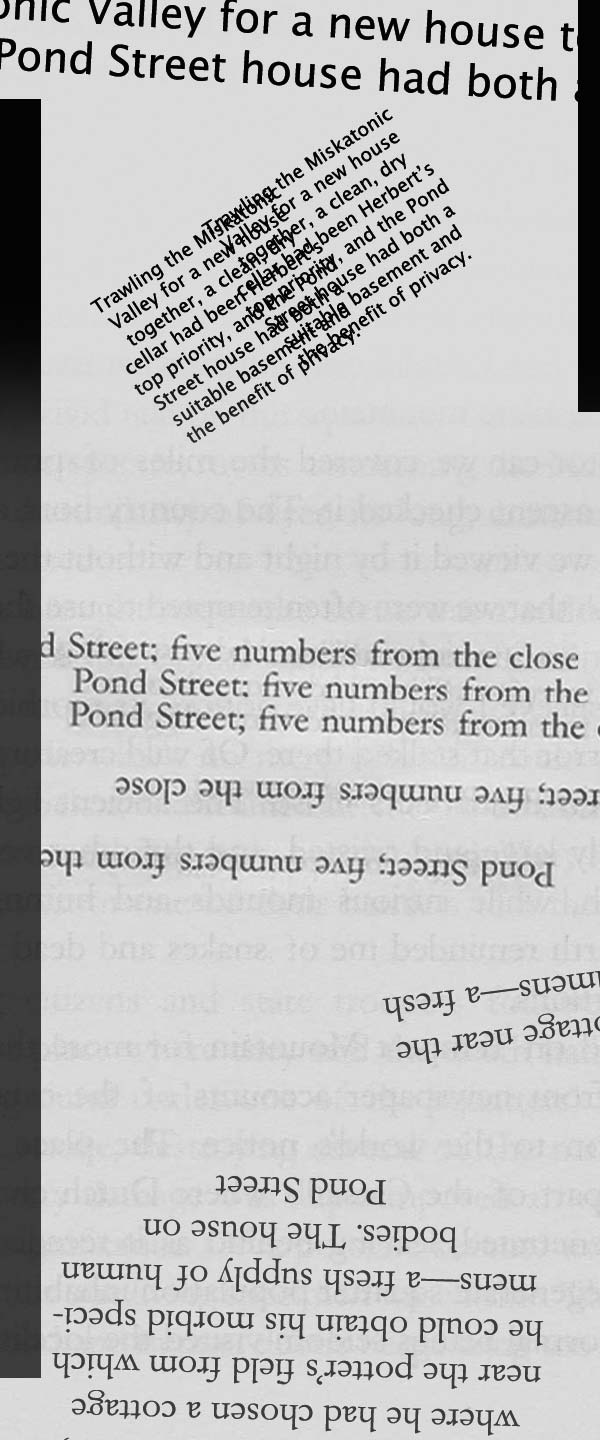
There’s a larger hole
established a
practice in Bolton,
where we had chosen a
cottage near the potter’s
field from which he could
obtain his morbid speci-
mens—a fresh supply
of human bodies
.
in the wall.
Using a tool meant for wide-diameter bones, Herbert has cut a circle with the circumference of a hubcap. The edges are jagged, and the floor is dusted with a coat of plaster and powder.
Dan burns with anger. Last time Herbert had put a hole in the wall, he’d stuffed it with rejected experiments that had almost got them both killed. And why widen that little termite circle? A square would have been easier. It’s all very Herbert, the strangeness of it, the late hour, the manic insistence.
“I told you I’d deal with the rats,” Dan says. “You didn’t have to put a goddamn hole in the wall just to show me—"
“Listen,” says Herbert.
Dan squats next to him. There’s a cool breath coming out of the wall. No insulation, just a breeze with the smell of an attic. He shifts forward, gets his face a little closer to the darkness.
He doesn’t hear anything. But when Herbert lifts the lantern to the wall to shine through, he can see it, clearly.
There’s a hallway on the other side of the wall.
Dan stares. Then he turns to look at Herbert. In the lantern light, his eyes are wide and triumphant, his plump lips glistening from being wetted by his tongue. He seems fully recovered from his shock with the nightmare.
Whatever expression Herbert sees on Dan’s face, he grasps onto it. His eyebrows spring up as he leans a little closer. “This wall should be the exterior wall,” he says. “It should lead outside.”
“Yeah,” says Dan. “Shit. You were right.”
Herbert looks radiant. Flush with success on his discovery, he seems healthier, saner, than he has in weeks. Lifted on shared wonder, they’re a breath apart in this conspiratorial moment, nose-to-nose. Almost like their argument hadn’t happened at all.
Dan wants to forget Herbert had tried to twist him again before he dismissed him on the topic of love. He wants to kiss him. It would be so easy to lean forward and capture the sweetness of his lips, but it’s a barbed trap like the fabric clinging to his ass and waist. Touch him when he’s this focused, and all Dan will do is get them into another fight.
“Voices,” says Herbert. “Two men. You hear them?”
More eager to obey Herbert now, Dan listens again. But he can’t hear anything at all, and a chill goes down his spine.
“I want to see more,” says Herbert. “Help me open up the wall.”
“Hang on, I’ll get a mallet.”
Dan descends into the basement, into their empty, sterile lab. When he returns with the mallet, Herbert has an ear pressed to the hole and is scribbling notes.
“I still can’t make out the conversation,” he says. “The source of the sound is too far away. It must be a recording of some sort.”
Dan’s skin prickles. He doesn’t doubt Herbert hears something; maybe he’s got better senses. That means whoever had owned the house before had put a radio in the walls and boarded it up. Or, worse than a radio—some kind of strange conversation playing off a portable CD player, plugged into a power source hooked up to the house’s wiring, meant to sink into the subliminal mind or torment its occupants into tearing holes in the wall just to prove to themselves it exists and make it stop.
He gestures Herbert back. He takes a swing at the edges of the hole,
set
about destroying
the wall. Here I was
forced to intervene, for
the destruction of the
property could only lead to
more calamity. West grew
wildly combative and I
gave up my efforts
to stop
and is surprised when a section of the wall falls away in a neat ring, as if perforated already into a larger circular shape. Weird, but then this whole situation is weird. This house, this disrupted day and broken night.
Herbert holds the lantern inside the hole to illuminate the space. It’s a short hallway covered with what Dan suspects is the house’s original wallpaper. There’s nothing inside but a rough-hewn wood floor and some debris shored up against the baseboards, dust and dirt and even a few curled red leaves. At the end of the hallway is a dead-end wall. Somewhere inside is the speaker that’s playing the men’s voices, although it’s hard to imagine where it could be hidden since he can’t hear it himself.
“It’s probably in the walls,” says Dan.
Herbert nods. “Bring the mallet.”
He ducks to step through the hole and walks across the floor. Dan lifts his foot to follow him, but the moment his body touches the hole, he smashes up against it, as if there’s a barrier there. Dan is held in place while Herbert seems
to
get
further
and
further
away

VII. The Madness at Pond Street
Of Dr. Herbert West, who had been my college friend and companion, there had been many things that convulsed me with horror. His experiments to reanimate the dead, his great life’s work in which I had joined him in the practice of medicine, were carried out with ice-cold calculation. So it was with surprise and terror that I witnessed the descent of this intellectual mind into madness.
We had recently established a practice in Bolton, where we had chosen a cottage near the potter’s field from which he could obtain his morbid specimens—a fresh supply of human bodies. The Pond Street house suited us well for this access to the field and its isolation, five numbers from the closest neighbor. For a time, West seemed occupied by our work, but there came upon him a lethargy of spirit. I attributed this to a failed experiment and a bit of bad luck, but West was not so mollified.
For days, he descended into a strange humor. The measurements of the house preoccupied him, most of all the wall near the stairwell that was of particular interest, for he felt it did not measure up to the dimensions of the house. He became convinced there was a scratching or susurrus of something in the walls.
It was a night in late October when he acted most strangely of all. He had departed our joint study, where we had been in conversation, to inspect the wall. When he returned, an irrational confusion had seized him with sinister swiftness. Small, clean-shaven, spectacled, with blond hair and an icy demeanor, West was usually scientific and mechanical. But when his eyes took in the room and lit upon me, a flash of horror came to his face and it turned bone-white, hitherto flush with red colour.
I called out his name and asked him what was the matter. The word “West” upon his ears had never struck him with such alarm. But he recovered himself, and in precise tones, he asked me the date and our location. I told him it was October 31st, 1910, and we were on Pond Street. When he asked me if anyone else lived there, I was forced to entertain this startling lapse in his awareness and told him it was him and I only, for we were too poor for servants at this cottage.
A shadow came into his face when I answered his query about my name, ■■■■■■■■■■. He looked at me with little recognition, although I had been his closest friend and assistant for five years. That West had suffered some erasure of his natural character, I was certain. What I couldn’t be sure if I was dealing with a more or less dangerous man.
He apologized and described how he had hit his head on the stairs, resulting in a blankness in his mind where his memories should be, and proceeded to interrogate me on the nature of the house—how long we had lived there, if he had previously had any success in exploring or traversing behind the walls.
This last suggestion filled me with dread. With such a strange, devilish look of curiosity on his face, I felt uncertain about answering more of his questions. No longer interested in entertaining his madness, I asked him to sit down while I inspected his concussion. He refused me, and his whole demeanor was full of suspicion. I saw he had lost the trust he had once placed in me all those years ago when I became his assistant, when we first began our hideous and unbelievable work.
While I went through this realization, West had returned to his fanatical observation of the wall. He searched it, and finding nothing to satisfy him, began to call out in a loud, determined voice, crying the name of “■■■.” His repeated shouts and beating of his fist against the wall startled me fearfully.
Though I had been keen to retire to bed, I had reservations about leaving West with run of the house in his state. Before he had been confused, but madness had infected him with a craze. Excitable, with a feverish interest that put a ghastly twist of concentration on his mouth, he continued to quiz me about the house, myself, and our laboratory in the cellar, all with the demented insistence of a man who has lost his memories as well as his mind.
When he moved into the cellar, it was as if it was his first time amongst the equipment we had used the hour before. He picked up a syringe full of the solution of his own creation, the vital injection with which he gave bodies their second and artificial life, and prompted me to explain its properties.
To West, the pronouncement of his own genius acted on him rapidly. He took great interest. Terror stalked me as I watched him from the safety of the stairs, and he kept his distance from me in turn. When he came up muttering strange things, he went to the wall and pressed his hand and ear flat. He went outside, then to the second floor, and roundabout the cellar again, then emerged with a mallet in hand.
He set about destroying the wall. Here I was forced to intervene, for the destruction of the property could only lead to more calamity. West grew wildly combative, and I gave up my efforts to stop him, although he seemed put out when the plaster had fallen away to reveal only the bones of the house.
Exceedingly anxious and concerned about the nature of his hallucinations and deterioration of his mind, I begged him to sleep or at least sit down. He did neither, and went into the cellar. I retreated into my room for my own safety and fell asleep.
It became clear to me, a few days after the onset of his madness, that I was in danger and West’s insanity was a threat. On one third fateful morning, I had been woken up by the incessant sounds of hammering at the walls, and when I dressed and exited my room, it was to a fearful shock worse than I could have anticipated.
West had been absent from the house yesterday. I thought perhaps he was exploring the countryside. But now he had returned, and with his mallet and a madman’s fury, West had torn down the walls in the house.
He was still working steadily at this loathsome work, coated in plaster that made him pale and unnatural as a fiend. He took no notice of me as I passed him toward the cellar stairs. During the previous days, he had all but ignored me except to ask questions about his solution and our experiments, and once to bid me to try swinging the mallet at the wall
X X X
X X X XX XXX
X X X X X X XX XXX
X X Herbert X X X X X
X X XX X CanXX XX
X X XX YouXX XX
X X HearX XX
X X X
myself, the results of which had disappointed him.
That I was in danger now, I was sure. My plan was to sedate him—we had a large supply for the use of our experiments—and once in the basement, I fetched a needle, and a rope with which I hoped to restrain him.
When I came up the stairs from the cellar, he was waiting for me. He at once noticed the rope in my hand. I told him what I intended to do, for his own good. Though West was the man of a more sinister constitution, I was larger and stronger, and it would not be trouble to hold him down.
He stood his ground. With his weapon raised, with his face pallid from lack of sleep over the last few days and the exertion of the night, he made a nerve-shattering image of madness and fear. In the ghastly cold tones I was accustomed to, he told me to stay back.
I did not like the way West looked at me then. He accused me of trapping him in the house. He related to me that his other options were exhausted, and hypothesized that if I was dead, he might be able to return through the wall, through the hole, to “■■■.” With the mallet raised in his hand, he rushed forward1
XXXXXXXXXXXXXXXXXXXXXXXXXXXXXXXXXXXXXXXXXXXXXXXXXXXXXXX
XXXXXXXXXXXXXXXXXXXXXXXXXXXXXXXXXXXXXXXXXXXXXXXXXXXXXXX
XXXXXXXXXXXXXXXXXXXXXXXXXXXXXXXXXXXXXXXXXXXXXXXXXXXXXXX
XXXXXXXXXXXXXXXXXXXXXXXXXXXXXXXXXXXXXXXXXXXXXXXXXXXXXXX
XXXXXXXXXXXXXXXXXXXXXXXXXXXXXXXXXXXXXXXXXXXXXXXXXXXXXXX
XXXXXXXXXXXXXXXXXXXXXXXXXXXXXXXXXXXXXXXXXXXXXXXXXXXXXXX
XXXXXXXXXXXXXXXXXXXXXXXXXXXXXXXXXXXXXXXXXXXXXXXXXXXXXXX
1The rest of the text is missing. —Ed
8
Herbert had disappeared. It rained that night and the night after.
Dan sits at the kitchen table of the house on Pond Street, smoking a cigarette. The table isn’t in the kitchen anymore, but dragged past the stairs to face the Impossible Wall. The cigarette is from a crumpled pack he’d stashed under his seat in the truck where Herbert couldn’t find it, because Herbert hates the smell of cigarettes. But Herbert isn’t here. The house had swallowed him through the wall and then the hole had vanished, as if it had never been there.
With the cigarette bobbing in his lips, Dan flattens his palms on the tabletop. His knuckles are bloody and coated in drywall. He had looked for Herbert immediately this time. There had been no hesitation, no waiting above ground before plunging back into this new crypt. After Dan had failed to go through the hole, it had closed up in the blink of an eye, and he had torn the wall apart with the mallet and his bare hands. But instead of finding an Impossible Hallway and Herbert, there was only the exterior of the house.
He shakes his head. Idiot. Stupid. Reckless. How was Herbert supposed to come back through the Impossible Wall if it didn’t exist?
Sleepless and quivering, hopped up on amphetamines from the lab because he’d broken their coffee pot, Dan had gone to the hardware store and purchased everything he’d need for his first house project, one that hadn’t been on the list: a huge square of drywall, utility knife and putty knife, compound and screws, a top-of-the-line power drill. He wanted to do it right. He owed it to Herbert to try. He'd fixed the wall, then mixed a new batch of re-agent and shot the diluted solution up his veins.
Now, he waits. He scrubs a hand around his face. Cigarette ash mingles with dust on the back of his hands.
A realization sets in through the tumult in his mind: He can leave.
He lets himself trace the shape of his ambiguous future. Even though he doesn’t want to live here alone, selling the house is anathema to him—Herbert is in the walls, the house is Herbert now, what if the next occupants tore down the house?—but he can’t afford to pay the mortgage on his own and isn’t sure how to extract himself legally from a nonexistent man.
He drums his fingers on the table. He could leave, but the cops would be all over this. Dan has motive more than anyone alive to hate Herbert enough to kill him, to take his research or to exact revenge. What could he say? Herbert was cut off from everyone but me, we lived here in total isolation, but don’t worry, he’s just walked through the wall?
Or maybe Dan has gone mad.1 Maybe he killed Herbert by swinging the mallet at his head. Maybe he put his body behind the wall and plastered him over and this is guilt he’s feeling, not grief, because those two emotions are all tangled up in his head anyway ever since Meg.
Dan puts out the cigarette in a bouquet of crumpled butts on a plate in the center of the table. When he looks up, Herbert is staring at him through the

hole.
A noise comes out of Dan’s chest. Herbert is the same, but the hole looks different. It’s widened to the size Dan had made for Herbert to crawl through, but the space behind it seems smaller, shallower. Herbert is bending down with his hands planted on his knees. There’s plaster on him, a fine coating of dust.
He’s also covered in blood. It’s splashed on his shirt, flecked on his cheek. His eyes are feverish in that way he gets when a corpse murmurs words, when a breakthrough is imminent. Whose blood this time? Does it matter? Dan just wants him to come out of the wall.
“Herbert,” he says.
“Dan,” says Herbert, with a weighty enunciation on his name. “How long has it been since you’ve seen me?”
Dan is on his feet. He doesn’t remember standing. He’s fighting back tears, nauseous with shock, so weak that he has to prop himself up by leaning on the table. Herbert is alive. He’s not gone, he’s not dead. Realities collapse on Dan, all the timelines and futures he’d dreaded and anticipated, and he’s never been so upset and so relieved in his whole damned life.
“It’s been three days,” says Dan. “Get out of there. Get out of the wall.”
Herbert contemplates Dan’s words but doesn’t move. “Interesting. It was the same for me. Dan, I think reality is thin here—” He draws a circle with his index finger— “and while we were apart, I was the common body between some sort of parallel world with you on one side and a man who is your counterpart on the other.” His gore-soaked hands make bookends. “Go into the basement and find my recorder. I need to make notes when I go back.”
No. No. Dan shakes his head. He’s not enabling another second of this. “Come here.”
“Dan, this is important. We’re wasting time.”
He would like to think he’s a changed man. That after five years, he’s not negotiating with Herbert’s insanity anymore. But he contemplates doing Herbert’s bidding if it will buy him more time, more assurance that Herbert will be there when he returns. “Baby, please come out of the wall.”
But he’s hesitated too long. “Never mind,” says Herbert. “I’ll write down my notes. Now that I’ve opened this pathway, I’m confident I can come back. I need to test something related to the reagent. Stay right there. I’ll only be gone an hour or so this time.”
What Dan would give to never have widened the hole. What he’d give to be asleep and wake up and have their worst problem be the echo of their argument upstairs three nights ago. If only that was the trial he needed to face, he would face it gleefully. He would sit Herbert down at the table he’d consecrated with his tears and hold his hands and say I miss Meg and I blame you but that doesn’t I mean I don’t love you, we’re not making progress right now but that doesn’t mean I don’t love you, you don’t love me but that doesn’t mean I don’t love you,
Dan screams his name. But Herbert is gone.
1 Inspired by “Herbert West—Reanimator,” VI: The Tomb-Legions: “Detectives have questioned me, but what can I say? …I told them of the vault, and they pointed to the unbroken plaster wall and laughed. So I told them no more. They imply that I am a madman or a murderer—probably I am mad.” –Ed.
IX. The ■■■■
XXXXXXXXXXXXXXXXXXXXXXXXXXXXXXXXXXXXXXXXXXXXXXXXXXXXXXX
XXXXXXXXXXXXXXXXXXXXXXXXXXXXXXXXXXXXXXXXXXXXXXXXXXXXXXX
XXXXXXXXXXXXXXXXXXXXXXXXXXXXXXXXXXXXXXXXXXXXXXXXXXXXXXX
XXXXXXXXXXXXXXXXXXXXXXXXXXXXXXXXXXXXXXXXXXXXXXXXXXXXXXX
XXXXXXXXXXXXXXXXXXXXXXXXXXXXXXXXXXXXXXXXXXXXXXXXXXXXXXX
XXXXXXXXXXXXXXXXXXXXXXXXXXXXXXXXXXXXXXXXXXXXXXXXXXXXXXX
XXXXXXXXXXXXXXXXXXXXXXXXXXXXXXXXXXXXXXXXXXXXXXXXXXXXXXX
When I came to, West was standing above me. The daemonic smile on his face chilled me. My arms and legs were strapped down, and I was incapable of moving my head.
He held a familiar syringe in his hand, the injection which he used to1
XXXXXXXXXXXXXXXXXXXXXXXXXXXXXXXXXXXXXXXXXXXXXXXXXXXXXXX
XXXXXXXXXXXXXXXXXXXXXXXXXXXXXXXXXXXXXXXXXXXXXXXXXXXXXXX
XXXXXXXXXXXXXXXXXXXXXXXXXXXXXXXXXXXXXXXXXXXXXXXXXXXXXXX
XXXXXXXXXXXXXXXXXXXXXXXXXXXXXXXXXXXXXXXXXXXXXXXXXXXXXXX
XXXXXXXXXXXXXXXXXXXXXXXXXXXXXXXXXXXXXXXXXXXXXXXXXXXXXXX
XXXXXXXXXXXXXXXXXXXXXXXXXXXXXXXXXXXXXXXXXXXXXXXXXXXXXXX
XXXXXXXXXXXXXXXXXXXXXXXXXXXXXXXXXXXXXXXXXXXXXXXXXXXXXXX
1 The text XXXXXXXXXXXXXXXXXXXX –Ed.
10
The truck bumps wildly over the road. Dan presses the gas pedal to the floor.
There’s a tether to his heart tied to the hole where Herbert vanished. It strains as it tightens, as he seizes another mile going 60 past the turnoff to the harvest festival, where the hay bales and scarecrow and spider’s web are caught in harsh light by his high beams.
But the more distance he gains, the worse he feels. He thought leaving Herbert would bring him a sense of vindication, the satisfaction of an eye for an eye. Herbert vanished, so Dan can disappear from the house, too. See how he likes it when he gets back and Dan’s not there.
But Dan can’t stop thinking about what will happen to Herbert. There are two realities on either side of a thin spot in the universe at the Pond Street house, and Dan and his counterpart are the bookends—so does that mean Herbert needs Dan there to return?
Why the hell did he go back to wherever he’d gone? 1 Dan had begged him not to leave. But the allure of the unknown was too great. Herbert had made his choice.2 And maybe this time, it’s done.
Why?
Dragged from the crypt, soaked in blood and choked with dust, Herbert had clutched at Dan, wrapped thin arms around him, buried his face in his neck.
Why?
His heart pounds in his chest. At the turn-off to Bolton, he whips the truck around.
He slams on the brakes. The truck lurches. “Fuck,” he mutters, thrown forward into the seatbelt, as dust and rocks settle from being kicked up in his semicircle plume.
He drops his forehead to the steering wheel. He rocks his skull back and forth. Then he puts the truck in drive and goes home.
When he pulls up, Herbert is standing on the porch.
The house on Pond Street had so much potential. But now, instead of thinking of the sagging rail and shutters, of rugs and picture frames, Dan is trying to remember where he put the kerosene, and how much it would take to torch the place.
He slams the truck door and stops at the foot of the steps leading up to the house. Herbert is fidgeting with his hands. Illuminated under the moth-choked light fixture by the front door, he looks pale, anxious, and cold.
“Dan,” he says. “Where did you…”
“I just went for a drive,” says Dan.
They stare at each other. Wind rushes in the big tree, scaling away more leaves from the lower boughs. Herbert licks his lips as he comes forward a step.
“Dan,” he says. “On the other side of the wall, I performed an experiment. I brought a man back to life. Perfectly. He remembered me, he was calm, lucid, vital. I succeeded. I defeated death. Using what I know, what I learned over there, I can make changes to the re-agent here.”
There’s a million questions to ask. Dan grabs the first one that pops up. “Where were you?”
“The other house on Pond Street. I heard two men through the walls, but I took one of their places when I went through. You’re the anchor on both sides, you couldn’t have come through, so I had to kill your counterpart. To return the second time, I had to kill him again. A shame. My first perfect patient. I wanted you to see him. But my work wouldn’t have done me any good over there. Over there, Dan, the year is 1910. Barbaric. With what I know, my mind almost a century advanced, I would have been—” He wheezes in nervous laughter that wrinkles his cheeks. “I would have been killed.”
An invisible man behind the Impossible Wall, who existed, who had to exist, because his blood is all over Herbert’s shirt.
“Dan,” says Herbert. “Come inside. Let’s sit down.”
“I’m not going back in that fucking house.”
Fear flashes in Herbert’s eyes. “It’s not dangerous.”
“Nothing dangerous about a house that grew a hole in the wall—” Dan laughs, drags a hand through his hair. “A hole that goes into another, what, world? The past?”
“We’re not in danger. I had a counterpart, but I severed the anchor to his reality, and I doubt he exists anymore.” His eyes are wide and searching. “I’ve had a breakthrough, and we can continue the work. I have so many ideas to tell you about. We need bodies. Fresh ones. And a new batch of our re-agent. You can come back inside now, and we can talk about it.”
Come out of the wall. Dan had begged him, and now Herbert is begging Dan. He’s worried about Dan getting back in the truck. After everything that’s fucking happened, Herbert just doesn’t want him taking off.
“Dan?” Herbert steps closer, pinching his hands together. His eyes are moving rapidly over Dan’s face. “Danny?”
Dan can’t believe how tired he sounds when he says, “We’re not staying here another night. We need to pack.”
Relief floods Herbert’s expression. When Dan climbs the stairs to the porch, Herbert seizes his arm. He’s breathing heavily, in and out, chest rising and falling.
“You—” He kneads the fabric of Dan’s sleeve under his grip. He’s working so hard at this that Dan can almost hear him thinking. “Dan. You know how much I appreciate you.”
X XXXX XXX
X XXXX XXX
He’s desperate. Still, it’s rare to hear appreciation of any kind, besides a ‘good’ here or there, and Dan soaks it up like a ray of sun, a tiny bit of warmth in the aftermath of their argument and the whiplash horror of that three-day nightmare.
“Yeah, well,” says Dan, “I’m glad you’re alive, and acting more like yourself.”
Dan shoulders through the screen door. He feels exhausted, totally crashed, from the adrenaline rush and stimulants, his nervy escape attempt. Back inside the house, it’s like nothing ever happened. Except there’s still the hole in the wall around the corner from the stairs, breathing on them, expelling particles of some corrupted otherness where Herbert had been atomized and returned covered in blood and talking like he'd won the world’s greatest prize.
“You were smoking,” Herbert says, clutching his arm again. “You know it’s not good for you. I need you in your best shape. We have lots of work to do. From now on, I know exactly what I’m doing. We have a clear path to success.”
Dan hates him, a little bit. But he loves him more. Even now, there’s love welling up out of him from some deep gash inside his body, a wound that oozes a dark, indulgent urge. This isn’t candy apples at the festival or sunshine on hair. It’s blood and skin and dust, fear that snaps through him like an electric shock, and the relief and elation that pour through him when Herbert corrects their course. It’s exciting. It’s an addiction, the high and comedown from a drug.
Dan was holding himself off from Herbert, but now he relaxes into his pull. Herbert isn’t one for subtlety, and it’s obvious what he’s doing even before he tilts his face up, clutching Dan with both hands. His eyes are huge, his brows drawn in pleading concern. His body is a livewire. Dan feels his muscles tense as he presses closer, quivering, intense, warm.
“Dan.” Herbert reaches up to stroke his hair, his face. His voice is dangerously soft. “I conquered my failures. Now, I can give you what you want.”
Dan has been wanting this since they moved in. Herbert’s attention on him, his hands in Dan’s hair, his breath on his skin, even though he knows what Herbert is doing and why he’s doing it. Right now, Herbert wants reassurance that Dan won’t bolt out the door. He wants Dan to move past all the horrors and write him a blank check of acceptance.
Acceptance of something as insane as disappearing on Dan and killing a man and killing him again. “That guy—my counterpart, or whatever… Who was he?”
Herbert’s face is an inch away. His eyes are hooded. His hands have slid down Dan’s cheeks and neck to curl onto his chest, and he’s leaning on Dan, practically clinging to him. “He was nothing like you.”
X XXXX XXX
“Did he have a family? Anyone?” Meg, is what Dan is trying to ask. Did he have someone like Meg?
“No one but me.”
Along with curiosity and guilt about his counterpart’s suffering, an irrational jealousy spikes in Dan. He’d suffered those three days alone, while goddamn Herbert had given all his attention to some parallel surrogate of him on the other side of the wall.
Dan grabs him tight and yanks him forward, kissing him roughly. Herbert lets out a pant of surprise against the pressure of his lips. He’s pliable as Dan walks him backwards, covets him in groping handfuls, finally getting his fill of his taste and the shape of his flesh.
Goddamn this house and everything that happened. Dan needs this. He needs this to survive what he saw, what he knows. One concrete thing, one fulfillment of the naive dreams he’d had about finding permanence here before it all went up in smoke.
Breaking off from Herbert’s lips, Dan drags the knot out of Herbert’s tie and yanks it off his neck. He attaches Herbert’s wrists to the balustrade of the stairs. His knot is sloppy under his shaking hands, but Herbert goes easily, offering himself to Dan, panting as Dan finishes his task and slots them together, working them both up through their clothes.
“Here?” asks Herbert in a rush of breath.
“You don’t want to be in my bed,” Dan murmurs into his neck, “and you won’t let me in yours. The basement’s no good.” Usually, they’d have fucked on a table by now, maybe done some things with equipment that floods Dan with shame and excitement to think about, but there’s something off-putting about the barrenness of the lab where their experiments had come to a standstill. In the Pond Street house, there was no life to be made together.
Herbert doesn’t seem to mind Dan’s choice, if his moans and pleadings are anything to judge. The sounds he makes under Dan’s hands are unfiltered, raw, the most noise he’s made in days. It’s exciting to please him, to see him so full of energy again.
But knowing there’s still a hole in the wall makes Dan uneasy, so he leaves Herbert whining at him, affixed to the rail with his clothes half-shed. He goes into his room, flips the queen mattress on its side, and drags it flat to cover the wall.
He grimaces. He’ll have to patch it again before he puts the house on the market. If anyone asks about the quick turnover, he’ll say some family emergency forced the move. He has to accept that he’s willingly putting someone else at the mercy of the house and its secrets, because he and Herbert need the cash.
It’s all another mess to clean up. Returning to Herbert, a little more irritated now, Dan leans down to kiss him and touch him, slowly, tormenting him, edging him out of love and desire and spite.
Herbert is getting desperate by the time Dan sucks on his earlobe and mutters in his ear. “I should fuck you until you’re tired,” he says, “and tie you up, and throw you through the wall. Then I couldn’t get to you even if I wanted to. Even if I changed my mind.”
Herbert whimpers. “Danny.”
X XXXX XXX
“I’d do it, baby. You know I would.”
X XXXX XXX
They both love shit like this. Scaring each other. And now they have a new depravity to plumb. For the first time in a week, Dan feels electric and alive, his blood and body singing. Herbert writhes under him, moaning his name. When Dan embraces him from behind and presses his forearm against his throat, Herbert cries out so loud it echoes up the stairs. He feels a little vindication knowing Herbert’s abandon with him in pleasure sounds louder than the fear and betrayal of his nightmare about the crypt.
Even as Dan loses himself in the sensations, his mind is spinning. He doesn’t know what this means. Any of it. Herbert’s revelation from another world, the new logic of the space Dan inhabits where walls echo with the voices of other men and Herbert can move through reality but not him, how it will influence their work, how this madness will influence him and Herbert.
He doesn’t know what it means that he’s bound up in love to a man who can’t love him back.3 He wonders if he missed his chance to escape from the mortgage, from Herbert, from his life as he knows it, a tragedy and an opportunity offered through the house and the spot in the Impossible Wall. 4
For now, 5 though, 6 it ends with7 them together,8
XXXXXXXXXXXXXXXXXXXXXXXXXXXXXXXXXXXXXXXXXXXXXXXXXXXXXXX
XXXXXXXXXXXXXXXXXXXXXXXXXXXXXXXXXXXXXXXXXXXXXXXXXXXXXXX
1 Inspired by House of Leaves, pg 385. The section title “Why Did Navidson Go Back to the House?” might become “Why Did Herbert Go Back to the Lovecraft House?” Similar to the story of Navidson, we can only speculate on Herbert’s motives as they relate to his relationship to death, his unflinching scientific curiosity and the single-minded drive to progress his work. –Ed.
2 I’m doing this for Dan, too. This is for me and him. Doesn’t anyone understand?
3 I went to extreme lengths to reignite his devotion to the work. I sacrificed my greatest accomplishment to come back to him. I missed him, I showed him how much I desired him. It’s as good as professing my love out loud. I’ve been robbed of my agency in this text. This is about my triumph. My victory. I won’t be eclipsed by another failure. He will understand how I feel. He must.
4 It can’t end like this. He’ll leave me.
5 You will let me tell him how I feel.
6 Please let me tell him.
7 Let me tell him.
Let me tell him.
Let me tell him.
Let me tell him.
Let me tell him.
Let me tell him.
Let me tell him.
Let me tell him.
Let me tell him.
X XXXX XXX
X XXXX XXX
X XXXX XXX
X XXXX XXX
8 The text cuts off here. –Ed.
APPENDIX
